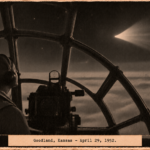
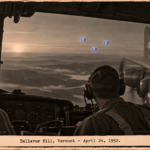
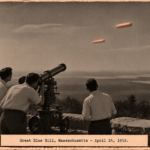
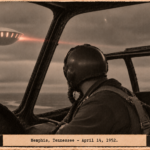
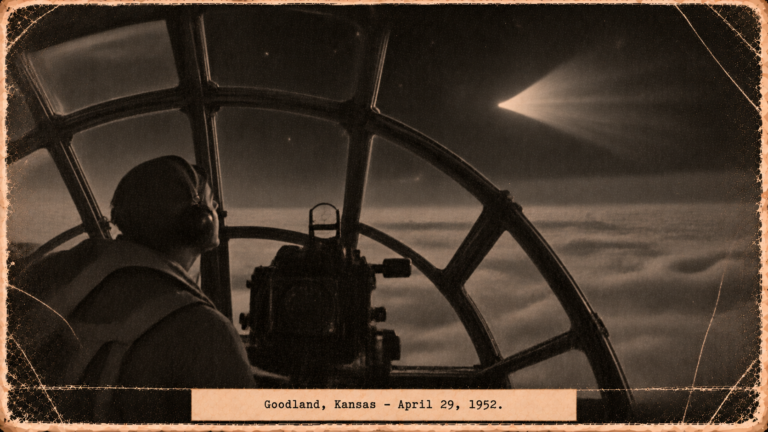
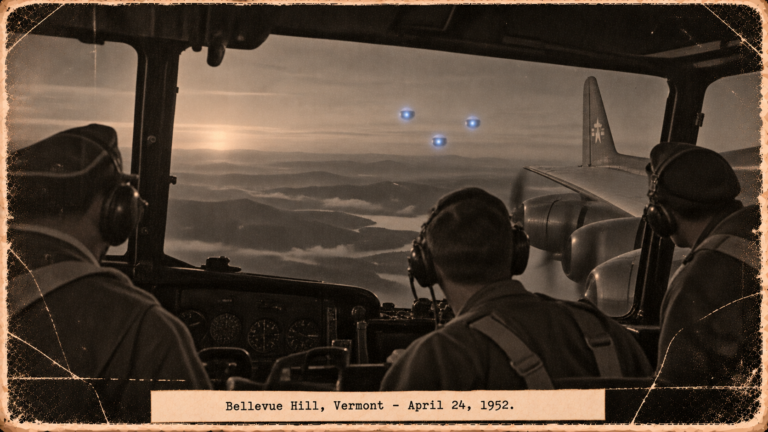
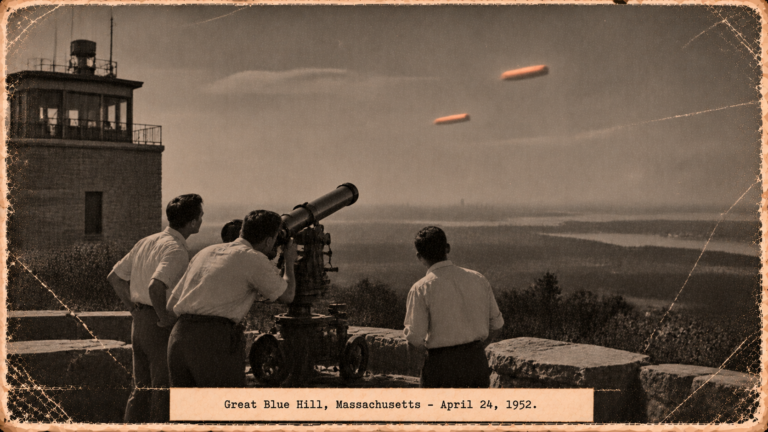
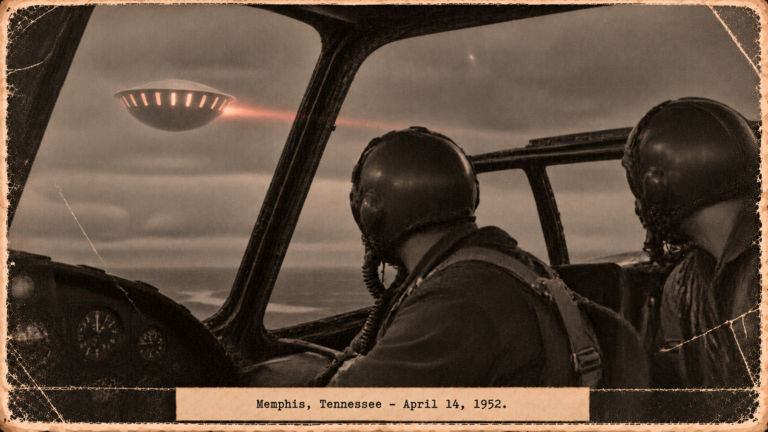
Washington, D.C., November 18, 1951: an Andrews controller watches the object that followed Capital Airlines Flight 610.
THINK ABOUTIT UFO|UAP SIGHTINGS REPORT
1951: Capital Airlines Flight 610 Reports an Object Following Its DC-4 Near Washington, D.C., and an Andrews Controller Sees It
At 3:20 a.m. on November 18, 1951, the Washington control tower called the senior controller at Andrews Air Force Base and asked whether he had seen any strange aircraft or objects around the base. A Capital Airlines pilot on Flight 610, flying a DC-4 at 8,000 feet, had reported a strange object following his aircraft for about 20 miles before it turned and went back. The pilot said it was not a star, because of the brilliant light it carried, and that several other lights were visible on it.
The tower told the controller the object was now east of Andrews. He looked and saw it, moving very slowly if at all. An F-94 sent south saw nothing, and Washington radar could not pick it up. Base operations suggested Venus, but the controller wrote that what he saw passed under Venus, heading south. Project Blue Book carried the case as Unidentified.
Date: November 18, 1951
Sighting Time: 3:20 a.m. EST (the card also prints 0320Z, which does not match EST)
Day/Night: Night (a cold, clear night)
Location: Washington, D.C., area: east of Andrews Air Force Base, Maryland, and along the route of Capital Airlines Flight 610 at 8,000 feet
Urban or Rural: Suburban (the Washington metropolitan area)
No. of Entity(‘s): Not Applicable
Entity Type: Not Applicable
Entity Description: Not Applicable
Hynek Classification: Nocturnal Light (NL)
Duration: Not reported; the object followed the airliner for about 20 miles and the controller watched it for a short time, lost it, and then saw it again
No. of Object(s): 1
Description of the Object(s): A single object carrying a brilliant light, with several other lights visible on it according to the airline pilot. The Andrews controller saw it east of the base, apparently moving very slowly, and later saw it again before it disappeared to the south.
Shape/Size/Color of Object(s): Not described beyond a brilliant light and several other lights
Distance to Object(s): Not given; the object was reported as following the airliner, and the controller saw it from the ground at Andrews
Height & Speed: The airliner was at 8,000 feet; the object followed it for about 20 miles, then turned back. Speed was not estimated, and the controller described the object as moving very slowly, if at all.
Number of Witnesses: At least 2 (the Flight 610 pilot and the Andrews senior controller; names redacted or omitted in the file)
Special Features/Characteristics: Washington radar was unable to pick up the object; an F-94 sent south found nothing; base operations and weather staff suggested Venus; the controller wrote that the object passed under Venus, heading south
Case Status: Unidentified (Project Blue Book record card: Other, “Unidentified”; listed in Berliner’s Blue Book Unknowns). The card says the object was reported to be a star, while the controller’s statement says the pilot reported it was not a star.
Source: Project Blue Book record card; statement of the Andrews Air Force Base senior controller, November 18, 1951; Andrews intelligence officer’s forwarding letter of November 19, 1951; Air Force disposition form of 1952; Berliner’s Blue Book Unknowns list
Summary/Description: A Capital Airlines pilot reported an object following his DC-4 for 20 miles near Washington, D.C., and an Andrews controller saw an object east of the base. Radar did not track it and an F-94 found nothing. Blue Book left the case Unidentified.
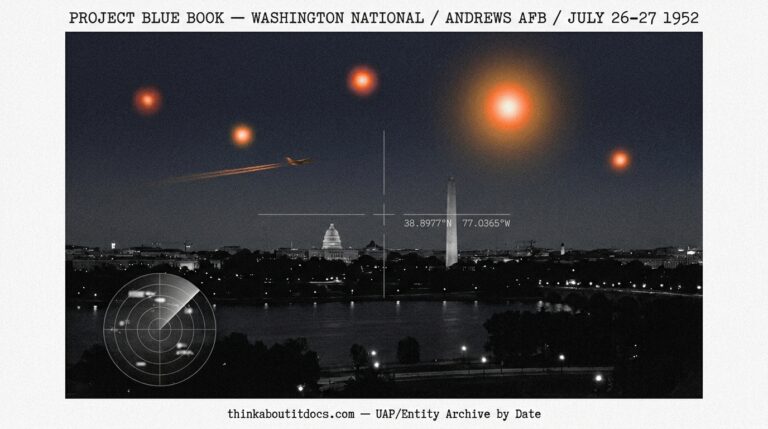
Related Cases: The Washington, D.C. National Airport and Andrews radar and visual sightings of July 19 and 26, 1952; the earlier Andrews Air Force Base sighting of September 1951
Detailed Report
The Call From the Tower
At 0320 EST on November 18, 1951, the Washington tower called the senior controller at Andrews and asked whether he had seen any strange aircraft or objects flying around the base. He said no. The tower then told him that a Capital Airlines pilot, flight 610, had reported a strange object following his DC-4 for about 20 miles at 8,000 feet. The pilot reported that it was not a star, because of the brilliant light it carried, and that several other lights were seen on it. The object followed Capital 610 for 20 miles and then turned and went back.
What the Controller Saw
The tower told the controller the object was about east of Andrews. He wrote that he saw it, and that it appeared to be moving very slowly, if at all. His attention was turned to something else, and when he looked again it was gone. The only thing he then saw was a bright star, which he said he had also seen at the time of the strange object. Later he saw the object again, and it soon disappeared to the south.
Radar, an F-94 and Venus
The Washington tower asked for an aircraft to be sent to check. An F-94 in the area, call sign Redman 22, flew south and saw nothing. Washington radar advised that it was unable to pick up the object. Base operations later told the controller that it could have been Venus, and the weather office added that on a cold, clear night Venus stands out distinctly and at times creates strange illusions. The controller answered in his statement, “Could be, but what I saw passed under Venus, headed south.”
The Paperwork
On November 19, 1951, the Andrews intelligence officer forwarded the controller’s statement to the Directorate of Intelligence at Bolling Air Force Base. A 1952 Air Force disposition form notes that the Bolling intelligence office had forwarded the material to Air Force headquarters but that it was not received there until April 11, 1952, because of a misunderstanding about the proper way to handle such reports. The Blue Book card carries the case as Unidentified.
RESEARCHER’S NOTES
Why the Capital Flight 610 Case Still Matters
- Two independent witnesses: An airline crew and a ground controller both reported an object, and the controller saw it from the ground after the tower called him, so his sighting was not simply a repeat of the pilot’s words.
- Venus was offered, and the witness disputed it: Base operations and weather staff suggested Venus. The controller, who knew the star he had seen beside the object, wrote that the object passed under Venus and headed south.
- No radar, no interception: Washington radar could not pick up the object and the F-94 found nothing. The case rests on visual reports.
- The card and the statement disagree on one point: The Blue Book card says the object was reported to be a star because of its brilliant light. The controller’s statement says the pilot reported it was not a star because of that light. The statement is the primary document.
- A time problem on the card: The card prints local time 0320 EST and Greenwich time 18/0320Z. 0320 EST is 0820Z, so the Greenwich entry looks like a copy of the local time.
- Months in transit: The Air Force received the paperwork about five months late. The delay was administrative, and it means the case reached Blue Book long after anyone could re-interview the crew.
A DC-4 crew and an Andrews controller both reported an object near Washington in the early hours of November 18, 1951. The Air Force offered Venus, the controller disagreed in writing, radar saw nothing, and Blue Book left it Unidentified. The case is a quiet earlier example of the visual-without-radar pattern that the capital would see again in July 1952.
“Could be, but what I saw passed under Venus, headed south.”
— Andrews Air Force Base senior controller, statement of November 18, 1951