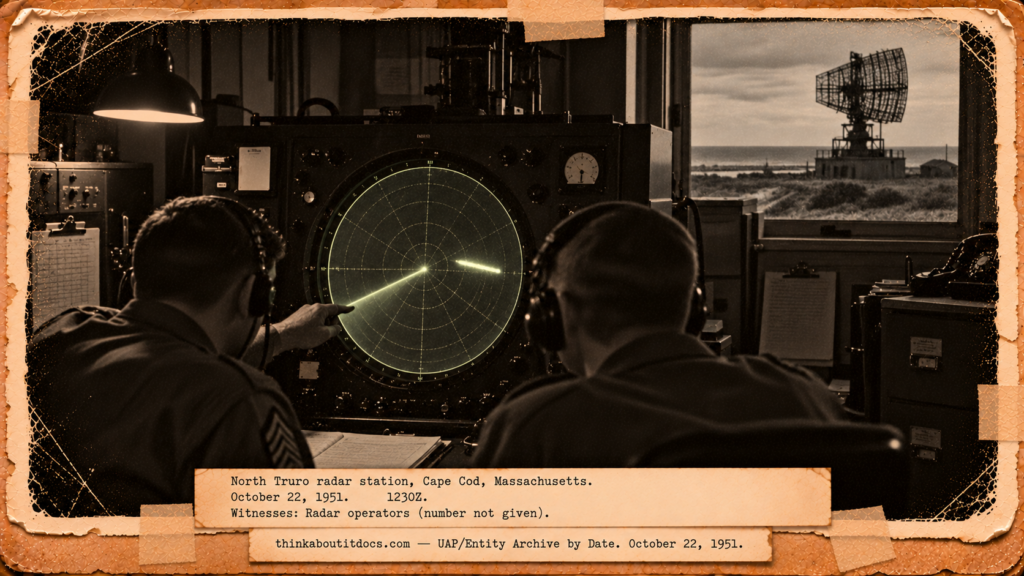
North Truro, Massachusetts, October 22, 1951: a radar crew tracks a 2,400-knot target for two minutes.
THINK ABOUTIT UFO|UAP SIGHTINGS REPORT
1951: Cape Cod Radar Station Tracks a Sausage-Shaped Target at 2,400 Knots Off North Truro, Massachusetts
On October 22, 1951, radar operators at the North Truro, Massachusetts, radar station on Cape Cod saw a single target move across their CPS-6B scope for two minutes at a computed 2,400 knots, heading west and then south, and fade out 30 miles north of the station. The 32d Air Division, which reported it, said the individual echoes and the look of the track made it probable that the radar was picking up a real flying object, not interference or a malfunction, and listed the probable identity as unknown.
Blue Book later carried the radar UFO case as Insufficient Data and floated a meteor explanation, while the air division’s own follow-up said the weather might have caused anomalous propagation. Neither explanation was ever settled, and the file shows an air defense command trying to understand a fast radar target with no visual sighting to back it up.
Date: October 22, 1951
Sighting Time: 1230Z to 1232Z per the 32d Air Division report; the Blue Book card prints 22/0230Z to 0232Z
Day/Night: Not stated
Location: North Truro, Massachusetts, radar station on Cape Cod (CPS-6B radar at about 42°02′ N, 70°03′ W); the track ran from about 43°05′ N, 68°15′ W to 42°40′ N, 70°05′ W, fading 30 miles north of the station
Urban or Rural: Rural (radar station)
No. of Entity(‘s): Not Applicable
Entity Type: Not Applicable
Entity Description: Not Applicable
Hynek Classification: Radar only (no visual observation); a radar-only event falls outside the six Hynek categories
Duration: About 2 minutes
No. of Object(s): 1
Description of the Object(s): A single radar target whose individual returns had the characteristic sausage shape, with the dimension in range smaller than the dimension in azimuth. The strength of the returns varied from pickup to pickup and was never appreciably strong, which the report says is characteristic of any aircraft radar return.
Shape/Size/Color of Object(s): Sausage-shaped radar return; no size, shape or color information beyond the echo
Distance to Object(s): From about 43°05′ N, 68°15′ W (well east-northeast of Cape Cod) to about 42°40′ N, 70°05′ W; faded 30 miles north of the station
Height & Speed: Altitude unknown; speed 2,400 knots; course west, then south
Number of Witnesses: Radar operators at the station (number not given)
Special Features/Characteristics: Return strength fell sharply as the track turned toward the station, which the report calls a phenomenon common to highly streamlined aircraft; the track faded 30 miles north of the station and the report does not say whether it dived into the water or climbed out of range; no interception was attempted; a second sighting under the same report number occurred about eight hours earlier
Case Status: Insufficient Data (Project Blue Book record card; “Other: Insufficient Data”); the 32d Air Division listed the probable identity as unknown
Source: Project Blue Book record card; 32d Air Division (Defense) report “Information on Unconventional Aircraft” (October 31 and November 1, 1951); Air Technical Intelligence Center and Eastern Air Defense Force message traffic of November 1951
Summary/Description: A Cape Cod radar tracked a sausage-shaped target at 2,400 knots for two minutes; the air division thought it a real object, Blue Book called it Insufficient Data and suggested a meteor, and the weather explanation was never confirmed.
Related Cases: The Kadena, Okinawa radar case of October 3, 1951 (sausage-shaped echoes at an estimated 4,800 mph), and the Goose Bay, Labrador GCA radar targets of September 1951
Detailed Report
The Report
On October 31, 1951, the 32d Air Division (Defense) at Stewart Air Force Base, Newburgh, New York, sent a report titled “Information on Unconventional Aircraft” to Air Materiel Command, in compliance with Air Defense Command letter 200-1 of April 11, 1951. The manner of observation was a radar pickup on the plan position indicator of the CPS-6B radar at North Truro, Massachusetts. The time was 1230Z to 1232Z on October 22, and the track ran from about 68°15′ W, 43°05′ N to 70°05′ W, 42°40′ N. One object was seen for two minutes on a course of west, then south, at an unknown altitude and a speed of 2,400 knots.
Clouds were scattered at 1,400 feet, visibility was 15 miles and the temperature was 42 degrees F. The radar was running on frequencies of 2,992 and 3,014 megacycles. The report lists the probable identity of the target as unknown and states that no interception or identification action was taken.
Why the Division Thought It Was Real
The report argues that the individual echo returns and the appearance of the track made it probable that the pickups were of a flying object rather than radar interference or malfunction. The individual returns had the characteristic sausage shape in which the range dimension is smaller than the azimuth dimension. Their amplitude varied from pickup to pickup and was never appreciably strong, both of which the report calls characteristic of any aircraft radar return. When the track turned toward the station, the strength of the returns dropped sharply, “a phenomenon common to all highly streamlined aircraft.” The track faded 30 miles north of the station, and the report says it is unknown whether it faded because it plunged into the water or because it was flying at an extremely high altitude.
The Evaluation
The Blue Book card is marked “Radar Report. See Case file” and concludes “Insufficient Data.” The comment says the sighting occurred about eight hours after another sighting filed under the same report number, with all conditions similar except the time, the duration of tracking and the direction of the track. The temperature and altitude information was the same, indicating no temperature inversion. The analyst thought it unlikely that two meteor trails would be seen the same day, and that the duration seemed too long for that type of target, and wrote that there was not enough data on track direction, range and changes to make a meaningful evaluation.
A continuation page adds that the weather information does not support temperature-inverted anomalous propagation, though other upper-atmosphere conditions could also cause it. It states that the possibility of meteors entering the atmosphere and being detected cannot be disregarded and “may be the answer,” because a meteor would ionize the air and increase target detectability, and the short duration of the condition supports that theory over anomalous propagation.
The Follow-Up Questions
In early November the Air Technical Intelligence Center asked the 32d Air Division whether weather data were available from nearby weather stations, whether any other nearby radar had seen the target, and whether anomalous propagation had been seen to extend ground clutter at the site during or near that time. The Eastern Air Defense Force replied that weather material was being forwarded, that no other equipment had seen the phenomenon, and that the weather information indicated an existing subsidence condition that may have resulted in anomalous propagation.
RESEARCHER’S NOTES
Why the North Truro Radar Case Still Matters
- A command that thought it real: The 32d Air Division did not treat the track as a glitch. Its report gives the technical reasons it believed the returns were from a moving object.
- Two opinions on the weather: Blue Book’s analyst said the weather did not support temperature-inverted propagation and suggested a meteor. The Eastern Air Defense Force replied that a subsidence condition may have caused anomalous propagation. The two Air Force views disagreed.
- The speed: 2,400 knots is roughly 2,760 mph. Blue Book’s analyst suggested a meteor, and the file does not reconcile that with a track that lasted two minutes.
- The echo shape: The report describes each return as sausage-shaped, with the dimension in range smaller than the dimension in azimuth. It gives no size for the target itself.
- Figures that differ: The report gives 1230Z; the card prints 0230Z, so the time of day cannot be settled from the file. Both give October 22. The report mentions an earlier sighting under the same report number that the file does not describe.
With no visual sighting, no second radar and no confirmed weather cause, the North Truro track stays on file as a fast, unexplained radar target. It joins the Kadena case as an example of how air defense radar crews in autumn 1951 were already reporting targets that did not behave like known aircraft.
“The track faded at a distance of 30 miles north of the station.”
— 32d Air Division (Defense), report on North Truro radar sighting, October 31, 1951