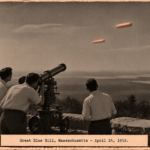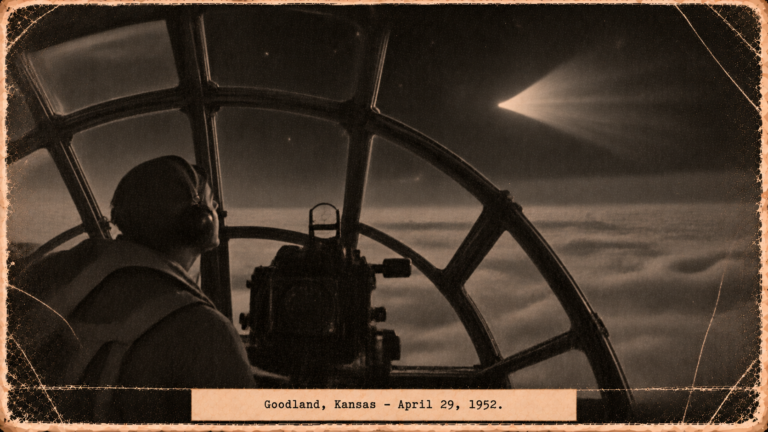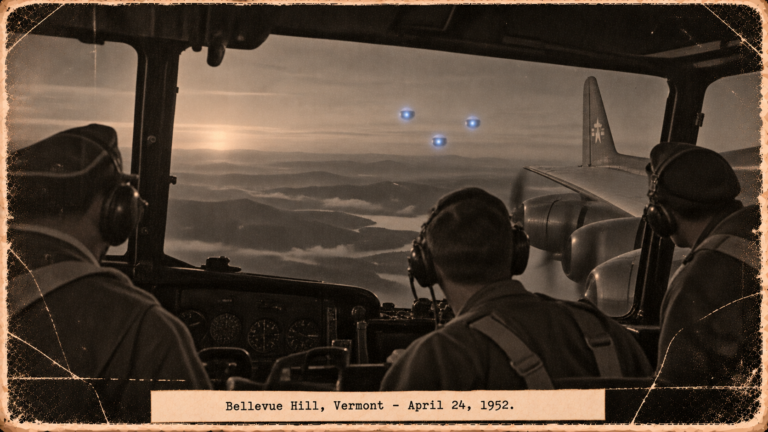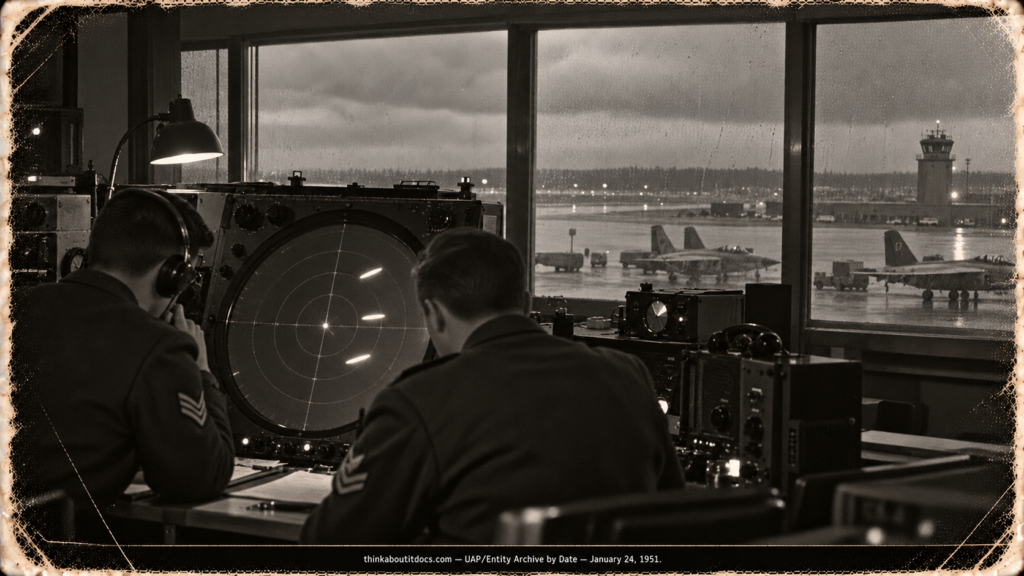
Radar operators at Westover AFB tracked three large unidentified echoes on January 24, 1951.
THINK ABOUTIT UFO|UAP SIGHTINGS REPORT
1951: Radar targets over Westover AFB blamed on a B-17 beacon
At 10:45 on a rainy morning, January 24, 1951, radar operators in the approach control center at Westover Air Force Base, Massachusetts, watched three large echoes crawl toward the field. Each echo was as large as or larger than a B-36 bomber. One faded out. The other two came on, reversed, came on again without ever turning, and then dissolved into the radar’s cone of silence over the base, where they stayed for five to ten minutes. When they emerged they were leaving at an estimated 500 to 600 miles per hour.
Westover’s F-86 squadron could not launch because of weather and ice on the ramps, no other radar in the area picked up the targets, and Air Materiel Command’s intelligence analysts concluded the echoes were “almost assuredly” produced by a radar beacon on a B-17 flying in the region. This Westover AFB radar UFO case shows how an anomaly was reported, evaluated and filed in 1951, and the loose ends the file still leaves.
Date: January 24, 1951
Sighting Time: 10:45 a.m. EST (1545Z); observation lasted 15-20 minutes
Day/Night: Day (low cloud and light rain)
Location: Westover Air Force Base, Chicopee, Massachusetts, United States (observed from the Westover Approach Control radar center)
Urban or Rural: Rural (air base)
No. of Entity(‘s): 0
Entity Type: None observed
Entity Description: Not Applicable
Hynek Classification: RV (radar-only; no visual confirmation; nearest Hynek category)
Duration: 15-20 minutes
No. of Object(s): 3 radar targets at first; one faded, two remained
Description of the Object(s): Three unidentified radar returns, each the same size as or larger than a B-36 echo, first picked up about 28 miles from the station.
Shape of Object(s): Not Applicable (radar returns only)
Size of Object(s): Echo the same size as or larger than a B-36 echo
Color of Object(s): Not Applicable
Distance to Object(s): First detected about 28 miles from Westover; one target faded about 12 miles out; the other two reached the radar cone of silence over the station
Height & Speed: Altitude not determined (the set was designed to be effective up to 10,000 feet and 40 miles). About 120-150 mph on approach; an estimated 500-600 mph departing on a course of 60 degrees.
Number of Witnesses: 4 radar-qualified observers at Westover Approach Control
Special Features/Characteristics: The two remaining targets stayed about half a mile apart through all maneuvers; they reversed between courses of 240 and 60 degrees without apparent turns; they faded into the cone of silence for five to ten minutes; no other radar picked them up; the base’s F-86 squadron could not be launched
Case Status: Probably explained. Project Blue Book: Other (electronic effects from a radar beacon aboard a B-17). Air Materiel Command analysts: targets “almost assuredly” caused by the B-17 beacon. Several details were never reconciled.
Source: Project Blue Book record card; Report of Unconventional Aircraft, 1600th Air Transport Wing, Westover AFB, Feb. 5, 1951; Air Materiel Command endorsements, Feb. 1951; McDonald list; FUFOR Index; Sparks; Dan Wilson
Summary/Description: Westover Approach Control radar picked up three unidentified returns about 28 miles out, approaching at 120-150 mph. One disappeared about 12 miles from the station. The other two approached and receded several times on courses of 240 and 60 degrees without turning, stayed about half a mile apart, faded into the cone of silence for five to ten minutes, and then left on 60 degrees at an estimated 500-600 mph. A ground-control intercept station and Boston Air Traffic Control had no matching aircraft. Air Materiel Command concluded the targets were produced by a radar beacon on a B-17.
Related Cases: January 1951 UFO sightings archive | Sioux City, Iowa, January 20, 1951 | Holloman AFB, January 22, 1951
Detailed Report
This report concerns an unidentified radar observation at Westover Air Force Base, Massachusetts, on the morning of January 24, 1951. It was filed by the 1600th Air Transport Wing under the Air Force’s September 8, 1950 directive for reporting unconventional aircraft, and sent to Air Materiel Command at Wright-Patterson Air Force Base on February 5, 1951. The observers were four radar-qualified personnel of the 1917th AACS Squadron working in the Westover Approach Control Center; the report lists their backgrounds as pilot, pilot, ex-pilot and maintenance technician.
According to the report, three targets were picked up on the approach control scopes about 28 miles from the station, approaching on a heading toward the base at an estimated 120 to 150 miles per hour. About 12 miles out, one target faded and disappeared. The other two appeared to approach Westover and move away again several times, on courses of 240 and 60 degrees, without making any apparent turns. They stayed about half a mile apart through all of these maneuvers, and each echo appeared as large as or larger than the echo of a B-36. After several passes the targets approached and faded out in the radar’s cone of silence over the station, where they stayed for about five to ten minutes. When they next appeared they were moving away from the station on a course of 60 degrees at a very high rate of speed, estimated at 500 to 600 miles per hour from approximate time and distance, and they disappeared from the scope on that course.
During the observation Approach Control contacted “Powder,” the ground-control intercept station near Manchester, New Hampshire. The report says Powder told them a target believed to be an aircraft was approaching Westover at about 8,000 feet, and that a check with the Air Traffic Control Center in Boston turned up no aircraft in the area. The reporting officer’s later comments say that when Approach Control contacted Powder at 11:07 EST Powder had no radar targets corresponding to the Westover observations, and that no explanation was available for the 8,000-foot target. Westover’s GCA radar, which has a much shorter range, registered nothing unusual. The base’s F-86 squadron could not be dispatched to intercept because of weather; the report notes that runways and ramps carried considerable ice.
The weather records at Westover showed a ceiling around 1,100 feet, visibility five miles and light rain. Approach Control’s own records show the ceiling and visibility varying down to about 500 feet and one mile during the observation. The report states that no known meteorological or other condition that might account for the observation was present, and that no physical evidence, fragments or photographs exist. It also records the set’s limits: the Approach Control radar was designed to be effective up to 10,000 feet and 40 miles, and in proper tune it does not display stationary targets or targets moving less than 50 miles per hour.
The explanation came from the reporting officer’s investigation. Powder passed the query to the Fighter Air Division, which contacted Mitchell Control and learned that a B-17 equipped with a radar beacon was flying in the Nashua, New Hampshire and Lowell, Massachusetts area at 4,000 to 5,000 feet. Mitchell Control said the beacon could cause two radar blips about two miles apart on any scope in the area. The reporting officer wrote that it was considered possible the B-17 could account for the unusual observations if it deviated from the stated area or if the beacon had extended radar effects. The report adds that a similar observation on October 20, 1950, which was not reported at the time, did not involve the two targets staying together: in that case each of two targets approached and left on headings of 270 and 90 degrees and, at about 30 miles, separated into four targets close together.
Air Materiel Command’s first endorsement, signed by the chief of its Technical Analysis Division, stated that a preliminary analysis indicated the unknown radar targets were almost assuredly caused by the beacon in the B-17 and asked Westover for four items: the radar frequencies at Westover, the B-17 beacon’s frequency, the B-17’s flight path, and the track of the targets on the airport control radar, including whether they always approached and departed along the same azimuth. A handwritten note on that draft reads “Never sent out. Answer too late.” The Project Blue Book card lists the observation type as Air-Intercept Radar, the evaluation as Other, and the comment that the returns were believed to be electronic effects from a beacon in a B-17.
The report is a radar-only observation, so it does not meet the visual requirement of a Radar-Visual (RV) case in the strict sense. RV is used here as the nearest Hynek category.
Researcher’s Notes
Radar Targets and a Beacon Theory: What the Westover File Settles and What It Leaves Open
- Classification: No object was seen. The Hynek system’s RV category assumes a radar target confirmed by a visual sighting, so the label here is a convenience. No physical trace, no beings and no visual contact are reported.
- Where the Explanation Fits: Two radar echoes from a beacon-equipped aircraft is a recognized effect, and Mitchell Control said the beacon could produce two blips two miles apart. The Westover targets stayed about half a mile apart. The B-17 was reported near Nashua and Lowell, and the report itself says the explanation works only if the aircraft deviated from that area or the beacon had extended radar effects.
- Where It Does Not Fit Cleanly: Reported behavior includes course reversals between 240 and 60 degrees without turns, a fade into the cone of silence for five to ten minutes, and a departure at 500-600 miles per hour after approaching at 120-150. The report gives no speed for the B-17 itself, and a third target dropped out about 12 miles from the station. The 8,000-foot target Powder reported was never explained.
- The Unfinished Analysis: Air Materiel Command called its conclusion preliminary and asked for four pieces of data, including the B-17’s flight path and the radar frequencies. The reply asking for them was never sent, so the beacon explanation was never tested against the actual track.
- Witness Quality: The observers were trained radar personnel working the scopes they operated daily, and the report is detailed and professionally written. Radar anomalies from beacons, anomalous propagation and interference were also well known to such crews. The report says a similar observation was made at Westover on October 20, 1950 and not reported at the time, which suggests the pattern had been seen there before.
- Evidence: No scope photographs, plots or tape exist in the file, and the weather was poor. The case rests on written testimony and the Air Force’s own analysis, so it is best read as a documented example of how a radar anomaly was handled rather than as proof of anything exotic.
The Westover AFB radar sighting of January 24, 1951 is a case where the official explanation is plausible, partly supported and incompletely tested. A beacon-equipped B-17 was in the region and could have produced paired echoes, but the reported spacing, speeds and behavior only match if the aircraft or the beacon behaved unusually, and the follow-up that would have checked it was never sent. The honest record position is probably explained, with open details, rather than unexplained or solved.
“…the unknown radar targets were almost assuredly caused by the beacon in the B-17 aircraft.”
— Air Materiel Command Technical Analysis Division, first endorsement on the Westover report, February 1951