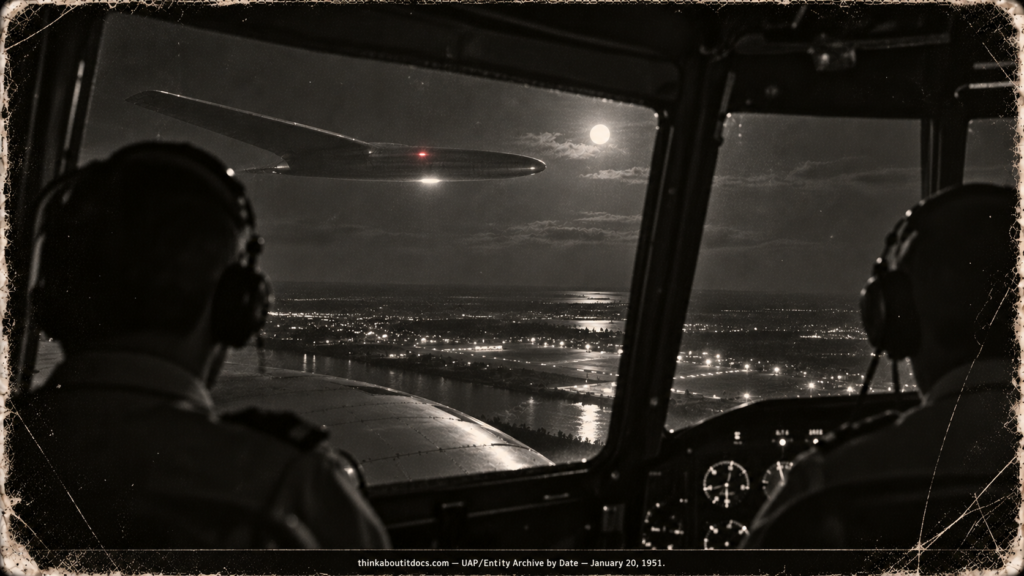
A Mid-Continent Airlines DC-3 crew reported a winged, engineless object alongside their aircraft over Sioux City, Iowa, on January 20, 1951.
THINK ABOUTIT UFO|UAP ENCOUNTER REPORT
1951: Winged object buzzes DC-3 over Sioux City, Iowa
On a clear, moonlit night in January 1951, the control tower at Sioux City, Iowa, asked the captain of a Mid-Continent Airlines DC-3 to look at a very bright light to the west. Capt. Lawrence W. Vinther took it for a star. The tower told him it was higher than that, about 8,000 feet, and moving. Minutes later, with the DC-3 airborne and circling, the object dove across the airliner’s nose about 200 feet away, matched its heading and speed off the left wing, then dropped under the fuselage and was gone.
What the crew said they saw has made the Sioux City DC-3 UFO encounter one of the best-documented airliner cases of the early 1950s: a cigar-shaped fuselage with a straight wing but no engines, no exhaust glow, and a red light, watched by two airline pilots, an Air Force officer’s aide, and two tower controllers. The Air Force’s answer was a B-36 reported somewhere in the area. Project Blue Book chief Edward Ruppelt did not accept it, and the case is listed in Brad Sparks’ catalog of Blue Book Unknowns.
Date: January 20, 1951
Sighting Time: About 8:30 p.m. to 9:26 p.m. CST (sources differ; see Detailed Report)
Day/Night: Night (clear and moonlit)
Location: Sioux City, Iowa, United States (Sioux City airport traffic pattern)
Urban or Rural: Urban (airport environment)
No. of Entity(‘s): 0
Entity Type: None observed
Entity Description: Not Applicable
Hynek Classification: CE-I (Close Encounter of the First Kind)
Duration: About six minutes from the tower’s first sighting to the object’s departure (9:20-9:26 p.m. in the NICAP chronology); the close pass lasted only seconds
No. of Object(s): 1
Description of the Object(s): A large winged object with a cigar-shaped fuselage and a straight wing, carrying a steady red light, a blinking light, and a bright white light on its underside. No engine nacelles, jet pods, or exhaust glow were seen.
Shape of Object(s): Cigar-shaped fuselage with a straight, high-aspect-ratio wing set farther forward than a B-29’s
Size of Object(s): Between the size of a B-29 and half again as large (Vinther’s estimate)
Color of Object(s): Not determinable; not enough light to see material or markings. Red navigation-type light and white underside light reported.
Distance to Object(s): Closest approach about 200 feet; first seen from the DC-3 about four miles away (NICAP)
Height & Speed: Tower estimate about 8,000 feet at first sighting; the object flew alongside at the DC-3’s own altitude, heading and speed. No other speed estimate was made.
Number of Witnesses: At least 5: Capt. Lawrence W. Vinther, copilot James F. Bachmeier, an Air Force officer’s aide aboard as a passenger, Chief Controller John M. Williams, and a second CAA tower controller
Special Features/Characteristics: Object crossed the nose, then appeared instantly on the other side; wings but no engines; lights blinked; tower and cockpit observations were independent
Case Status: Unexplained. Listed as a Blue Book Unknown (Sparks Case 435); the Air Force’s B-36 explanation was disputed by Project Blue Book chief Edward Ruppelt
Source: Lawrence W. Vinther, “Another Saucer Mystery,” Flying, June 1951; NICAP chronology; Brad Sparks, Blue Book Unknowns, Case 435, p. 104; Edward J. Ruppelt, The Report on Unidentified Flying Objects (1956), Chapter 7
Summary/Description: Mid-Continent Airlines Flight 9, a DC-3 bound for Omaha, was preparing to leave Sioux City when the control tower asked the crew to look at a bright light to the west, which the tower put at about 8,000 feet. After takeoff the DC-3 climbed in a left circle while the object moved around it on a wider circle. East of the field the object dove across the airliner’s nose about 200 feet away, then flew alongside on the left, matching its heading, altitude and speed for several seconds before dropping beneath the fuselage and disappearing to the northwest. Vinther described a cigar-shaped fuselage and a straight wing with no engines or exhaust glow. The Air Force suggested a B-36 in the area.
Related Cases: January 1951 UFO sightings archive | Holloman AFB, January 22, 1951 | Westover AFB, January 24, 1951
Detailed Report
This report concerns the encounter between a Mid-Continent Airlines DC-3 and an unidentified winged object at Sioux City, Iowa, on the night of January 20, 1951. The DC-3 was Flight 9 to Omaha, Nebraska. The night was clear and moonlit. The pilot, Capt. Lawrence W. Vinther, later wrote his own account for Flying magazine (June 1951). His copilot, James F. Bachmeier, was a Naval Air Reserve lieutenant commander with World War II Pacific service and more than 6,000 flying hours, according to Vinther’s article. An Air Force aide traveling as a passenger also saw the object, and so did Chief Controller John M. Williams and a second CAA controller in the tower.
Sources disagree on the time. Vinther wrote that the sighting began at about 8:30 p.m. as he taxied for takeoff, and other accounts also place the tower’s first sighting at about 8:20 to 8:30 p.m. The NICAP chronology and Sparks’ catalog give 9:20 p.m. for the tower’s first sighting and 9:26 p.m. for the end of the event. The two versions are preserved here without choosing between them, because the sequence of events does not depend on the clock.
The tower called the airliner first. Controllers had noticed a very bright light west of the field and asked Vinther to look at it. He assumed it was a star, and the tower answered that it was higher than that, about 8,000 feet. The light was seen to move from north to south west of the field. After takeoff the DC-3 turned left in a climbing circle around it. Vinther estimated that the object’s own circle had a radius of at least two miles, wider than the airliner’s. According to the NICAP version, the crew picked it out to the north-northwest at about 8,000 feet and four miles away while still climbing near 1,000 feet. Southeast of the field the light blinked five or six times, and otherwise it stayed steady. A red light was visible throughout, and a bright white light, probably on the underside, was seen at an angle. Vinther thought the white light might have been set in a tunnel or switched off as the object closed.
The close pass began when the DC-3 was east of the field. The object dove across the airliner’s nose about 200 feet away. In the NICAP version the crew had to turn their heads to follow it, and it then appeared instantly on the other side. It turned to fly alongside on the left, on the same heading, at the same altitude and speed, about 200 feet off the wing. Vinther said it stayed there four or five seconds or more; the NICAP chronology gives two to three seconds. It then dropped under the fuselage. The crew lost it after a left turn and then a right turn, and the NICAP chronology has it gone toward the northwest within another two to three seconds.
Vinther described the object as between the size of a B-29 and half again as large, with a cigar-shaped fuselage and a straight, high-aspect-ratio wing set farther forward than a B-29’s. He saw no engine nacelles or jet pods and no jet glow or exhaust. There was not enough light to make out the material or any markings. Vinther noted that a Cessna 140 had landed at Sioux City nearby and that a Bonanza arrived later from the east-northeast. He did not offer either aircraft as an explanation.
The Air Force’s explanation was a B-36. According to Ruppelt’s account, an Air Force officer who was assigned to UFO reports sent a wire to Flight Service, learned that a B-36 was somewhere in the area of Sioux City, and tried to blame the sighting on it. Ruppelt wrote that it did not take an expert to see that a B-36 could not have done what the UFO did. In his telling, the official reaction to the report was “a great big, deep belly laugh,” which puzzled him because he had read that the Air Force was seriously investigating all UFO reports. The case was entered into the CIRVIS reporting system, appeared in the Sioux City, Lincoln and Kansas City newspapers on January 22, 1951, and was later catalogued by Sparks as Blue Book Unknown Case 435.
The Hynek classification is CE-I. By the crew’s account the object came within about 200 feet of the aircraft, inside the 500-foot range that defines a close encounter. No physical trace, electromagnetic effect, or occupant is reported, so CE-II and CE-III do not apply.
Researcher’s Notes
A Tower-and-Cockpit Case: Sioux City and the Failure of the B-36 Explanation
- Classification and Range: CE-I rests on the crew’s estimate of about 200 feet at closest approach, which is inside the roughly 500-foot proximity that defines a Close Encounter. The report documents no physical trace, no instrumented effect, and no beings.
- Two Independent Vantage Points: The object was seen from the control tower and from the cockpit, and the tower’s first observation preceded the DC-3’s takeoff. Two airline pilots, an Air Force officer’s aide and two controllers saw it. For a 1951 case that is a strong witness base, and the pilot wrote his own account within months.
- The Time Discrepancy: Vinther’s article and other accounts put the start at about 8:30 p.m., while NICAP and Sparks give 9:20 to 9:26 p.m. The difference does not change what was seen, but it is the kind of detail a researcher should check against the Blue Book file or the newspaper reports of January 22, 1951.
- The B-36 Explanation: Ruppelt’s objection is that a B-36 could not have flown the pattern the crew described, circling around an airliner in the traffic pattern and pulling alongside at 200 feet. The explanation was based on a wire to Flight Service reporting a B-36 somewhere in the area, not on a track matched to the object. Vinther’s description of a straight wing with no engines also does not match a B-36, which has six piston engines and four jet pods.
- Perception and Alternatives: Night observations of lights are prone to error, and a crew in a climbing turn can misjudge relative motion. Against that, the object was seen alongside the aircraft for several seconds by pilots who describe a structured shape rather than a point of light. Vinther’s article also discusses the Office of Naval Research’s 1951 suggestion that cosmic-ray balloons account for reliable reports and leaves the question open. No radar record, photograph or recovered material exists.
- Documentation Gaps: The Blue Book record card and the Air Force investigator’s report were not available for this page. The identity of the passenger who saw the object is limited to his role as an aide to Col. Matthew Thompson of Offutt Air Force Base, whom Vinther described as assigned to investigating strange aircraft.
The Sioux City DC-3 encounter remains one of the early 1950s’ stronger airline cases: independent tower and cockpit witnesses, a pilot who put his name and account in print, a detailed description of a winged shape with no engines, and an official explanation that the head of Project Blue Book rejected. What it lacks is instrumental data and, for this page, the primary Blue Book file. The honest record position is that the Air Force’s B-36 explanation did not fit the reported behavior, and that the sighting remains unexplained.
“…it didn’t take an expert to see that a B-36, even one piloted by an experienced idiot, could not do what the UFO had done.”
— Edward J. Ruppelt, The Report on Unidentified Flying Objects (1956), on the Sioux City DC-3 sighting of January 20, 1951