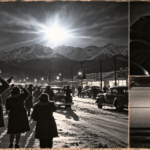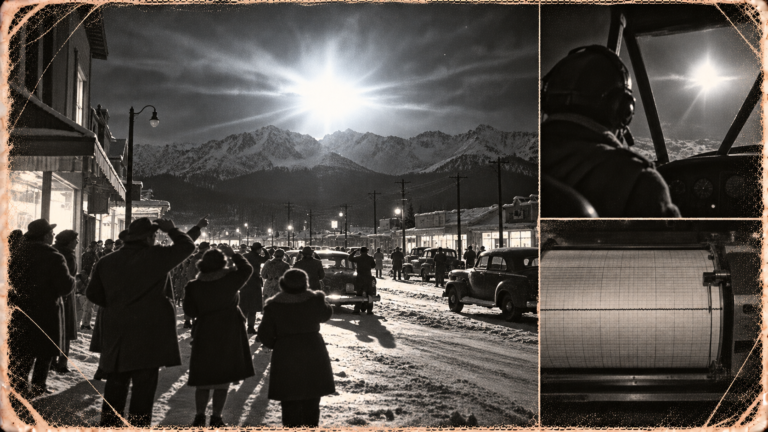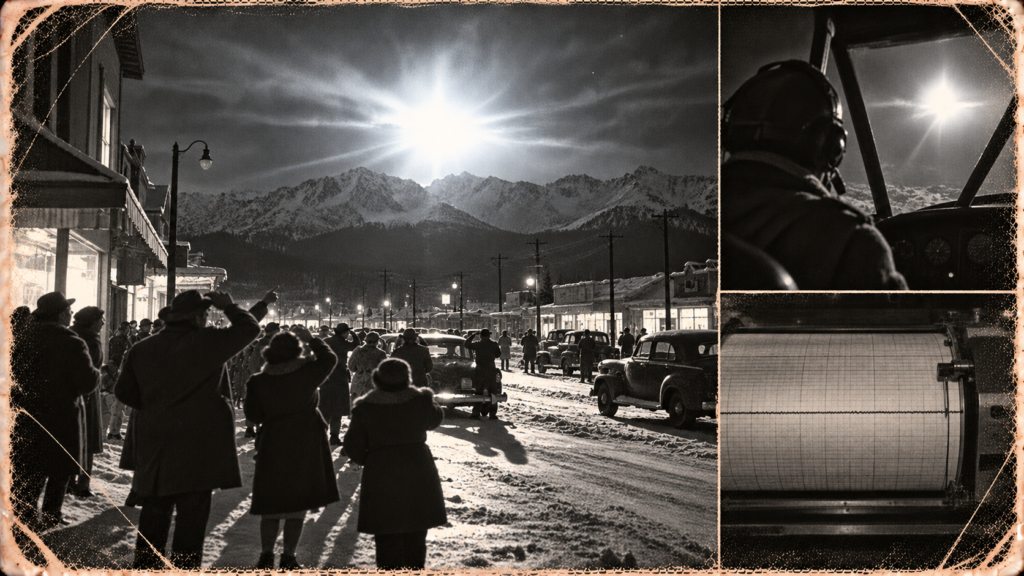
Anchorage, Alaska, November 30, 1950: a blue-white flash lit the town like daylight, followed by explosions; the Air Force called it a meteor.
THINK ABOUTIT UFO|UAP SIGHTINGS REPORT
1950: Anchorage, Alaska — A Blue-White Flash Turns Night to Day, Followed by Five Explosions
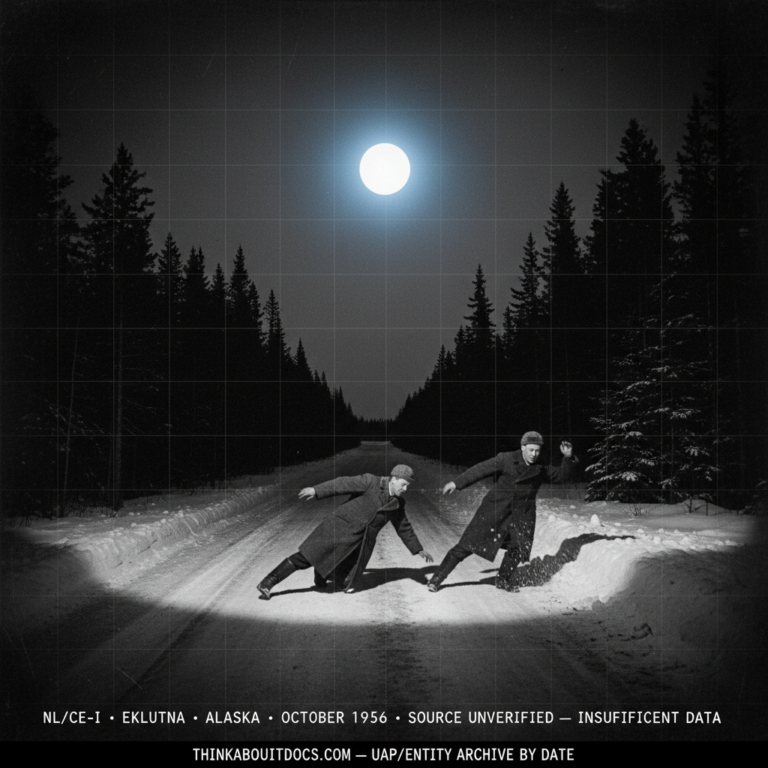
At about 7:53 on the evening of November 30, 1950, the whole of Anchorage lit up. A brilliant blue-white light flooded the town and the mountains seventy miles away, grew until it matched daylight, and then vanished high in the sky. Seconds later came a rumble or crash, and for some witnesses a string of up to five explosions, each fainter than the last. Hundreds of residents saw it. One man four miles outside town said he had a clear view and heard the blasts almost overhead, a little to the south, and a pilot approaching the city said the object seemed to explode northeast of his plane.
The Anchorage blue flash was seen from Kodiak, Seward, Whittier, Palmer and by an officer aboard a Navy vessel 50 miles south of Kodiak, as far north as Healy but not at Fairbanks. The Alaskan Air Command investigated, sent a report to Air Force Intelligence and considered it a meteor. Project Blue Book agrees: “Astro (Meteor).” The file is a detailed example of how a natural event looked, and sounded, to people who had been told to watch for something else.
Date: November 30, 1950 (0553Z, December 1)
Sighting Time: About 7:53 p.m. Alaska Standard Time
Day/Night: Night
Location: Anchorage and South-Central Alaska; also seen from Kodiak, Seward, Whittier, Palmer, a Navy vessel 50 miles south of Kodiak, and as far north as Healy
Urban or Rural: Urban and rural
No. of Entity’s: Not Applicable
Entity Type: Not Applicable
Entity Description: Not Applicable
Hynek Classification: Nocturnal Light (NL)
Duration: The flash lasted a few seconds; rumbling and explosions followed for up to a few minutes
No. of Object(s): One
Description of the Object(s): A brilliant blue-white flash or fireball; some described a flare traveling east to west that crossed about 15 degrees of sky in a second or two; others described a blue-white meteorite traveling north-northwest, or a flash like a transformer explosion; a Palmer observer compared it to a photo-reconnaissance flare
Shape/Size/Color of Object(s): Not determined; blue-white (most witnesses), with some reports of other colors
Distance to Object(s): Not determined; a Whittier report put the flash directly overhead and a Seward observer put it about 5,000 feet up; a pilot said it seemed to explode northeast of his plane
Height & Speed: Not determined; described as high, rising diagonally to the northeast by some
Number of Witnesses: Hundreds of residents, plus military personnel, CAA tower staff, a weather observer and a pilot
Special Features/Characteristics: Illumination described as nearly daylight, with mountains clearly visible at 70 miles; thunder-like rumble or up to five explosions seconds later; a faint trail visible for 20 to 30 seconds; radar contact negative; no seismograph reaction at the University of Alaska
Case Status: Identified as a meteor by the Alaskan Air Command; Project Blue Book card: Astro (Meteor).
Source: Alaskan Air Command message AAOTD-8111, December 2, 1950; Fort Richardson message to the Department of the Army, December 1, 1950; Air Intelligence Information Report, Alaskan Air Command, December 28, 1950; Project Blue Book record card
Summary/Description: A blue-white flash lit Anchorage like daylight on the evening of November 30, 1950, followed by up to five explosions; the Air Force called it a meteor.
Related Cases: Another November 1950 flash identified as a meteor: Rome, New York (November 2); see the November 1950 archive.
Detailed Report
Fort Richardson reported by message on December 1, 1950: “Unusual blue light lit up sky approximately 0105552.” Pilots flying about 25 miles from Fort Richardson saw the blue flash hit the ground and cause a grumble or explosion, and many individuals saw the light but few heard any sound. A check with one individual at Seward indicated the flash went directly overhead, apparently some 5,000 feet high, with no noise heard. At Whittier, a blue-white flash lit up the entire area and appeared directly overhead for about one second, with no noise. At Palmer, an observer said the object resembled a photo reconnaissance flare, blue-white, appearing just below the overcast at about 1,200 to 2,000 feet with no noise, lighting the area for about one to two seconds in two flashes, resembling a Roman candle dropping in the general direction of Anchorage. Local commercial radio stations said they were swamped with calls and reported that the flash was believed due to a meteor.
Alaskan Air Command followed with its own message on December 2. At about 0553Z, “the entire Anchorage area was suddenly illuminated by brilliant blue-white light which rapidly increased in intensity almost to daylight intensity before it disappeared high in the sky. Mountains were clearly visible at a distance of 70 miles.” The flash was observed for only a few seconds by hundreds of residents, “including those listening at the time,” and was followed in a few seconds by a rumbling noise. It was reported from a ship 50 miles south of Kodiak, at Kodiak, and as far north as Healy, 185 miles north of Anchorage, but not at Fairbanks. Radar contact was negative. Samples of the varied descriptions were: an official weather bureau report of a bright blue flash accompanied by a loud rumbling like thunder; a flare traveling east to west that crossed about 15 degrees of sky in a second or two and “went out like a match,” on a trajectory curving downward; a blue-white flash traveling north-northwest followed 30 seconds later by an explosion, then a second, third, fourth and fifth, each fainter than the last; a blinding flash that lit the whole sky followed by a great rumbling crash; a flame like a transformer explosion only brighter, followed in ten to twelve seconds by a low rumble like distant thunder; and a pilot approaching Anchorage from the south who said it appeared directly overhead, brightening until it was blinding to look at, then seemed to explode northeast of his plane, leaving a faint trail visible only 20 to 30 seconds. Other observers said it was very high and seemed to rise diagonally to the northeast. The message concluded: “On basis of evidence it is considered that the phenomena was a meteor,” with weather at the time of layers of scattered cloud at 3,000 and 5,500 feet and visibility of 10 miles.
The full report, an Air Intelligence Information Report from the Alaskan Air Command dated December 28, 1950, compiles the evidence. The Merrill Field weather observer recorded “bright blue flash in sky at 7:55 [p.m.] accompanied by loud rumbling similar to thunder which lasted about two or three minutes. Evidently rather large meteorite struck earth not too distant.” The Civil Aeronautics Administration tower at Merrill Field logged a “very bright lightning-like flash in the sky,” advising that it was believed to be a meteor, and noted that several persons reported hearing and feeling the blast at various points in Anchorage. A district intelligence officer in Kodiak reported that a USN vessel 50 miles south of Kodiak, on course 010 degrees, also saw it, and a CAA engineer at the Kodiak Airport said that the flash lit the sky for about two seconds in a southeasterly direction and was followed immediately by a sequence of rumbling like gunfire, which he thought was caused by Air Force maneuvers. A telegram from the University of Alaska said that its most sensitive seismographs showed no sign of disturbance.
The most detailed eyewitness statement came from a man about four miles outside Anchorage, at his home, where there were no lights or sounds nearby. He wrote that on the evening of November 30, at about 7:50 p.m., “the sky lit up almost as bright as day. I looked up and saw a blue-white meteorite traveling about north-northwest [or northeast to west, per the OCR] from the southeast. It was just a flash. I would judge about three seconds. About thirty seconds later I heard an explosion overhead. I saw the meteorite. Then I heard the second, third and fourth and fifth explosions in rapid succession, each one a little further away. The last one was very faint and far away. All explosions were almost overhead and a little to the south.” A reporter on the staff of a local newspaper who was on the street at the time gathered spot interviews: everyone who had been outside reported a very large flash of blue-white light lasting about two or three seconds, though people indoors apparently heard no explosions. Some people thought it might be a flashbulb firing for aerial photography at night; others thought it was some sort of military action from Fort Richardson. The report says there was no unusual disturbance reported by the University’s equipment.
RESEARCHER’S NOTES
A Meteor With a Sound Track
- Why the meteor identification holds: A bolide that bright, seen across hundreds of miles, followed by multiple sonic booms is the standard signature of a large meteor fireball. The Air Force’s identification fits the sky, the delay of seconds before the sound, and the wide reporting area.
- The sound delay: The sound arriving about 30 seconds after the flash in the most detailed statement is consistent with a meteor 5 to 6 miles high, though the file does not calculate this.
- Why the descriptions differ: Witnesses disagree on direction, color and sound because they were spread over a large area and saw different parts of a single moving fireball. People indoors missed the sound entirely.
- Alternative guesses recorded: Reporters’ questions about a photographic flashbulb or a military test at Fort Richardson show what the people of Anchorage were prepared to think in November 1950; the file offers no evidence for either.
- No instrument record: Radar picked up nothing and the University of Alaska’s seismographs recorded no disturbance, which fits an airburst high in the atmosphere rather than something that struck the ground, the weather observer’s “struck earth” remark notwithstanding.
- Why it is in the archive: It was investigated, reported through channels to Air Force Intelligence and given a Blue Book card, and it is one of the best-witnessed identified events of the year, useful as a comparison for unidentified flash reports.
The Anchorage flash is an identified case with a very large witness base and a detailed paper trail. Its value in the archive is as a benchmark: what a natural fireball looked, sounded and felt like to a town that had been hearing about “flying saucers” all year.
“The entire Anchorage area was suddenly illuminated by brilliant blue-white light which rapidly increased in intensity almost to daylight intensity before it disappeared high in the sky.”
— Alaskan Air Command message AAOTD-8111, December 2, 1950