Highway 421 near Bonlee, North Carolina, October 23, 1950: a former Air Force pilot watched a dirigible-shaped craft hover for 35 seconds.
THINK ABOUTIT UFO|UAP SIGHTINGS REPORT
1950: Bonlee, North Carolina — An Ex-Air Force Pilot Watches a Dirigible-Shaped Craft Hover for 35 Seconds
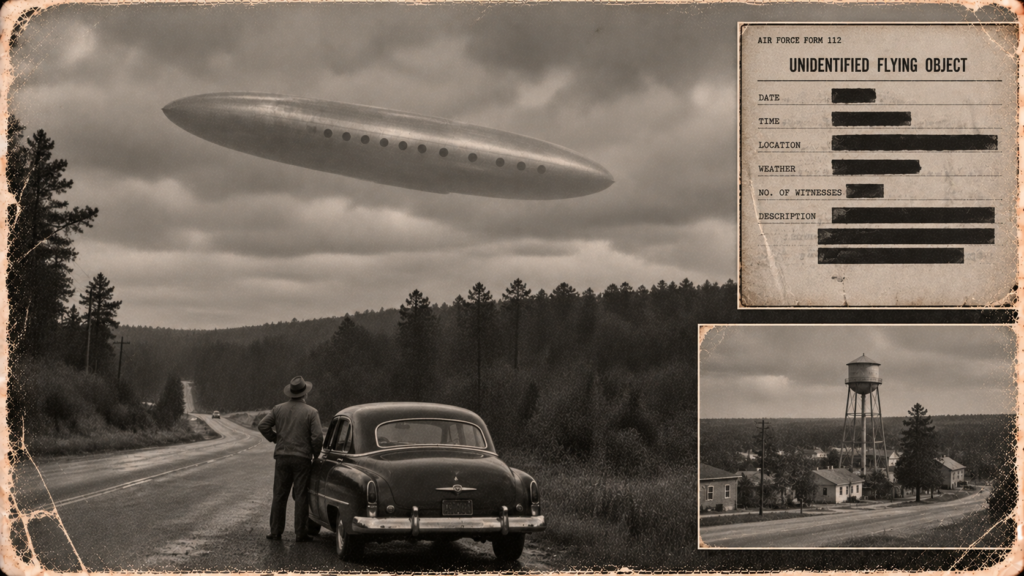
Driving southeast on Highway 421 two miles west of Bonlee, North Carolina, at 12:42 on the afternoon of October 23, 1950, former Air Force pilot Frank M. Risher saw what he took for a water tank — until it started moving. The aluminum object, shaped like a dirigible and as big as two B-36 bomber fuselages stacked one on top of the other, crossed the highway about two miles off, hovered for 35 seconds beneath a low overcast, and then slipped into the clouds.
Risher gave the Air Force a signed statement, and the 9th Air Force sent it up the chain by teletype. The Bonlee, North Carolina UFO sighting carries a Project Blue Book card marked in handwriting “UNIDENTIFIED,” a sketch, and a detail the published lists get wrong: it did not hover for three to five seconds, but for thirty-five.
Date: October 23, 1950
Sighting Time: 12:42 p.m. (1742Z)
Day/Night: Day
Location: Highway 421, about 2 miles west of Bonlee, North Carolina (35°39′ N, 79°25′ W)
Urban or Rural: Rural
No. of Entity’s: Not Applicable
Entity Type: Not Applicable
Entity Description: Not Applicable
Hynek Classification: Daylight Disc (DD)
Duration: About 40 seconds, including 35 seconds of hovering
No. of Object(s): One
Description of the Object(s): An aluminum, dirigible-shaped object with no visible control surfaces, propulsion system, trail, or exhaust; three portholes about the center, one-third of the way down from the top (a handwritten footnote on the witness statement says four portholes that looked dark against the light metallic surface)
Shape/Size/Color of Object(s): Dirigible shape; about the size of two B-36 fuselages stacked one above the other; aluminum
Distance to Object(s): About 2 miles
Height & Speed: Beneath an overcast of 600 to 700 feet; speed not estimated
Number of Witnesses: 1 (Frank M. Risher of Greensboro, a former Air Force pilot)
Special Features/Characteristics: Moved across the highway from southeast to south-southeast, hovered for 35 seconds, then disappeared rapidly into the overcast to the south-southeast; no sound; at first mistaken for a water tank in Bonlee
Case Status: Unidentified. The Blue Book record card carries the handwritten notation “UNIDENTIFIED” and notes a sketch.
Source: Air Force Form 112, 9th Air Force (Tactical), with signed statement by Frank M. Risher (teletype 231610Z October 1950); Berliner; Project Blue Book record card (BBU 824)
Summary/Description: An ex-Air Force pilot driving on Highway 421 saw a dirigible-shaped aluminum object hover for 35 seconds about two miles away beneath a low overcast, then vanish into the clouds.
Related Cases: Same state, the same month: Pope AFB (October 15) and Warrenton (October 21); see the October 1950 archive.
Detailed Report
At 12:42 p.m. on October 23, 1950, Frank M. Risher of Greensboro, North Carolina, was driving southeast on Highway 421, two miles west of Bonlee, when he saw an unidentified object in the sky. Risher, a former Air Force pilot, gave this account in his signed statement: it was “similar in shape to a dirigible, but no control surfaces, propulsion system, trail, or exhaust were visible,” and in size appeared “to two B-36 fuselages stacked one above the other.”
It looked about two miles away. “As I watched it, it moved across the highway from SE to SSE, hovered for 35 seconds, and disappeared into the overcast SSE.” The overcast, he said, was 600 to 700 feet up. The total time was about 40 seconds. “When I first saw it, I thought possibly it was a water tank in Bonlee, until it started moving.” The observation was visual from the ground. A footnote in his handwriting adds: “Four portholes that appeared dark in comparison to the light metallic surface.”
The 9th Air Force (Tactical) sent a teletype report to Air Materiel Command (attention MCIS) in accordance with the September 8, 1950 USAF letter on reporting unconventional aircraft. Its AF Form 112, prepared by the 9th Air Force intelligence office and dated November 7, 1950 (information dated October 23), repeats Risher’s description but says three portholes about the center, one-third from the top. Project Blue Book’s record card lists the same data — dirigible shape, B-36 fuselage double, course southeast to south-southeast, one in the group, 40 seconds, ground observation, hovered 35 seconds, one sketch — and carries the handwritten evaluation “UNIDENTIFIED.”
RESEARCHER’S NOTES
Details the Published Lists Miss
- Hover time: Berliner’s summary and the Blue Book unknowns list say the object hovered three to five seconds. The Blue Book card (“Hovered for 35 Seconds”), the Air Force report, and Risher’s own statement all say 35 seconds.
- Porthole count: The official report says three portholes; the witness’s handwritten footnote on his own statement says four dark ones. The archive records both rather than choosing.
- The water-tank mistake: Risher’s first thought, a water tank in Bonlee, is a useful honesty marker: he was identifying it against a known landmark until it moved, and he was an aviator, not a casual observer.
- Low overcast: The object was seen beneath a 600-to-700-foot ceiling about two miles away, which limits how large it could really have been, but the file contains no analysis of that and no second witness.
- The sketch: The record card notes one sketch. It is not in the files supplied for this page; if you have it, add it here.
Bonlee is a single-witness case, but the witness was a trained pilot, he reported it promptly, the Air Force gave it a formal report and a sketch, and Blue Book left it “Unidentified.” The one thing the record changes is the length of the hover: thirty-five seconds is a very different sighting from three.
“When I first saw it, I thought possibly it was a water tank in Bonlee, until it started moving.”
— Frank M. Risher, signed statement, October 23, 1950