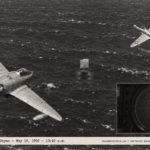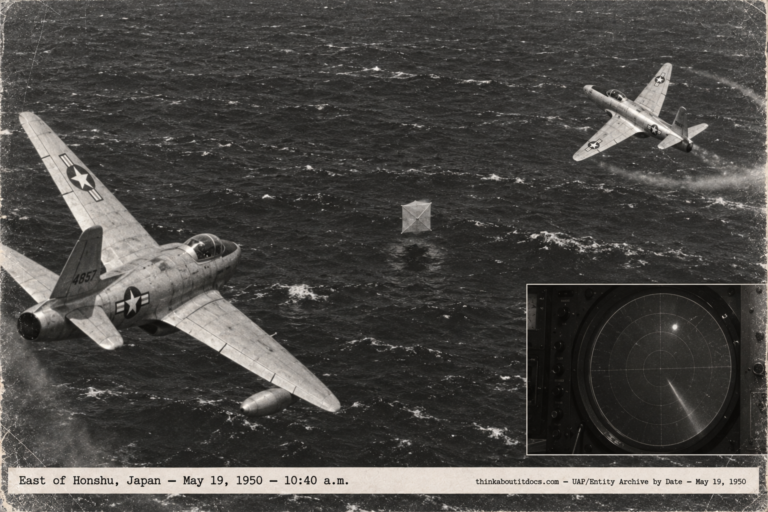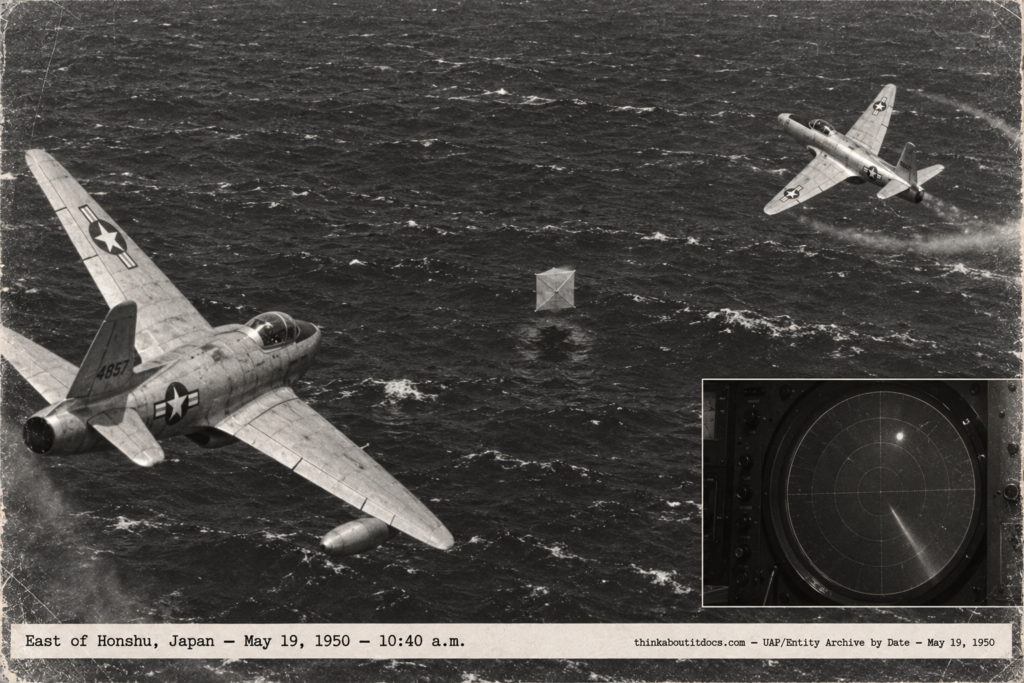
On May 19, 1950, two F-80 pilots made six or seven passes at a stationary kite-like object east of Honshu, Japan.
THINK ABOUTIT UFO|UAP SIGHTINGS REPORT
1950: East of Honshu, Japan, The Kite That Might Have Been a Dropsonde
Two Air Force F-80 pilots scrambled from Misawa Air Base in northern Honshu on the morning of May 19, 1950, to chase a target their ground radar had locked onto over the Pacific. A hundred miles out they found a stationary object that looked like a box kite, about 30 by 24 inches, with nothing visible holding it up. For twelve minutes they flew pass after pass around it, slowing with flaps and landing gear down on the last pass for a better look, while radar followed the same target for 22 minutes.
The Air Force record card closed the case as “Other (Dropsonde),” and a weather aircraft had in fact released a dropsonde in the area that morning. But the intelligence officer who forwarded the report would not call it a match: the dropsonde reached the water at 10:15, and the pilots did not reach the object until 10:40. This Honshu, Japan F-80 radar-visual UFO case lets us read both sides of a 1950 identification in the Air Force’s own words.
Date: May 19, 1950
Sighting Time: Radar pickup about 10:30; pilots’ contact 10:40; observed until 10:52 (local “K” time)
Day/Night: Day
Location: About 100 miles east of Misawa Air Base, Honshu, Japan, over the Pacific (40°30’N, 143°26’E)
Urban or Rural: Rural (open ocean)
No. of Entity’s: 0 — Not Applicable
Entity Type: Not Applicable
Entity Description: Not Applicable
Hynek Classification: RV (radar-visual)
Duration: 22 minutes on radar; 12 minutes visual
No. of Object(s): One
Description of the Object(s): Resembled a box kite; no visible means of support; appeared metallic to one pilot; stationary during six or seven passes
Shape/Size/Color of Object(s): Kite-like; about 30 by 24 inches per the intelligence report (36 by 24 inches on the record card); about two and a half feet across and as high per Capt. Thomas’ statement
Distance to Object(s): Close enough for repeated passes; exact distance not stated
Height & Speed: Stationary; the pilot’s passes were at about 150 mph indicated airspeed; altitude not clearly legible in the file
Number of Witnesses: Two pilots (Capt. R. L. Thomas and 2d Lt. C. F. Wenzel) plus ground radar crew
Special Features/Characteristics: Independent ground-radar track; vectored interception by two F-80 jets; a weather-reconnaissance dropsonde released nearby earlier that morning
Case Status: Blue Book: Other (Dropsonde). Air Intelligence: not positively identified as the dropsonde because of the time discrepancy. Formally unresolved on timing.
Source: Air Intelligence Information Report IR-132-50 (Hq FEAF, APO 925, June 20, 1950; prepared by Maj. Edward R. McLean; approving officer Maj. H. J. Chisholm); Project 10073 Record Card; statement and sketch by Capt. R. L. Thomas; sketch by 2d Lt. C. F. Wenzel; Project 1947; McDonald list
Summary/Description: Two F-80 pilots circled a stationary kite-like object tracked by ground radar; the Air Force card says dropsonde, but the timing does not fit.
Related Cases: April 27-28, 1950 Misawa-area F-80 encounters (the rectangular “muslin”-like object near Hachinohe and the Wakkanai intercept)
Detailed Report
The record card. The Project 10073 record card lists the date as May 19, 1950, the location as 100 miles east of Honshu, a military source and one object. It gives the length of observation as 22 minutes by radar and 12 minutes visual, the observation type as air visual and ground radar, the course as stationary, with no photos and no physical evidence. The conclusion reads Other (Dropsonde), with the note that the time element differs slightly but appearance and all other elements are in accord with that evaluation. The summary says the object was picked up on ground radar, that pilots of two aircraft were vectored to the area, and that they identified an object that looked like a kite measuring 36 by 24 inches.
The intelligence report. The Air Intelligence Information Report, dated June 20, 1950, covers two F-80 pilots who sighted an unidentified object at 40°30’N, 143°26’E, 100 miles east of Misawa Air Base. Ground radar detected it first and the pilots were given a vector at 10:30. At 10:40 they made contact, and several passes were made to determine its identity. They described it as similar to a box kite, with approximate dimensions of 30 by 24 inches. No visible means of supporting the object was noted, and both pilots reported that it appeared to remain stationary. It was under observation from 10:40 to 10:52.
The pilot’s statement. Capt. Thomas’ statement describes a call from the tactical control center, vectors toward the target and a series of six or seven passes. On the last pass the flight leader dropped flaps and landing gear, and Thomas went by the object at about 150 mph indicated. He wrote that the object did not appear to be moving, was approximately two and a half feet across and about the same in height, had the appearance of a kite, could have been square or triangular, and was made of metal or at least appeared to be. During all the passes he saw no visible means of support. His sketch and Lt. Wenzel’s accompany the file; as far as the faded scans allow, they show a boxy frame with cross-bracing and a line running down to a small rectangular box.
The dropsonde. The report also states that at 10:00 a dropsonde was released from a WB-29 weather reconnaissance aircraft in the approximate vicinity of the sighting, that it is similar in appearance to the reported object, and that it reached the surface at 10:15. A 2143d Air Weather Wing enclosure describes the device as a small rectangular radio transmitter in a bright aluminum finish, hung on a cord of about 100 feet from a camouflaged parachute; that page is only partly legible.
The approving officer. Maj. H. J. Chisholm of the Directorate of Air Intelligence Requirements added a comment that since the object could not be positively identified as the dropsonde, due to the incongruity of the time element, the report was being forwarded for information.
RESEARCHER’S NOTES
Reading the Timeline
- The 25-to-37-minute gap: The dropsonde reached the surface at 10:15. The pilots made contact at 10:40 and watched until 10:52, which is 25 to 37 minutes later. The card’s phrase “differs slightly” understates that gap, and nothing in the file explains how a sonde already on the water could be stationary at altitude.
- Radar timing: The ground radar pickup (about 10:30) also came 15 minutes after the sonde’s landing. The file does not mention a second sonde.
- Resemblance is real: Everyone in the chain agrees the dropsonde and the object looked alike, which is why Blue Book filed it under Other. The disagreement is about timing and the stationary hover, not appearance.
- Catalog drift: Project 1947 and the McDonald list describe a “triangular” object at 10:30. The primary documents say box kite, so “triangular” is a catalog simplification.
- Legibility: The weather-wing enclosure and Lt. Wenzel’s statement are the hardest pages to read; a cleaner scan could settle the sonde’s release position and any second release.
- Why no BBU tag: The Blue Book evaluation is Other, not Unknown, so this archive does not tag it as a Blue Book Unknown.
The Honshu case is best read as a probable misidentification that its own paperwork refuses to close. The pilots saw a small, kite-like object that matched a weather instrument in appearance but not in time, and the Air Force said so plainly. Without a second release record or a cleaner scan, it stays unresolved on the clock.
“cannot be positively identified as the dropsonde”
— Maj. H. J. Chisholm, Air Intelligence Information Report IR-132-50, June 20, 1950