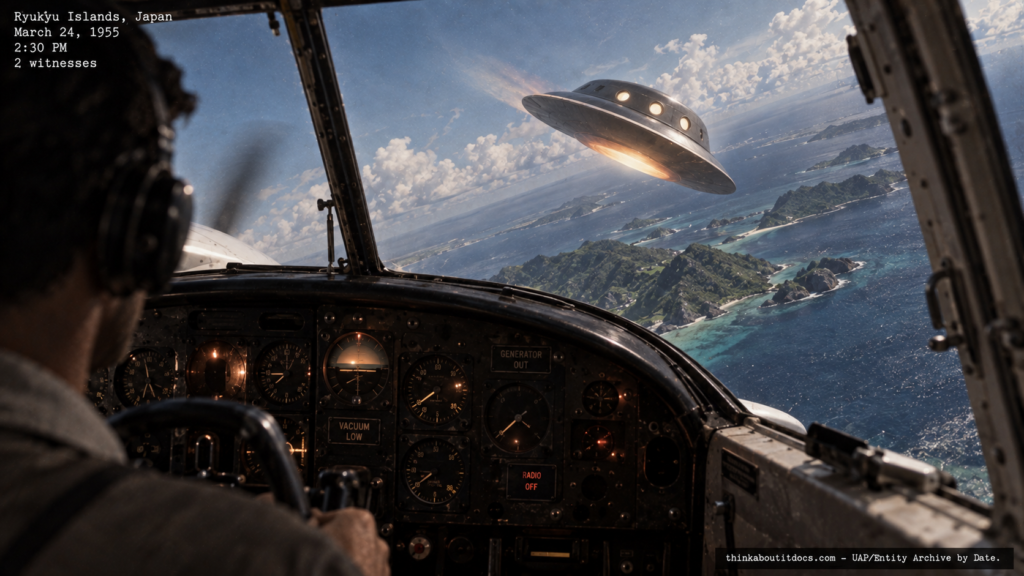
The March 24, 1955 Ryukyu Islands instrument-failure encounter.
THINK ABOUTIT UFO|UAP SIGHTINGS REPORT
1955: Ryukyu Islands, Japan: The Hat-Shaped Object That Failed a Beechcraft’s Instruments
On March 24, 1955, a Beechcraft flight instructor and student pilot over the Ryukyu Islands found their instruments failing and their engine sputtering as a hat-shaped object, banded with windows and shifting color from white to orange, flew under and around their plane and matched every evasive maneuver they attempted. Two jets scrambled from Kadena Air Force Base — one of a cluster of radar and visual UFO cases from the U.S. military’s Okinawa-area operations in this period.
Date: March 24, 1955
Sighting Time: 2:30 PM [or 2:13 PM]
Day/Night: Day
Location: Ryukyu Islands, southern Japan
Urban or Rural: Airborne, over the Ryukyu Islands region
No. of Entity(‘s): Not Applicable
Entity Type: Not Applicable
Entity Description: Not Applicable
Hynek Classification: DD (Daylight Disc) — with instrument interference, bordering on RV-type characteristics
Duration: Several minutes, through the evasive dive and pursuit
No. of Object(s): 1
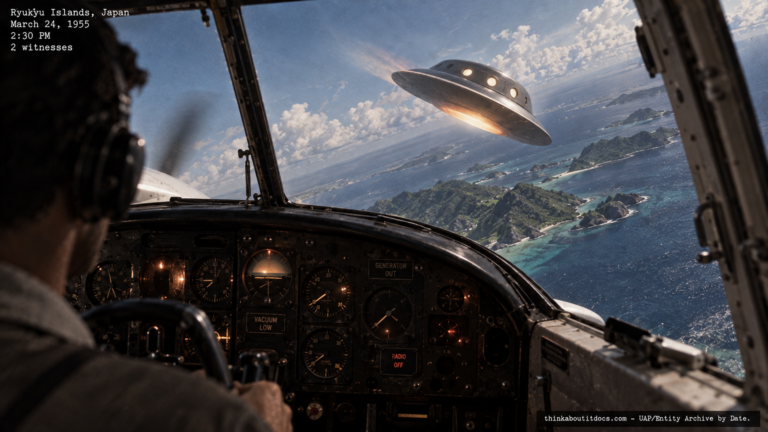
Description of the Object(s): A hat-shaped object with 3 windows visible on its top section, changing color from white to orange during the encounter
Shape/Size/Color of Object(s): Hat-shaped; color shifted between white and orange
Distance to Object(s): Close range — described as flying under and around the aircraft
Height & Speed: Matched the Beechcraft’s altitude and speed throughout, including during an evasive diving maneuver
Number of Witnesses: 2 — a flight instructor and a student pilot aboard the Beechcraft
Special Features/Characteristics: Aircraft instruments failed and the engine sputtered during the encounter; the object flew under and around the plane and kept pace through an evasive dive, suggesting deliberate maneuvering rather than a passive object; two jets were scrambled from Kadena AFB in response
Case Status: Project Blue Book-era (BBU) case, cross-referenced via NARCAP and Project 1947; occurs amid a cluster of Okinawa-area radar and visual cases from this period tied to the broader U.S. air defense buildup in the region
Source: NARCAP; Project 1947
Summary/Description: A flight instructor and student pilot flying a Beechcraft over the Ryukyu Islands on March 24, 1955 saw a hat-shaped object with three windows on its top section, shifting color from white to orange, fly under and around their aircraft. Their instruments failed and the engine sputtered; when the pilot dove the plane to try to evade the object, it kept pace with the maneuver. Two jets were scrambled from Kadena Air Force Base in response.
Related Cases: Occurs within a broader cluster of March 1955 Ryukyu/Okinawa-area radar-visual and instrument-interference reports tied to the region’s growing U.S. Air Force presence; cf. the February 11, 1955 Ryukyu Islands MATS C-124 sighting logged elsewhere in this archive
Detailed Report
On March 24, 1955, at approximately 2:30 PM local time, a flight instructor and his student pilot were flying a Beechcraft over the Ryukyu Islands, the chain of islands in southern Japan that includes Okinawa. During the flight, they spotted a hat-shaped object marked with three windows across its top section. As they watched, the object’s color shifted between white and orange. Rather than remaining at a distance, the object flew directly under and around their aircraft — a proximity and maneuvering pattern suggesting the object was actively responding to, or at least closely tracking, the Beechcraft’s own flight path.
During the encounter, the aircraft’s instruments failed and the engine began to sputter — a detail suggesting some form of electromagnetic or mechanical interference coincident with the object’s presence, a pattern that recurs across a number of Cold War-era UFO encounters involving aircraft. The pilot attempted to escape the situation by putting the plane into a dive, a standard evasive maneuver — but the object matched the dive and kept pace, refusing to be shaken off.
In response to the reported encounter, two jets were scrambled from Kadena Air Force Base, the major U.S. installation on Okinawa and a central hub of American air power in the region during this period. The surviving case summary does not detail what, if anything, the scrambled jets subsequently observed or accomplished.
RESEARCHER’S NOTES
The Ryukyu Islands Intercept — 1955 Okinawa and a Pattern of Instrument Interference
- Instrument Failure as Corroboration. The combination of a visual sighting with simultaneous instrument failure and engine trouble is a meaningfully different, and in some ways more evidentially interesting, case type than a visual sighting alone — it suggests either a genuine physical interaction or, at minimum, a coincident and unexplained aircraft malfunction during a reported encounter.
- Active Matching Behavior. The object’s ability to keep pace through the pilot’s evasive dive is the case’s most striking behavioral detail, consistent with a pattern seen elsewhere in this archive’s 1950s military-aviation cases of objects appearing to respond directly to a pilot’s own maneuvers rather than simply being outrun or evaded.
- Regional Context. This case sits within a broader cluster of Ryukyu/Okinawa-area radar and visual reports from the same general period, reflecting the intensity of U.S. Air Force operations and airspace monitoring in the region during the mid-1950s — worth cross-referencing against the archive’s February 11, 1955 Ryukyu Islands MATS C-124 case for anyone tracking the regional pattern.
- Named Response, Unnamed Witnesses. While the responding jets and their launch base (Kadena AFB) are specifically named, the flight instructor and student pilot themselves are not — a common asymmetry in Project 1947/NARCAP-sourced cases where the official response is documented in more institutional detail than the original witnesses.
The Ryukyu Islands case is a well-anchored, if unnamed-witness, military-aviation encounter, distinguished by its combination of visual sighting, instrument interference, and an active-pursuit response from Kadena AFB. It belongs among the archive’s stronger 1955 military cases even without named crew members.
“Instruments failed and engine sputtered, pilot dove the plane to evade the object but it kept pace.”
— NARCAP / Project 1947 case summary, Ryukyu Islands, March 24, 1955