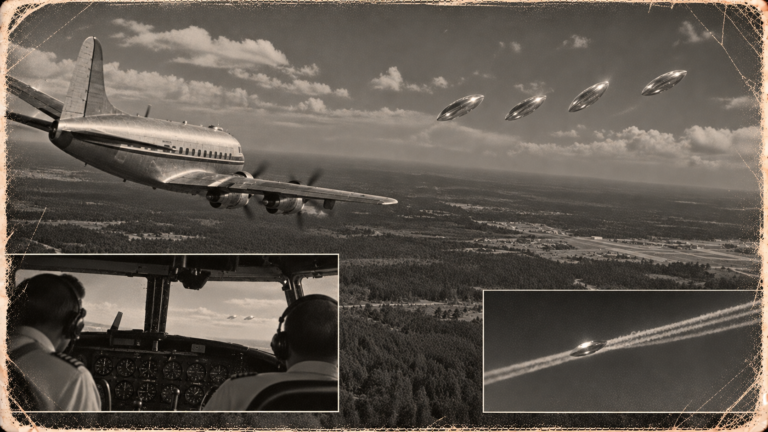
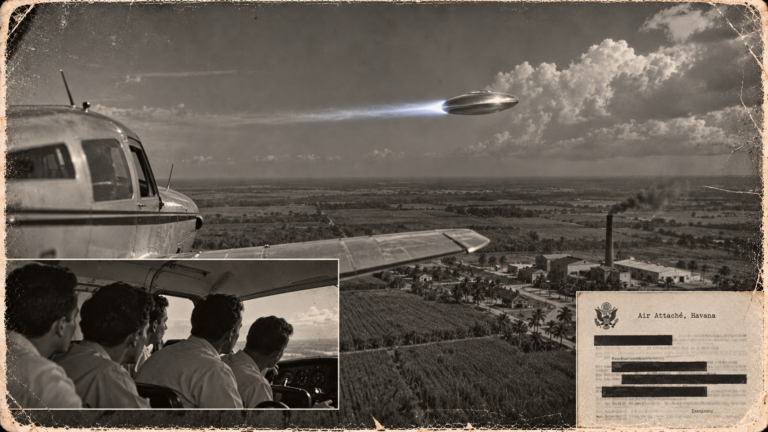
Wilfredo Arevalo's March 18, 1950 encounter at Lago Argentino, Patagonia — one of the most detailed CE-III reports of the early 1950s wave.
THINK ABOUTIT UFO|UAP | ENTITY ENCOUNTER REPORT
1950: The Lago Argentino Landing — Patagonia, Argentina
On the evening of March 18, 1950, a Patagonian rancher named Wilfredo Arevalo walked to within 150 yards of a landed disc-shaped craft on the shore of Lago Argentino, close enough to smell what he described as burning benzene and to see, through a transparent cabin in a second disc rotating above it, four tall, pallid-faced men in what he called “cellophane” working calmly at their instruments — until the craft turned a searchlight on him, lit up blue, and climbed away trailing red and green flame. It is one of the more detailed close-encounter-with-occupants reports from the great 1950 UFO wave, corroborated the next day by burnt grass at the site and, in the following hours, by other observers who reported the object in flight.
Date: March 18, 1950
Sighting Time: 18:30
Day/Night: Dusk
Location: Shore of Lago Argentino, Santa Cruz Province, Argentina
Urban or Rural: Rural (remote Patagonian ranch country)
No. of Entity(‘s): 4
Entity Type: Humanoid
Entity Description: Four tall, pallid-faced humanoid figures, dressed in a material the witness described as “cellophane,” observed working at instruments inside a transparent cabin; no communication or interaction with the witness was reported
Hynek Classification: CE-III (Close Encounter of the Third Kind — object and occupants observed at close range)
Duration: Not recorded (the described sequence — approach, observation, searchlight, departure — implies several minutes)
No. of Object(s): 2 (a landed disc and a second disc hovering above it)
Description of the Object(s): A large disc rested on the ground, emitting a greenish-blue vapor and an odor of burning benzene. Above it, a second, flatter disc rotated “like a phonograph record,” with a transparent central cabin through which the occupants were visible.
Shape of Object(s): Disc / saucer, in two stacked or paired components
Size of Object(s): Not established (described only as “huge”)
Color of Object(s): Greenish-blue vapor at rest; lit up in solid blue light before departure; red and green flame on ascent
Distance to Object(s): Witness approached to within approximately 150 yards
Height & Speed: Not established — the craft rose vertically from the ground before departing, leaving bluish trails
Number of Witnesses: One primary witness (Wilfredo Arevalo) at close range; several unnamed additional witnesses reported seeing the object in flight afterward
Special Features/Characteristics: Greenish-blue vapor and burning-benzene odor at the landing site; rotating upper disc; transparent occupant cabin; a searchlight directed at the witness; a faint hum during departure; burnt grass discovered at the site the following day
Case Status: Insufficient Data
Source: Hanlon, Donald, The Humanoids
Summary/Description: On the evening of March 18, 1950, rancher Wilfredo Arevalo encountered a landed disc-shaped craft on the shore of Lago Argentino, in Argentina’s Santa Cruz Province. He approached to within 150 yards of the object, which gave off a greenish-blue vapor and a strong smell of burning benzene. Above the landed craft, a second, flatter disc rotated “like a phonograph record”; through a transparent central cabin, Arevalo reported seeing four tall, pale-faced humanoid figures dressed in a material he described as “cellophane,” apparently working at instruments and paying him no attention. The craft then trained a searchlight on him, lit up with a blue glow, and lifted off with a faint hum, trailing red and green flame and a bluish exhaust trail as both discs departed together. The following day, burnt grass was found at the landing site, and several other, unnamed witnesses separately reported seeing the object in flight in the hours that followed.
Related Cases: 1950: The Veghenza (Vicenza), Italy close encounter with dwarf entities, March 14 (same wave, entity presence) | 1950: The Piñon de los Baños, Mexico “Martian spaceship” contact claim, March 13 (same wave, contactee-adjacent narrative) | 1950: The Farmington Armada, New Mexico (same global wave, same week)
Detailed Report
The Lago Argentino case is among the more fully realized close-encounter-with-occupants narratives to emerge from the March 1950 global wave, and its detail is both its strength and its central problem. Unlike a fleeting light-in-the-sky report, this account offers a landing, an approach to close range, a description of the craft’s mechanism (a rotating upper disc, a transparent cabin, a vapor and odor at the point of contact), a description of four occupants at their apparent work, and a dramatic departure sequence with a searchlight, a color change, and a visible flame trail. That level of narrative structure is exactly what makes a single-witness account of this era difficult to weigh: it reads as a complete, well-formed story, which can reflect either an unusually clear and retained memory of an extraordinary event, or the shaping influence of the contactee narratives that were beginning to circulate more widely in UFO literature by the early 1950s.
What lends the account some corroborating weight is the reported discovery of burnt grass at the site the following day, and the fact that Arevalo was reportedly not the only person to see an object in the air that evening — other, unnamed witnesses are said to have observed the craft in flight after it departed the ranch. Neither detail rises to hard physical evidence: there is no indication the burnt grass was preserved, tested, or examined by anyone beyond the immediate community, and the additional witnesses are undocumented by name, making their testimony unverifiable at this remove. Still, an independently reported aerial sighting in the same time window is at least consistent with something having been in the sky over the area that evening, whatever it was.
The specific sensory details — a benzene-like odor, a greenish-blue vapor, a faint hum, a rotating upper section “like a phonograph record” — are worth noting for their internal consistency; they read as an attempt to describe something outside the witness’s frame of reference using available comparisons, rather than as a stock description lifted from contemporary saucer lore, which more commonly emphasized speed and metallic surfaces rather than smell and mechanical rotation. The “cellophane”-clad occupants likewise stand out from the more common jumpsuit-and-helmet humanoid description that would become standard later in the decade.
The source itself, Donald Hanlon’s compendium The Humanoids, is a secondary catalog of humanoid encounter reports rather than a primary investigative document, and no contemporaneous Argentine newspaper account or investigative follow-up has been located to corroborate the case independently. That places Lago Argentino in the same evidentiary category as many of the era’s more striking entity reports: preserved faithfully because it was reported and cataloged, but resting on a single primary witness and a secondhand compilation rather than verifiable documentation.
RESEARCHER’S NOTES
The Lago Argentino Landing — Patagonia 1950 and the Single-Witness Problem
- Classification issues: CE-III is the correct designation — a craft and its occupants were observed at close range, with no communication or physical interaction reported, which distinguishes this from a CE-IV abduction or a contact/communication claim. The case should not be conflated with the same week’s Piñon de los Baños “Martian spaceship” entry, which involves alleged direct verbal contact and belongs to the separate contact-claim category.
- Source chain assessment: The account traces to Donald Hanlon’s The Humanoids, a secondary humanoid-report compilation rather than a primary Argentine investigative file or contemporary press account. No original newspaper report, police record, or named secondary witness has been located to independently corroborate Arevalo’s testimony or the “several other witnesses” mentioned in the summary.
- Pattern context: The case sits within the same March 1950 global wave that produced the Veghenza, Italy dwarf-entity encounter and the Piñon de los Baños contact claim — a striking short-term cluster of humanoid-occupant reports worldwide, of a kind not seen again at this density until later flap years. Its landing-with-occupants structure also anticipates the more elaborate contactee narratives that would become a distinct UFO subculture later in the 1950s.
- Physical evidence and evidentiary weight: The reported burnt grass is the case’s only physical trace, and it was neither preserved nor examined by any documented investigator — it functions as a narrative detail supporting the account rather than as testable evidence. Combined with a single named witness and a secondary source, the evidentiary weight is low, though not zero given the reported independent aerial sighting later that evening.
- Geographic and historical context: Lago Argentino sits in sparsely populated Patagonian ranch country, where a lack of corroborating witnesses is unsurprising regardless of what occurred, and where isolation makes independent verification of any single account inherently difficult. The case predates Argentina’s later, much more prolific UFO reporting culture of the 1960s–1980s and stands as one of the earliest detailed entity encounters on record from South America.
The Lago Argentino landing endures in the humanoid-encounter literature because it is unusually complete: a landing, a close approach, a description of occupants at their work, and a dramatic departure, all from a single rural witness in a remote corner of Patagonia. That completeness cannot substitute for corroboration that was never gathered — no tested physical trace, no named secondary witness, no contemporary press record — and the case is honestly catalogued here as Insufficient Data: a vivid account, preserved faithfully, that neither confirms nor forecloses what Wilfredo Arevalo says he saw on the shore of Lago Argentino that evening.
“Four tall men with pallid faces, dressed in cellophane, working at instruments.”
— Wilfredo Arevalo, as recorded in Donald Hanlon’s The Humanoids