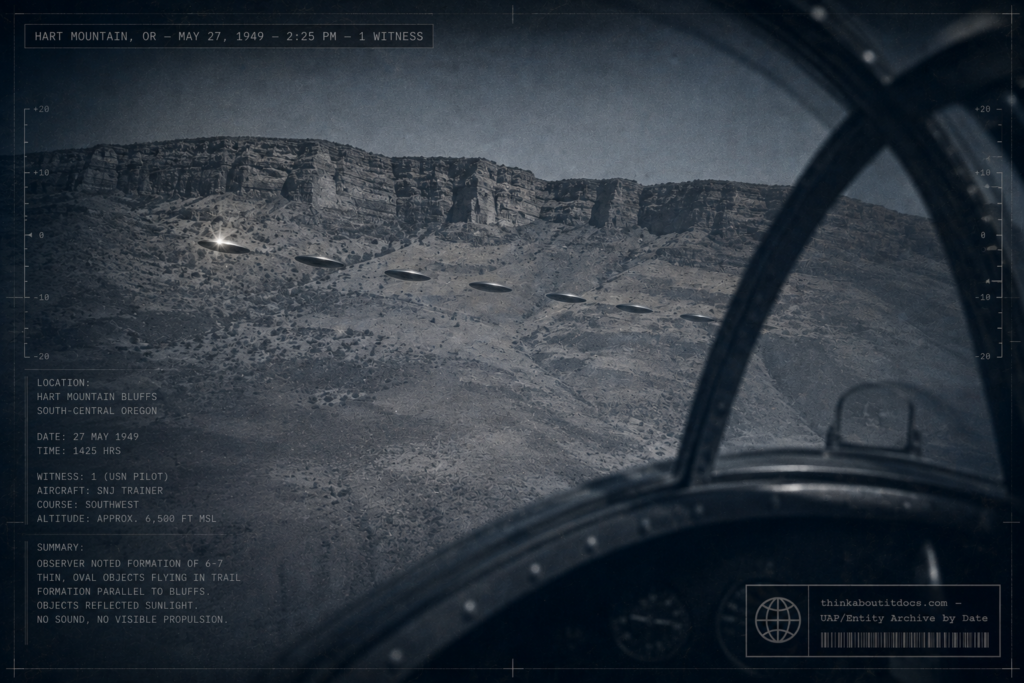
May 27, 1949 — pilot Joseph C. Shell's formation sighting near Hart Mountain, Oregon, filed as Blue Book Unknown 404.
THINK ABOUTIT UFO|UAP SIGHTINGS REPORT
1949: The Hart Mountain Formation — Joseph C. Shell
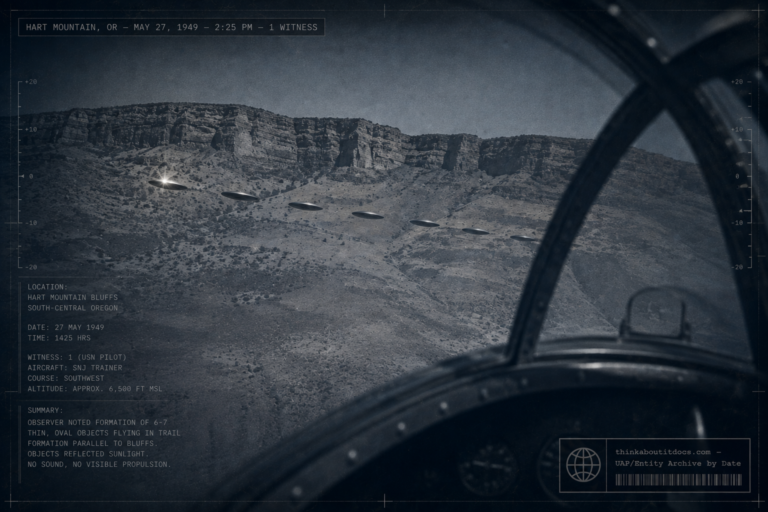
On the afternoon of May 27, 1949, an oil company vice-president and Navy Reserve pilot flying a lightened SNJ trainer over south-central Oregon watched what first looked like a glint of metal resolve, as he closed the distance, into six or seven small oval objects holding a rigid trail formation against the Hart Mountain bluffs — a sighting detailed enough in coordinates and behavior that Project Blue Book filed it as an Unknown rather than explain it away.
Date: May 27, 1949, BBU 404
Sighting Time: 2:25 p.m. (PST)
Day/Night: Day
Location: Near Hart Mountain, south-central Oregon
Urban or Rural: Rural
No. of Entity(‘s): Not Applicable
Entity Type: Not Applicable
Entity Description: Not Applicable
Hynek Classification: DD (Daylight Disc)
Duration: Approximately 5 minutes
No. of Object(s): 5-8, most likely 6-7
Description of the Object(s): Metallic, oval or egg-shaped, uniform in size, flying in tight trail formation with constant relative spacing throughout the sighting
Shape of Object(s): Oval/egg-shaped, length-to-width ratio about 2:1, roughly 1/5 as thick as wide
Size of Object(s): Each under 20 ft in diameter
Color of Object(s): Metallic (unspecified base color; reflective)
Distance to Object(s): First seen roughly 20 miles out; closed to about 5.5-7.5 miles at closest approach
Height & Speed: Roughly 1,000-1,500 ft below Shell’s aircraft (at 9,000 ft MSL), following the Hart Mountain bluff rim (about 7,000 ft MSL); traveling at an estimated 230 ± 30-40 mph
Number of Witnesses: 1 (Joseph C. Shell)
Special Features/Characteristics: Aviation Professional Witness, Trail/Tow Formation, Constant Inter-Object Spacing, Coordinated Course Change, Long Visibility Range (over 60 miles)
Case Status: Unexplained (Project Blue Book Unknown, BBU 404)
Source: Sparks; Berliner; Jan Aldrich; Footnote.com images 6313041 ff.
Summary/Description: Joseph C. Shell — an oil company vice-president, U.S. Navy Reserve pilot, and former Army Air Forces flight instructor — was flying a lightened-load SNJ Navy trainer from Red Bluff, California, to Burns, Oregon, heading NNE at 212 mph ground speed and 9,000 ft MSL. To his right, roughly 20 miles off, he spotted something metallic that resolved, as he closed the distance, into 5-8 (most likely 6-7) oval or egg-shaped metallic objects flying in trail formation. The lead object kept an interval of 3-4 times its own length ahead of the second object, while the remaining objects trailed each other at only 1/2 to 2/3 of an object-length apart — a spacing pattern that stayed constant throughout the sighting, almost as if the trailing objects were being towed by the lead one. Shell watched the formation outlined against the Hart Mountain bluffs, clearly able to see dark ground between each object, and noted they shifted from a “quartering” approach path to a course running parallel to his own but in the opposite direction, tracking the rim of the bluffs at an estimated 230 ± 30-40 mph. At closest approach the objects were roughly 1,000-1,500 ft below his altitude and 5.5-7.5 miles off to his ESE. Near the end of the encounter, Shell dropped altitude and briefly leveled with the objects, confirming their estimated height below his original 9,000 ft. The formation finally disappeared on the horizon; visibility that day exceeded 60 miles.
Related Cases: Not Applicable
Detailed Report
Shell’s professional background carries real weight here: a Navy Reserve pilot and former Army Air Forces flight instructor, flying his own aircraft, accustomed to estimating distance, altitude, and speed in the air as a matter of routine. His account preserves an unusual level of geometric detail for a 1949 civilian report — precise latitude/longitude estimates for the sighting’s start and end points, a specific closing distance, and a description of formation spacing that stayed internally consistent even as the objects changed course.
The behavior he described is the hardest part to explain conventionally. A loose flock of birds or a scattering of balloons does not typically hold a fixed, asymmetric trail-formation spacing — tighter between the trailing objects than between the lead and the second — for five continuous minutes while the group as a whole reorganizes its heading. Shell watched the formation shift from a “quartering” approach angle to a course running parallel but opposite to his own, without the spacing pattern breaking down, and was close enough at one point (5.5-7.5 miles, roughly 1,000-1,500 ft below him) to see dark sky between each object clearly.
Blue Book investigators had access to this same level of detail and still filed the case as BBU 404, an Unknown — rather than proposing birds, balloons, or aircraft as an explanation, which is itself notable given how readily Blue Book applied conventional explanations elsewhere in its files.
RESEARCHER’S NOTES
The Hart Mountain Formation — Oregon 1949 and the Problem of Precision
- Classification issues/corrections: Correctly filed as DD (Daylight Disc) rather than a Close Encounter tier — the closest approach recorded was 5.5-7.5 miles, well outside the roughly 500-foot threshold used for CE classification. No classification dispute exists in the source record.
- Source chain assessment: The case is documented through Brad Sparks’s Blue Book Unknowns research, Don Berliner’s compilation for the Fund for UFO Research, Jan Aldrich’s archival work, and surviving period photographic documentation referenced via Footnote.com — a multi-researcher chain that has cross-checked the coordinates and timeline independently rather than relying on a single retelling.
- Pattern context/comparative cases: Trail-formation sightings with constant relative spacing appear elsewhere in the 1949 record (for example, the December 1948 Sandia Base green fireball wave’s occasional multi-object reports), but few match the precision of Shell’s account, which specifies exact spacing ratios between each object pair rather than a general impression of “several objects together.”
- Physical evidence/evidentiary weight: No photograph, radar contact, or second witness exists for this case. Its evidentiary weight rests on one witness’s professional credibility and the internal consistency of his account — real but limited, since a single-witness sighting, however precise, cannot be independently corroborated.
- Geographic/historical context: South-central Oregon in 1949 was not a hotspot of military or nuclear activity like the New Mexico sites dominating this year’s record; this case stands somewhat apart from the era’s institutional UFO investigations, arising instead from a routine civil aviation ferry flight, which may partly explain why Blue Book handled it as a straightforward case file rather than folding it into a larger investigative program.
What keeps this case open is not any dramatic claim but the opposite: a precise, internally consistent account from a single credible witness that Blue Book’s own investigators could not fit to any conventional explanation, and chose to file as Unknown rather than force a fit. That restraint, on the government’s part as much as the witness’s, is most of why the case still stands as BBU 404 today.
“Objects flew in trail formation, with an interval equal to 3-4 times their length between the lead object and the 2nd.”
From the Blue Book Unknown 404 case file, describing Joseph C. Shell’s May 27, 1949 sighting.