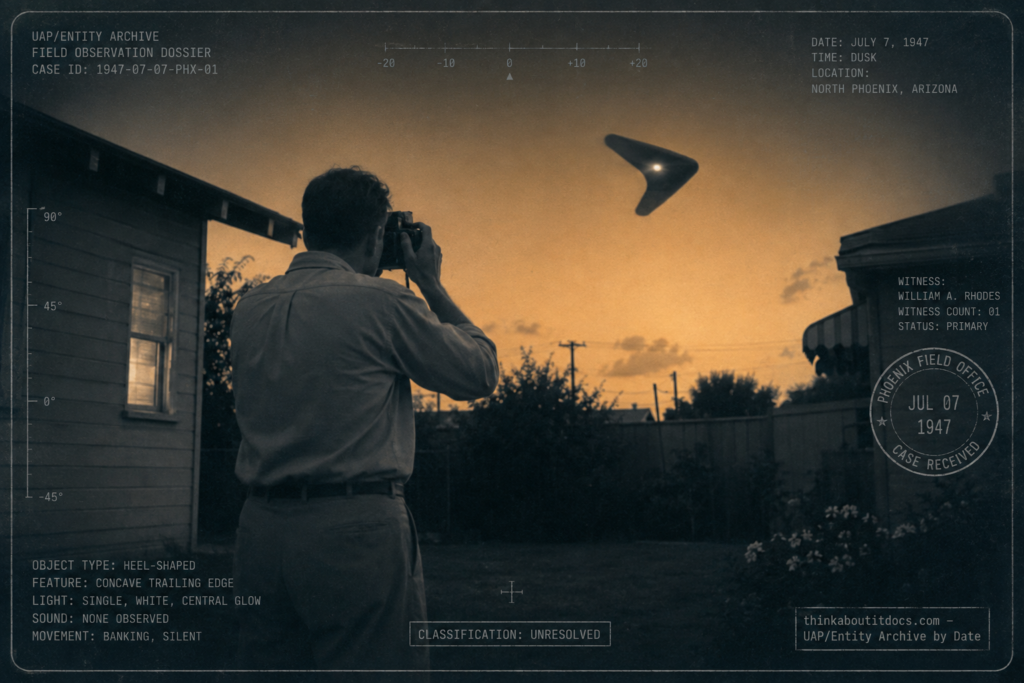
July 7, 1947 — Phoenix, Arizona. William Rhodes photographed a silent, heel-shaped object circling above his home — negatives later seized by the FBI and Army counterintelligence.
THINK ABOUTIT UFO SIGHTINGS REPORT
1947: William Rhodes and the Phoenix Photographs
A man “William Rhodes” photographed something strange over his own house in Phoenix, and within days the FBI and Army counterintelligence had confiscated his negatives. This is one of the most heavily investigated pieces of photographic evidence from the entire 1947 wave — not because of what it definitively proves, but because of how seriously the federal government treated it at the time.
Date: July 7, 1947
Sighting Time: Dusk
Day/Night: Dusk
Location: Above the witness’s home, north Phoenix, Arizona
Urban or Rural: Urban/suburban
No. of Entity(s): Not Applicable
Entity Type: Not Applicable
Entity Description: Not Applicable
Hynek Classification: DD — Daylight Disc (dusk-visible). A structured object observed and photographed at close range with distinctive maneuvering, no landing or entity involved.
Duration: Multiple minutes across three circuits
No. of Object(s): 1
Description of the Object(s): Heel-shaped, with a distinctive concave trailing edge, showing a white spot near its center in the photographs. Twin thin vapor trails were visible extending from the two points at the tips of the concave trailing edge during departure.
Shape of Object(s): Heel-shaped, concave trailing edge
Size of Object(s): Not specified
Color of Object(s): Not specified beyond the described white central spot visible in photographs
Distance to Object(s): Close enough for detailed photographic capture directly above the witness’s home
Height & Speed: Circled and banked at what appeared to be low-to-moderate altitude during observation; departed to the southwest at “phenomenal speed”
Number of Witnesses: 1 — William A. Rhodes
Special Features/Characteristics: The object approached from the west accompanied by an audible “whooshing” sound, but during its three clockwise circuits directly above Rhodes, he reported hearing no sound whatsoever — an unusual and specific acoustic detail (sound on approach, silence during close overhead maneuvering) that doesn’t fit a simple continuous-noise explanation; twin vapor trails from the trailing edge’s tip points, rather than a single central trail, is a specific and unusual structural detail; the case received direct, documented federal investigation — military intelligence extensively investigated the sighting, all prints Rhodes had made were confiscated, and Rhodes personally turned over his original negatives to FBI agents and an Army counterintelligence agent several weeks after the sighting, establishing a clear, traceable chain of official government interest and evidence seizure.
Case Status: Unexplained
Source: Phoenix Arizona Republic, July 9, 1947; San Diego (CA) Union, July 9, 1947; Los Angeles Herald-Express, July 9, 1947
Related Cases: 1947: July UFO|UAP & Entity Sightings Archive — Part1 | 1947: July UFO|UAP & Entity Sightings Archive — Part 3
Detailed Report
At dusk on July 7, 1947 — three days after Kenneth Arnold’s sighting had already made “flying saucers” a national conversation, and the same day Colonel Blanchard’s Roswell press release was still a day from being issued — William A. Rhodes, at his home north of downtown Phoenix, Arizona, spotted an unusual object approaching from the west, accompanied by an audible “whooshing” sound. Recognizing the moment for what it was, Rhodes retrieved his camera and managed to capture two, possibly three, photographs as the object circled and banked above him.
The object he photographed had a heel-like shape, with a distinctive concave trailing edge and a visible white spot near its center. Despite the audible approach, Rhodes specifically reported hearing no sound at all during the object’s three clockwise circuits directly overhead — a detail he was careful to distinguish from the initial whooshing noise. After completing its circuits, the object departed to the southwest at what Rhodes described as phenomenal speed, again without sound, leaving behind twin thin vapor trails visible from the two points at the tips of its concave trailing edge.
The photographs were published within days across multiple newspapers — the Phoenix Arizona Republic, the San Diego Union, and the Los Angeles Herald-Express all ran the story on July 9. What distinguishes this case from most photographic UFO claims of the era is what happened next: military intelligence launched an extensive investigation into the sighting. Every print Rhodes had made was confiscated. Several weeks later, Rhodes personally handed over his original negatives to FBI agents and an Army counterintelligence agent — establishing an unusually clear, documented chain of official federal interest, investigation, and physical evidence seizure, rare among 1947-era photographic cases.
RESEARCHER’S NOTES
Why the Government’s Reaction Matters as Much as the Photo
- On why this case is unusually well documented for a single-witness photograph: Most photographic UFO claims from this era survive as isolated newspaper curiosities, with no further institutional follow-up beyond initial press coverage. The Rhodes case is different specifically because of the government’s own response: a direct, traceable sequence of military intelligence investigation, confiscation of prints, and eventual FBI/Army counterintelligence collection of the original negatives constitutes independent evidence that federal authorities, at the time, treated this specific case as worth serious physical evidence-gathering — not simply worth reading about in a newspaper.
- On the significance of the confiscation itself: The government’s decision to physically seize both the prints and the original negatives is itself a data point independent of what the photographs actually show. It demonstrates that whatever official assessment was made of the case at the time, it was judged significant enough to warrant direct evidence control — a level of government engagement not extended to the vast majority of even well-documented 1947 sightings.
- On the limits of what remains verifiable today: With the original negatives having passed into federal custody in 1947, this archive — like most researchers examining the case today — is working from published newspaper reproductions rather than the original photographic material. What analysis has been possible from published copies has not conclusively resolved the object’s nature, and this report does not claim otherwise; the case remains genuinely unexplained on the evidence publicly available.
- On the sound discrepancy: Rhodes’s specific distinction between an audible approach and a silent overhead pass is a detail that resists easy dismissal as embellishment — it’s a subtler and less dramatic claim than simply “it made no sound at all,” and this kind of qualified, partial claim is generally considered a marker of careful observation rather than exaggeration.
A camera raised at the right moment, three silent circuits over a Phoenix rooftop, and then federal agents at the door weeks later asking for the negatives. Whatever William Rhodes photographed that July evening, the United States government thought it was worth taking away from him — and that alone makes this one of the most institutionally significant photographic cases of the entire 1947 wave.
 William Rhodes Photos, Phoenix, AZ, July 7, 1947
Source: the Phoenix Arizona Republic, 7/9; San Diego (CA) Union, 7/9; Los Angeles Herald-Express, 7/9