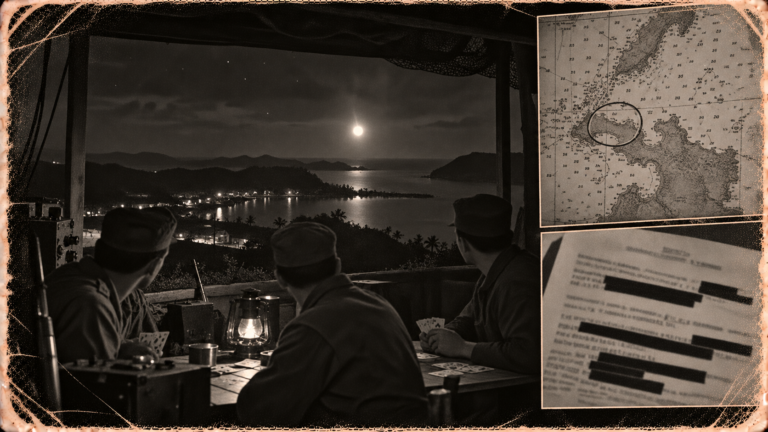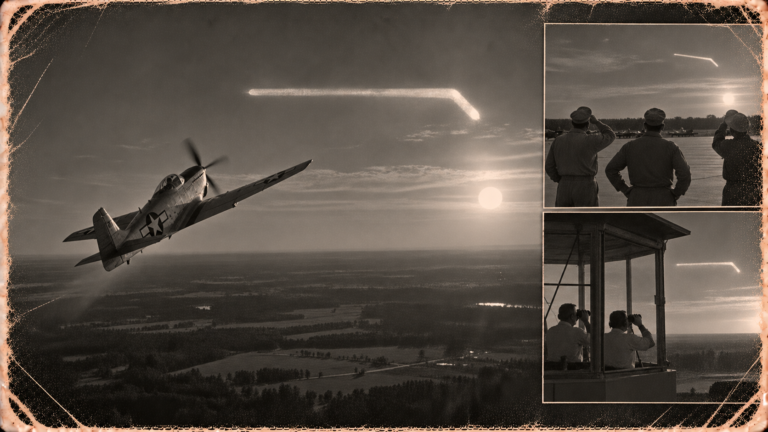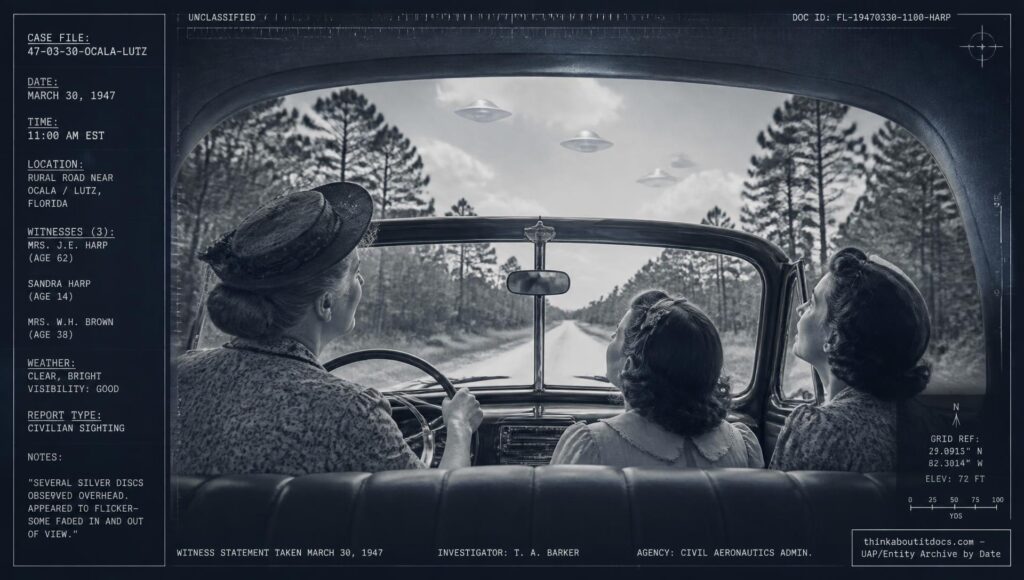
March 30, 1947 — near Ocala, Florida. Mrs. J.E. Harp, her seven-year-old daughter Sandra, and her mother watched several silvery discs flicker in and out of visibility while driving, nearly three months before Kenneth Arnold's famous sighting.
THINK ABOUTIT UFO SIGHTINGS REPORT
1947: Three Generations Near Ocala, Florida
A mother, her seven-year-old daughter, and her own mother were driving down a rural Florida road on an ordinary March morning when several silvery discs appeared overhead, flickering in and out of visibility as they moved. None of the three had time to count them, judge their size, or guess their speed — it happened too fast, and none of them expected it. This is a small case by the standards of what would come three months later, but it’s a genuine one: three named, related witnesses, documented through one of the more serious pre-Arnold research efforts in American ufology.
Date: March 30, 1947
Sighting Time: 11:00 AM
Day/Night: Day
Location: Near Ocala, in the vicinity of Lutz, Florida
Urban or Rural: Rural — a roadway between small central Florida communities
No. of Entity(s): Not Applicable
Entity Type: Not Applicable
Entity Description: Not Applicable
Hynek Classification: DD — Daylight Disc. Multiple disc-shaped objects observed in clear daylight conditions with no structural detail resolved beyond general shape and reflective quality; no landing, physical trace, or entity involved.
Duration: Brief; the witnesses’ own account specifies they did not have time to count the objects, implying a short observation window, likely under a minute
No. of Object(s): Several (exact number not determined by witnesses)
Description of the Object(s): Silvery-colored flying discs that appeared to flicker — alternately appearing and disappearing — as they moved across the sky, rather than remaining continuously visible.
Shape of Object(s): Disc-shaped
Size of Object(s): Not estimated by witnesses
Color of Object(s): Silvery
Distance to Object(s): Not estimated by witnesses
Height & Speed: Neither altitude nor speed could be estimated by the witnesses, who explicitly noted they lacked time to make any such judgment
Number of Witnesses: 3 — Mrs. J.E. Harp of Lutz, Florida; her seven-year-old daughter, Sandra; and her mother, Mrs. W.H. Brown, spanning three generations of the same family, all present in the same vehicle
Special Features/Characteristics: The “flickering,” appear-and-disappear quality of the objects’ motion is the most distinctive detail preserved in this account — a behavior pattern that recurs in other daylight disc reports of the era, sometimes attributed to objects tumbling or rotating in a way that alternately caught and lost sunlight reflection off a metallic surface; the witnesses’ own candor about the limits of their observation (no count, no size or speed estimate) is itself a point in favor of the account’s basic honesty, since an embellished or fabricated report would more plausibly include invented specifics rather than an admission of uncertainty.
Case Status: Unexplained
Source: Ted Bloecher, pre-Arnold 1947 case research
Related Cases: 1947: March UFO|UAP & Alien Sightings Archive | 1947: Three Objects Over Occupied Frankfurt (same Bloecher/Aldrich research tradition documenting the pre-Arnold period)
Detailed Report
At 11:00 in the morning on March 30, 1947, Mrs. J.E. Harp of Lutz, Florida was driving with her seven-year-old daughter, Sandra, and her own mother, Mrs. W.H. Brown, along a rural road near Ocala. All three watched as several silvery, disc-shaped objects appeared in the sky, moving in a manner that caused them to seem to flicker — alternately visible and then momentarily gone, as though catching and losing the sunlight as they moved.
By the witnesses’ own account, the sighting caught them entirely off guard. They did not have time to count how many objects were present, nor could they estimate the objects’ altitude, size, or speed. This lack of specific quantitative detail is, if anything, consistent with an unplanned, surprising observation rather than a rehearsed or embellished account — witnesses fabricating a story for attention typically supply more confident specifics, not fewer.
The case survives through the research of Ted Bloecher, whose work specifically focused on identifying and documenting sightings that occurred before Kenneth Arnold’s June 24, 1947 encounter — cases reported by witnesses with no cultural framework of “flying saucers” to shape their initial description, since the term itself would not exist for nearly three more months. Bloecher’s broader project, later published as his 1967 Report on the UFO Wave of 1947, remains a standard reference work in the field.
RESEARCHER’S NOTES
A Small, Honest Account From Before the Term Existed
- On why a modest, admittedly incomplete account carries its own kind of weight: This case will never be mistaken for one of the dramatic, richly detailed encounters elsewhere in this archive. That’s part of what makes it worth taking seriously on its own terms. The Harp family’s account contains no embellishment, no invented technical detail, and an explicit, unprompted admission that they couldn’t determine basic facts about what they saw. That pattern — a brief, startling sighting followed by honest uncertainty about the details — is exactly what a genuine unplanned observation would be expected to produce, and it stands in useful contrast to more elaborately detailed contemporaneous or later accounts that may have been shaped, consciously or not, by narrative expectation.
- On the pre-Arnold timing: Occurring nearly three months before Kenneth Arnold’s famous sighting, this case is part of a small but genuine body of American reports that predate the “flying saucer” cultural phenomenon entirely. The witnesses had no framework of media coverage, no popular vocabulary, and no reason to expect their sighting would ever be considered part of a broader pattern — they simply told Bloecher, or whoever first recorded their account, what they had seen.
- On the “flickering” detail specifically: Objects that appear to flash in and out of visibility rather than remaining steadily visible are commonly explained, in less ambiguous cases, by tumbling or rotating reflective surfaces catching sunlight intermittently — a mundane, physically plausible mechanism that doesn’t require any exotic explanation on its own. This archive notes that possibility honestly rather than treating the flickering as inherently more mysterious than a simple reflective/rotational effect would produce.
Three generations of one family, a few silvery flickers in a Florida sky, and an honest admission that they didn’t get a good enough look to say much more. It’s a small case. It’s also, by the standards this archive tries to hold itself to, exactly the kind of account that deserves to be preserved carefully rather than either dismissed for its brevity or inflated beyond what the witnesses themselves ever claimed.