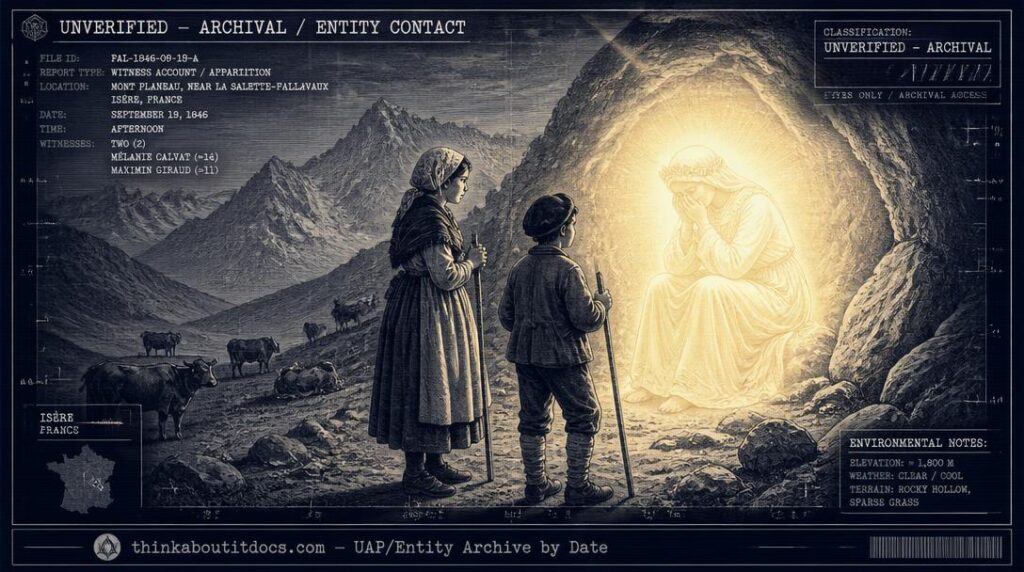
The September 19, 1846 La Salette encounter — cowherds Mélanie Calvat and Maximin Giraud met a weeping, luminous woman on Mont Planeau, an account that survived a five-year adversarial Church investigation before formal validation in 1851.
THINK ABOUTIT ENTITY ENCOUNTER REPORT
1846: La Salette, France — The Weeping Lady of Mont Planeau
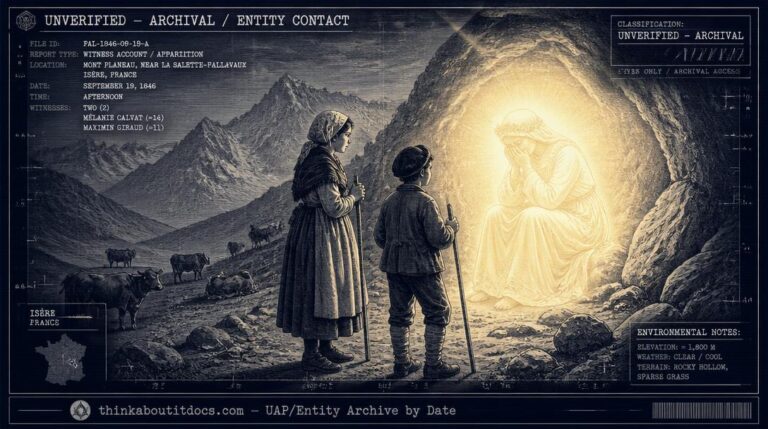
On the afternoon of September 19, 1846, two shepherd children tending cattle on the slope of Mont Planeau, high above the Alpine village of La Salette, walked into a small hollow and found what fourteen-year-old Mélanie Calvat could only describe as a fallen sun — a globe of fire so bright it looked, in her words, “as though the sun had fallen on that spot.” Within the light, seated with her elbows on her knees and her face buried in her hands, was a weeping woman. She rose, spoke to the children first in French, then switched to their own dialect of Occitan when eleven-year-old Maximin Giraud struggled to understand, delivered a warning about coming disaster tied specifically to blasphemy and the abandonment of Sunday observance, gave each child a private secret, and then climbed the hillside path, rose into the air, and dissolved into light facing southeast.
What happened next is what separates this case from almost every other contact account in this archive: the local Church did not simply accept or dismiss it. Bishop Philibert de Bruillard of Grenoble opened a formal five-year investigation — interviewing, cross-examining, and separately re-interrogating both children repeatedly, searching for inconsistencies. On September 19, 1851, exactly five years to the day after the encounter, he issued a pastoral letter declaring the apparition worthy of belief. It remains one of the only anomalous contact cases in this entire archive to have undergone a sustained, adversarial, multi-year institutional investigation and come out the other side formally validated by the investigating body itself.
Date: September 19, 1846
Sighting Time: Afternoon
Day/Night: Day
Location: Mont Planeau, near La Salette-Fallavaux, Isère, France (French Alps)
Urban or Rural: Rural — remote Alpine pasture, approximately 1,800 meters elevation
No. of Entity(‘s): One
Entity Type: Humanoid — luminous adult female figure
Entity Description: A weeping woman seated with elbows on knees and face in hands, enclosed within a bright globe of light; on rising, described as wearing a white robe studded with pearls, a gold-colored apron, white shoes surrounded by roses, a high headdress, and a crucifix on a necklace; spoke first in French, then switched to the children’s Occitan dialect
Hynek Classification: Not Applicable — non-craft entity contact, outside the standard Hynek close encounter scale
Duration: Not precisely timed — encompassed the initial sighting, the figure’s approach and address to the children, delivery of a message and private secrets to each child individually, and a final ascent and dissolution into light
No. of Object(s): One — the globe of fire/light enclosing the figure at first sighting
Description of the Object(s): A globe of intense light, described as though the sun itself had fallen to that spot on the mountainside, within which the figure was first perceived seated
Shape of Object(s): Spherical / globe
Size of Object(s): Not precisely measured — described as filling a small hollow in the terrain
Color of Object(s): Intensely bright, sun-like
Distance to Object(s): Close range — the children approached and eventually stood very close to the figure after she called them nearer
Height & Speed: The figure rose from a seated position, walked up the hillside path ahead of the children, then rose into the air and moved off facing southeast before dissolving into light
Number of Witnesses: Two — Mélanie Calvat (14) and Maximin Giraud (11)
Special Features/Characteristics: Entity wept continuously while speaking; delivered specific, dated predictive/warning content tied to social and religious conditions; gave each child an individual private message not disclosed to the other; entity switched languages mid-address to ensure comprehension; ascent and dissolution into light rather than a walking departure; subject to a formal five-year adversarial Church investigation before institutional validation
Case Status: Unexplained.
Source: Testimony of Mélanie Calvat and Maximin Giraud, written down the day following the event and signed by the visionaries and witnesses who heard the account; Bishop Philibert de Bruillard’s pastoral letter of September 19, 1851, Diocese of Grenoble; Mélanie Calvat’s later written testimony (1878), published with ecclesiastical Imprimatur in 1879
Summary/Description: On September 19, 1846, cowherds Mélanie Calvat, 14, and Maximin Giraud, 11, encountered a weeping, luminous woman seated within a globe of light on Mont Planeau above La Salette in the French Alps. The figure rose, called the children closer, and delivered a message warning of coming disaster — famine and hardship — tied to the desecration of Sunday and blasphemy among the local population, a concern shared at the time by regional clergy including the Curé of Ars. She gave each child a private secret individually, then ascended the hillside path, rose into the air, and dissolved into light. The parish priest declared the figure the Blessed Virgin; Bishop Philibert de Bruillard of Grenoble opened a formal investigation that ran five years, repeatedly cross-examining both children separately, before issuing a pastoral letter on September 19, 1851 declaring the apparition worthy of belief. Mélanie later entered religious life and continued to report revelations; pilgrimages to the site began following the investigation’s conclusion.
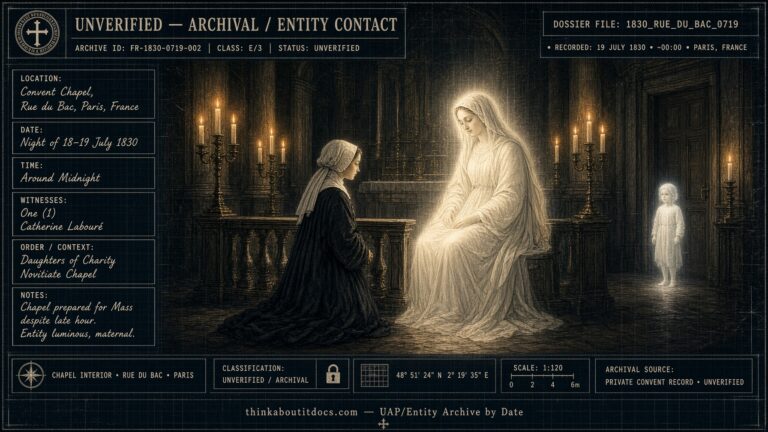
Related Cases: 1845–1849: UFO|UAP & Entity Sightings Archive | 1830 Paris, France — Catherine Labouré Rue du Bac Contact
Detailed Report
On Saturday, September 19, 1846, Mélanie Calvat, nearly fifteen, and Maximin Giraud, eleven, both from the nearby town of Corps, were watching their herds on the slope of Mont Planeau, roughly 1,800 meters in elevation, not far from the village of La Salette. In a small hollow of ground, they suddenly noticed a globe of fire — Mélanie later described it as though the sun had fallen precisely on that spot. As their eyes adjusted, they gradually made out, within the dazzling light, a seated woman, her elbows resting on her knees, her face buried in her hands, weeping.
The figure rose and spoke to the children in French: “Come closer, my children; don’t be afraid. I am here to tell you great news.” She took several steps toward them; reassured, the children ran down and stood very close to her. She continued speaking while weeping throughout — first delivering her core message in French, then, apparently noting the children’s difficulty following her, repeating herself in their own dialect of Occitan.
Her message centered on the desecration of Sunday and blasphemous swearing among the local population — concerns that regional clergy, including the Curé of Ars, were independently raising in sermons at the same period — and warned that without a change in behavior, disaster and famine would follow. She gave each child a private secret individually, told to neither the other child nor, initially, to anyone else; these secrets were not written down and submitted to the Vatican until 1851, at the Virgin’s own reported instruction that they remain confidential until that year. She concluded by instructing the children: “Well, my children, you will make this known to all my people.” The figure then climbed the steep path toward a rise called the Collet; as the children caught up to her, she rose into the air, looked up to the sky and down to the earth, and, facing southeast, dissolved into the light, which itself then vanished.
The children’s account was written down and signed the following day by the visionaries and those who heard their initial report. The parish priest declared the figure to be the Blessed Virgin Mary. Bishop Philibert de Bruillard of Grenoble, initially cautious, was reportedly convinced of the apparition’s reality by November 1846, but did not issue a formal ruling until he had conducted what contemporary accounts describe as a rigorous five-year investigation — interviewing the children repeatedly and separately over the intervening years, testing their accounts for consistency, and examining the content and consequences of the message itself. On September 19, 1851, exactly five years to the day after the encounter, de Bruillard issued a pastoral letter formally declaring the apparition “worthy of belief.” Maximin later entered seminary studies (though was later dismissed amid later controversy); Mélanie entered the Convent of the Sisters of Providence at Corenc in 1850 and took her vows in 1853, continuing to report further revelations for the rest of her life. The children’s original 1851 secret letters to Pope Pius IX, long thought lost or embellished in later retellings, were rediscovered in the Vatican archives in 1999.
RESEARCHER’S NOTES
The Weeping Lady of Mont Planeau — France 1846 and the Only Adversarial Investigation in This Archive
- Classification Issues: Filed as an entity encounter with no craft component, consistent with this archive’s treatment of visionary/contact cases (compare Joseph Smith’s 1820/1823 visitations and Catherine Labouré’s 1830 Rue du Bac contact elsewhere in this archive). Catalogued here as a documented anomalous contact event with specific predictive and behavioral content, not as a matter of religious doctrine, which is outside this archive’s scope.
- Source Chain Assessment: This case has the single strongest institutional verification process of any contact event in this archive. Most 19th-century entity encounters here survive as a single witness account, a newspaper clipping, or a folkloric retelling recorded decades later. La Salette instead has: a written, signed account taken the day after the event; two child witnesses cross-examined repeatedly and independently over five full years by a bishop specifically tasked with finding inconsistencies; and a formal, dated, published institutional ruling from the investigating body itself. The 1999 discovery of the children’s original 1851 letters in the Vatican archives — which turned out to be considerably shorter and less elaborate than later published versions of their “secrets” — is itself a useful reminder that even well-investigated testimony accretes embellishment in later retellings, and that the earliest written record is the one to weight most heavily.
- Pattern Context: This case shares a specific structural signature with Catherine Labouré’s 1830 Paris contact sixteen years earlier: a luminous adult female entity, specific and socially/politically dated warning content, and formal Church validation following institutional scrutiny. Unlike Labouré’s case, where the predictive content (an “overturned throne”) resolved within nine days, La Salette’s warnings were broader and less immediately falsifiable — worth noting as a difference in evidentiary weight between the two otherwise structurally similar cases.
- Geographic and Historical Context: Post-Revolutionary rural France in the 1840s had seen a marked decline in religious practice — irregular Mass attendance, casual profanation of Sunday, and habitual blasphemous swearing were widely lamented by contemporary clergy independent of this case, meaning the entity’s specific complaints matched concerns already circulating in regional sermons before the encounter, which is worth weighing alongside the apparition’s content rather than treating the message as arriving in a social vacuum.
Two shepherd children walked into a hollow on an Alpine hillside and found a weeping woman inside a fallen sun. What makes La Salette different from nearly every other case in this archive isn’t the encounter itself — luminous humanoid contact events recur throughout this record — but what happened afterward: a bishop who spent five years trying to break the children’s story, and couldn’t. Whatever occurred on Mont Planeau that September afternoon, it survived the most rigorous contemporaneous cross-examination this archive has on record.
“Come closer, my children; don’t be afraid. I am here to tell you great news.”