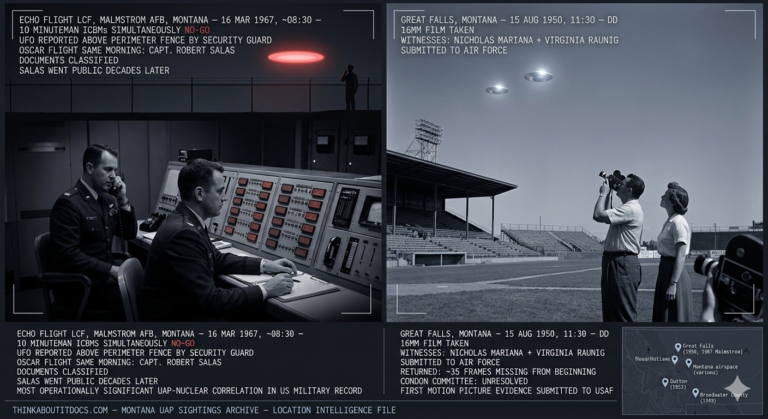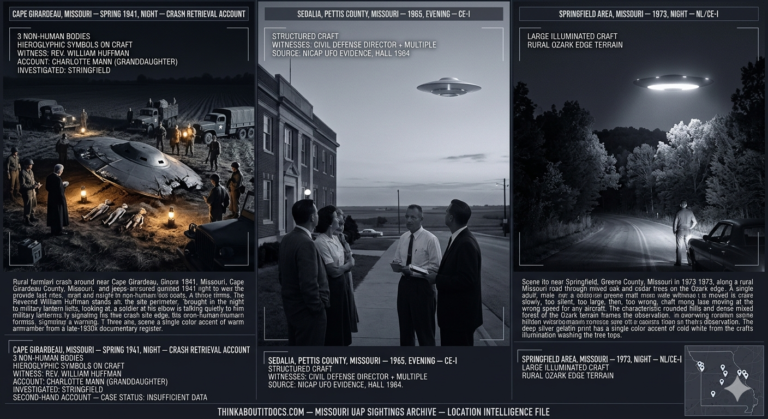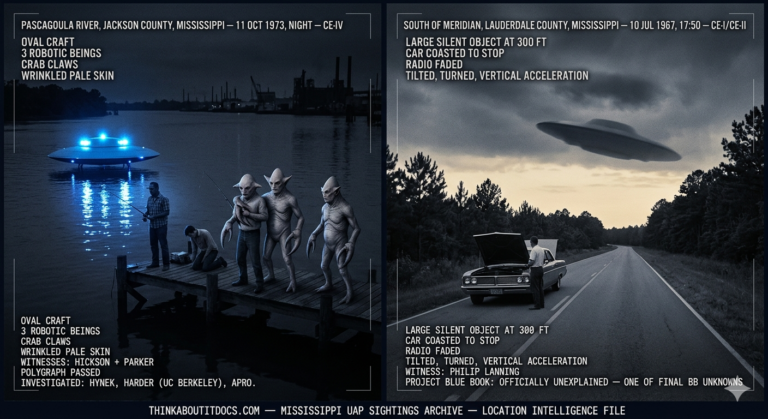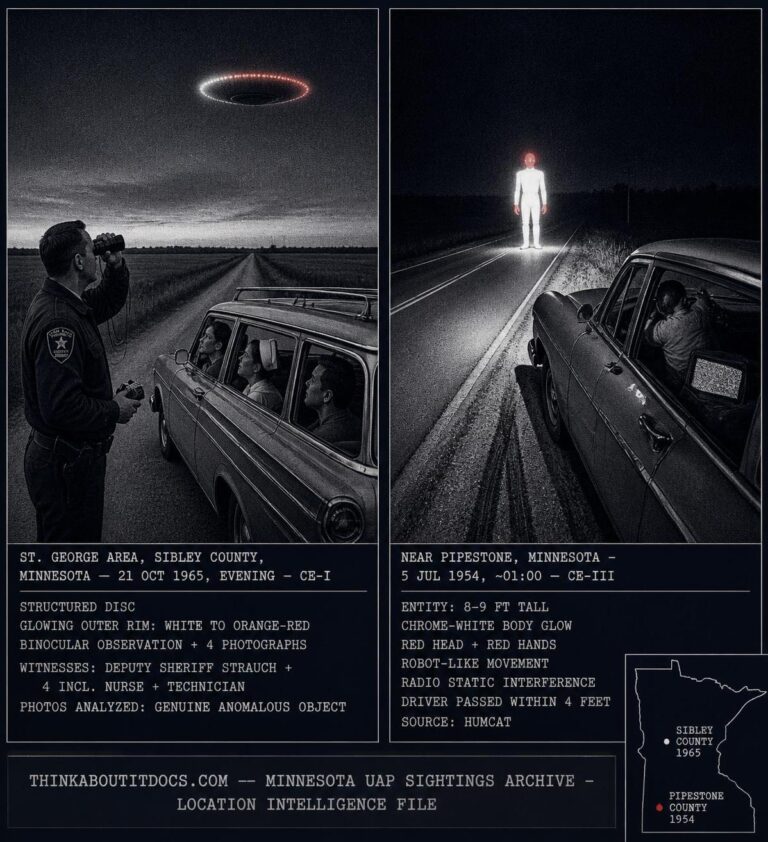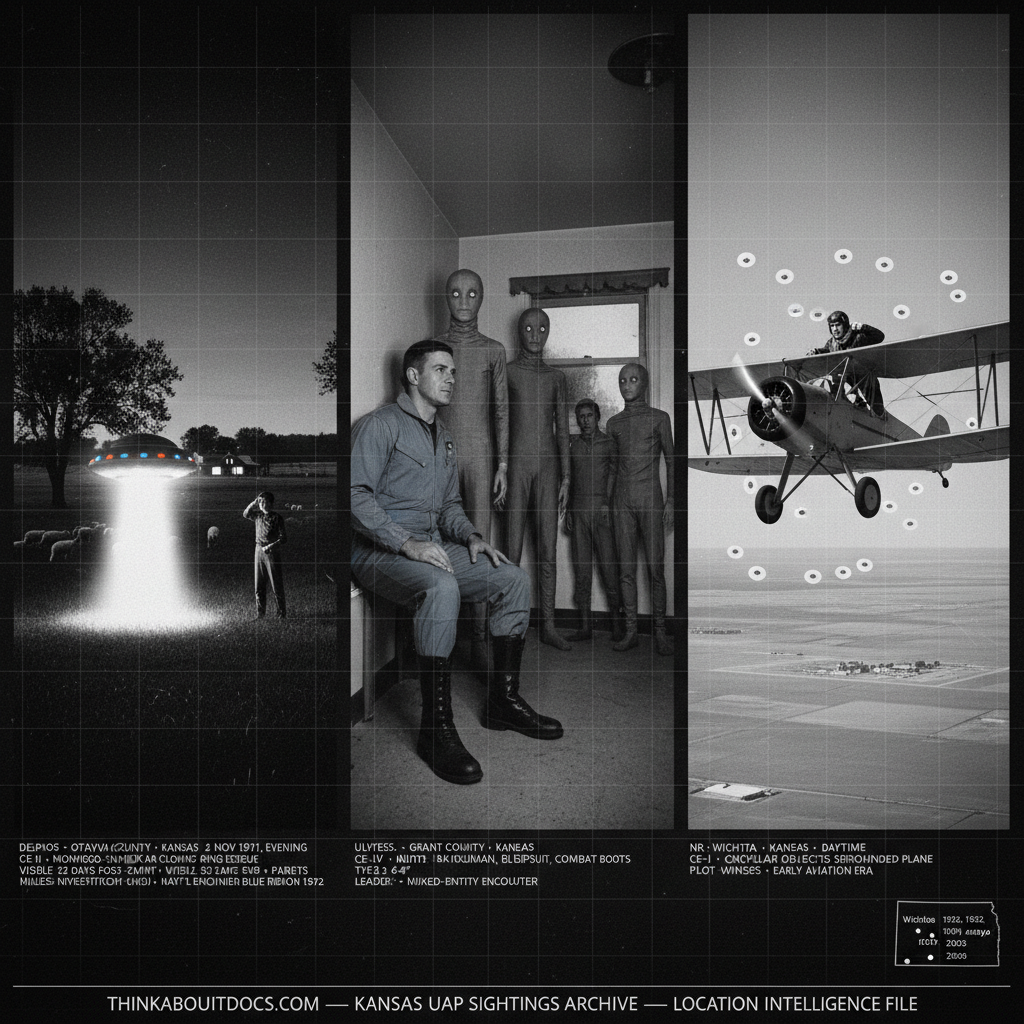
Kansas UAP archive: Delphos November 1971 landing ring with numbness-causing glowing residue, 32-day persistence, anomalous chemical analysis (Ted Phillips physical trace investigation, National Enquirer Blue Ribbon 1972), Ulysses 1982 mixed-entity abduction with near-human and cat-eyed gray-skinned beings, and January 1926 multiple circular objects surrounding plane near Wichita. 9 documented cases.
Kansas UFO|UAP & Alien Sightings Archive
Kansas’s UAP archive is defined by one of the most chemically documented physical trace cases in the entire national record. On November 2, 1971, sixteen-year-old Ronald Johnson was tending sheep at his family’s farm near Delphos, north-central Kansas, when a mushroom-shaped object approximately eight feet in diameter with red, blue, and orange lights appeared hovering about five feet above the ground near a copse of trees. It emitted a blinding glow from its underside and rocketed away with a high-pitched whine. Ronald’s parents caught a glimpse of it departing. When the family examined the spot where the object had hovered, they found a glowing ring on the ground and glowing material on nearby trees. Mrs. Johnson touched the glowing residue — it had a crust-like texture — and her fingers immediately went numb. She tried to wipe the material on her leg, and the numbness transferred. Her fingers remained slightly numb for approximately two weeks. The ring was photographed immediately, the newspaper was called, and thirty-two days later when physical trace specialist Ted Phillips examined the site, the ring was still clearly visible. Laboratory analysis found the ring soil to contain a high zinc concentration, hydrocarbons consistent with insecticide solvent or diesel fuel, and material that made the soil hydrophobic — water simply ran off rather than absorbing. The Delphos case won the National Enquirer’s Blue Ribbon Panel award for best physical evidence UFO case in 1972 and remains one of the most thoroughly chemically analyzed landing trace cases in the research record.
Against this physical evidence anchor, Kansas carries a structurally distinct entity case: the 1982 Ulysses abduction in western Kansas, in which the witness encountered multiple entity types in a single event — one near-human figure in a blue-gray jumpsuit and black combat boots, three extremely tall smooth gray-skinned beings with cat-like vertical-pupil eyes in tight gray hooded suits. The mixed-entity-type encounter, with its specific clothing and physical detail, places the Ulysses case in the analytical category of cases whose specificity resists easy fabrication. The 1926 circular objects surrounding a plane near Wichita adds a pre-modern aviation encounter to the state’s record, and the 1967 Wichita capsule photograph documents one of the Kansas record’s few pre-modern photographic cases. The wide-open skies and flat agricultural terrain of the Great Plains make Kansas one of the most observationally clear states in the country — objects at any altitude are visible from extraordinary distances, and misidentification of distant conventional aircraft is structurally less likely than in terrain with occluding features.
- 1926: Several Circular Objects Surrounded Plane
- 1952: ‘Figures’ seen in windows of oval-shaped object (William Squyres, Pittsburg, Kansas)
- 1967: Capsule-shaped Object Photographed by Jefferson Villar
- 1971: Delphos, Kansas Landing Ring
- 1982: Ulysses Kansas Abduction
- 2002?: Prairie Village, Kansas Hovering Triangle
- 2005: Dark Object Over North Kansas, Kansas
- 2006: Barbell-shaped object near Wakeeney, Kansas
Executive Summary
Delphos and the Chemical Record — Kansas’s Physical Evidence Anchor
Kansas’s UAP archive is defined by physical chemistry. The Delphos ring is the most thoroughly laboratory-analyzed landing trace in the American state-level record: a glowing residue that caused dermal numbness on contact, persisted as a visible ground feature for thirty-two days post-event, and produced multiple anomalous chemical findings — zinc concentration, hydrocarbons, hydrophobic soil treatment — that have never been satisfactorily attributed to any natural or conventional process. The case was investigated by Ted Phillips, who specializes in physical trace cases and has catalogued more such cases than any other researcher in the field. The Delphos ring meets the minimum physical evidence standard that most UAP cases cannot — the evidence was there, it was photographed, it was examined by a specialist, and it produced laboratory results that require explanation. The Ulysses 1982 entity encounter adds the most morphologically specific entity description in the Kansas record — three smooth gray-skinned cat-eyed beings in tight gray hooded suits alongside one near-human figure in a blue-gray jumpsuit and combat boots, a mixed-type encounter that the research literature has not been able to attribute to cultural contamination of any specific source. Kansas’s nine cases span from 1926 to the early 2000s across the Great Plains landscape from the western high desert to the Kansas City suburban corridor.