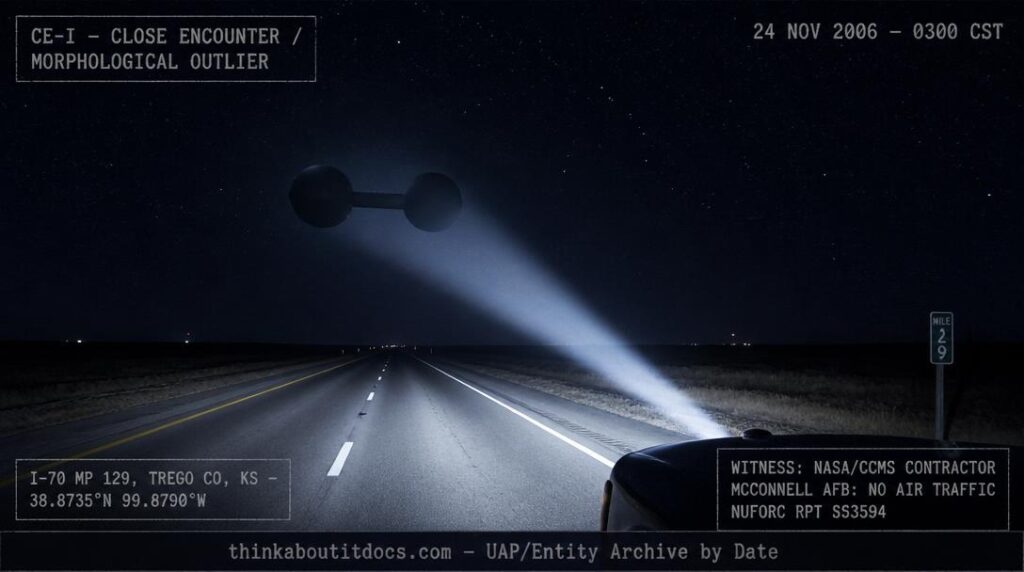
Two twenty-foot spheres connected by a rectangular link passed at 35 feet AGL — the witness's high-beam headlights partially died on the craft's surface instead of reflecting back.
THINK ABOUTIT UFO|UAP SIGHTINGS REPORT
2006: Barbell-shaped object near Wakeeney, Kansas
At three o’clock in the morning on November 24, 2006, a driver with NASA contractor and military electronics credentials was eastbound on Interstate 70 near milepost 129 near Wakeeney, in Trego County, Kansas when a barbell-shaped object — two spheres approximately twenty feet in diameter connected by a rectangular device — passed his vehicle at an estimated combined closing speed of 175 miles per hour, roughly thirty-five feet above the ground and thirty-five to fifty feet to the side of his car. The encounter lasted approximately six seconds. The witness’s high-beam headlights partially illuminated the object, with some of the light appearing to be absorbed by the craft’s surface. No color, portholes, antennas, doors, or protrusions of any kind were visible. The witness immediately contacted McConnell Air Force Base, which confirmed no military or civilian air traffic in the area, and the Trego County Sheriff’s Department, which found no other reports but recorded the witness’s account.
Date: November 24, 2006
Sighting Time: Approximately 3:00 AM CST
Day/Night: Night
Location: Interstate 70 near milepost 129, Trego County, Kansas (near WaKeeney)
Urban or Rural: Rural — open western Kansas highway
Hynek Classification: CE-I (Close Encounter I) — object observed at approximately 35 feet above ground level and 35–50 feet horizontal distance from the witness’s vehicle. Classification correct as given on the original page.
Duration: Approximately 6 seconds
No. of Object(s): 1
Description of the Object(s): Two spheres approximately twenty feet in diameter each, connected by a rectangular device of unknown dimensions. No discernible color. No portholes, antennas, doors, openings, or protrusions visible. Headlights partially absorbed by the craft’s surface while partially illuminating it.
Shape of Object(s): Barbell — two spheres connected by a rectangular link
Size of Object(s): Each sphere approximately 20 feet in diameter; total structure significantly larger
Color of Object(s): No discernible color — headlights partially absorbed, partially reflected
Distance to Object(s): Approximately 35–50 feet horizontally; 35 feet above ground level
Height & Speed: Estimated 35 feet AGL; estimated craft speed approximately 100 mph (combined closing speed with witness’s 75 mph = approximately 175 mph)
Number of Witnesses: 1
Special Features/Characteristics: Light absorption — the witness’s high-beam headlights were partially absorbed by the craft’s surface rather than reflecting normally. Morphological outlier — the barbell configuration (two spheres connected by a rectangular link) does not match any standard UAP morphology or known aircraft type. Featureless surface — no openings, markings, control surfaces, or protrusions of any kind despite very close observation distance. Immediate military verification — witness contacted McConnell AFB Command Post directly; no military or civilian air traffic confirmed in the area. Law enforcement contact — Trego County Sheriff’s Department logged the report and found the witness credible.
Case Status: Insufficient Data
Source: NUFORC (National UFO Reporting Center), Peter Davenport, Director. Original NUFORC Report
Summary/Description: A witness with NASA contractor experience and electronics expertise observed a barbell-shaped object — two twenty-foot spheres connected by a rectangular device — at approximately 35 feet AGL and 35–50 feet horizontal distance from his vehicle on I-70 near WaKeeney, Kansas at 3:00 AM on November 24, 2006. The object was featureless and partially absorbed headlight. The witness immediately contacted McConnell AFB and the Trego County Sheriff, both of which confirmed no known air traffic. NUFORC report filed through Peter Davenport.
Detailed Report
The witness was driving eastbound on Interstate 70 through western Kansas in the early morning hours of November 24, 2006 — the day after Thanksgiving. The location was near milepost 129, within Trego County, approximately at the WaKeeney exit. The Kansas plains at this longitude are flat, sparsely populated, and dark at three o’clock in the morning. The witness was driving at 75 miles per hour with his high-beam headlights on.
An object appeared in his field of view through the windshield at an angle between 30 and 45 degrees above horizontal. As the closing distance narrowed rapidly, the object resolved into a structure he described as barbell-shaped: two spheres, each approximately twenty feet in diameter, connected to each other by a rectangular device of undetermined dimensions. The object was traveling in the opposite direction (westbound) at what the witness estimated to be approximately 100 miles per hour, creating a combined closing speed of roughly 175 miles per hour.
At closest approach, the object was approximately 35 feet above ground level and 35 to 50 feet to the side of his vehicle. Despite this extremely close observation distance — well within the range of high-beam headlight illumination — the witness could not identify any color on the craft. His headlights produced an unusual effect: part of the light field appeared to be absorbed by the craft’s surface, while the remainder simply illuminated the object without producing a normal reflective return. No portholes, antennas, doors, openings, seams, or protrusions of any kind were visible. The encounter lasted approximately six seconds.
The witness’s first action after the encounter was to telephone the McConnell Air Force Base Command Post in Wichita, Kansas, and inquire about any military air traffic in the area — including medevac flights, helicopters, or fixed-wing aircraft from the known military inventory. The airman at the command post reported no military traffic and volunteered that no civilian air traffic was aloft at that time and location either. The witness then contacted a sergeant at the Trego County Sheriff’s Department, who checked communication traffic logs from the relevant time period and found no other reports. The sergeant was described as “very interested” and regarded the witness as credible.
The witness described his professional background in detail. He had worked for one year as a NASA contractor on the Checkout, Control and Monitoring Subsystems (CCMS) program for the Space Shuttle Mobile Launch Pad in the early 1980s, where he designed and tested electronics for systems that handled all data from the Orbiter and astronauts, transmitting it to Mission Control and the Firing Room at Kennedy Space Center. His experience included building initial prototypes, debugging equipment with design engineers, and revising the Approved Parts Lists — engineering documents distributed to all NASA facilities and contractors working with CCMS/Orbiter projects. He subsequently worked as an electronics technician and field service engineer for a large electronics firm in both the United States and Canada. He was also a licensed amateur (ham) radio operator, a self-described backyard astronomy enthusiast, and an ordained minister with a Doctor of Divinity degree.
The witness stated his willingness to testify under oath that the report was true, correct, and complete. The report was filed with NUFORC through Peter Davenport.
Researcher’s Notes
The I-70 Barbell — WaKeeney 2006 and the Morphological Outlier Problem
- Morphological Anomaly — No Pattern Match: The barbell configuration — two spheres connected by a rectangular link — does not correspond to any standard UAP morphology in the literature. Discs, triangles, cylinders, spheres, eggs, and boomerangs each have substantial case histories with recurring structural details. A barbell has almost none. The shape also does not match any known aircraft, drone, balloon, or atmospheric phenomenon. This cuts both ways: the uniqueness makes the observation harder to dismiss as a misidentification of a conventional object, but it also means there is no corroborating body of similar reports to establish the form as a recurring phenomenon. A single observation of a novel shape, however detailed, remains an isolated data point.
- Light Absorption — A Recurring Anomaly: The witness’s report that his high-beam headlights were “partially absorbed” by the craft’s surface is a detail worth flagging. This is not a standard reflection, scattering, or matte-surface effect — the witness, an electronics professional, distinguished between the portion of the light field that illuminated the object and the portion that appeared to be absorbed. Similar light-absorption or light-suppression reports appear in other cases in the archive, including the 2007 Bowdoinham, Maine triangle (where corner lights of high-beam intensity failed to illuminate the surrounding trees or the craft’s own underside). Whether these reports describe an actual engineered surface property (stealth coating, metamaterial, active light management) or a perceptual artifact of observing an unfamiliar object under unusual conditions cannot be determined from witness testimony alone.
- Witness Credibility — Unusually Strong Indicators: This case benefits from a witness whose credentials are specific, detailed, and in principle verifiable. NASA contractor work on CCMS for the Space Shuttle program, electronics field service engineering across two countries, ham radio licensure, and backyard astronomy experience all suggest a technically trained observer comfortable with estimating distances, speeds, angles, and physical characteristics. More importantly, the witness’s immediate post-encounter behavior — contacting McConnell AFB Command Post and the Trego County Sheriff within minutes, not days or weeks — is the mark of someone treating the observation as a serious anomalous event requiring official documentation. The military confirmation of no air traffic in the area and the sheriff’s positive credibility assessment are not evidence of what the object was, but they are evidence of what it was not (known military or civilian aircraft). The willingness to testify under oath, while not proof of accuracy, represents a higher commitment threshold than a typical NUFORC filing.
- Limitations — Six Seconds and One Witness: Despite the strong credibility indicators, the case has irreducible structural limitations. The encounter lasted six seconds at a combined closing speed of 175 miles per hour — a fleeting observation that occurred at 3:00 AM through a moving vehicle’s windshield. There is one witness. There is no photographic evidence, no radar data, no physical trace. The size estimates (20-foot spheres, 35 feet AGL, 35–50 feet horizontal) are reasonable given the witness’s technical background but cannot be independently verified. A six-second nighttime observation of an object illuminated only by headlights — even at close range, even by a trained observer — is a thin evidential basis for anything beyond “something anomalous was observed.” The case is classified Insufficient Data not because the witness lacks credibility, but because the observation itself was too brief and too singular to support stronger conclusions.
The WaKeeney barbell is a well-reported, credibly witnessed observation of a genuinely anomalous morphological form — but six seconds and one pair of eyes, however well-trained, cannot carry a case beyond the preliminary stage.