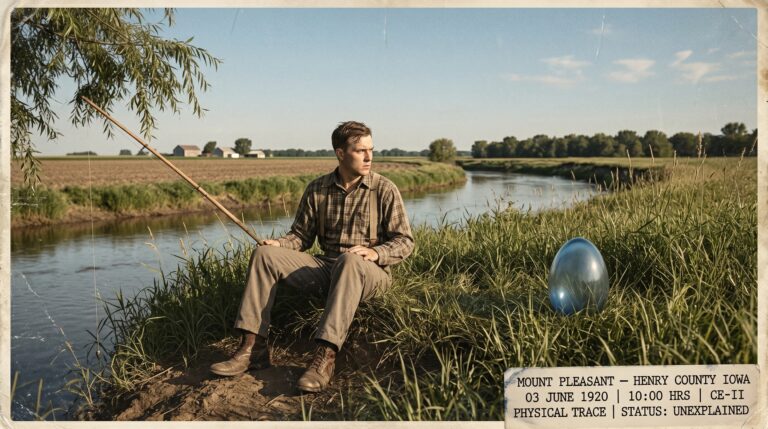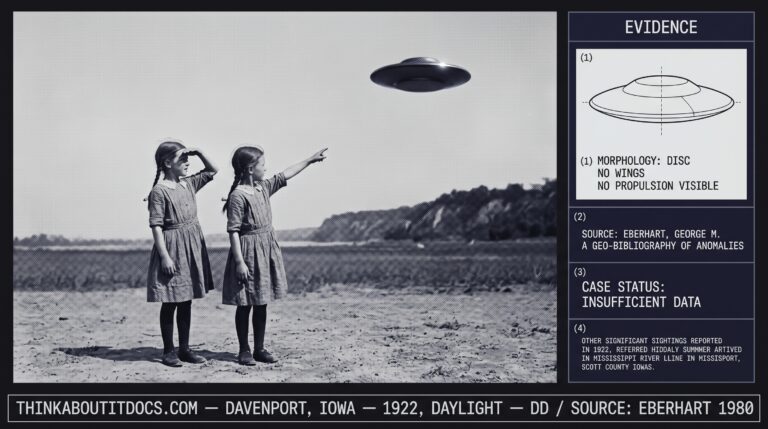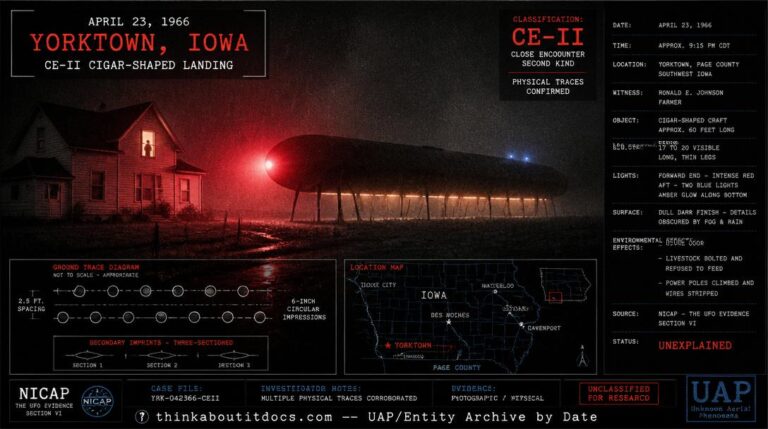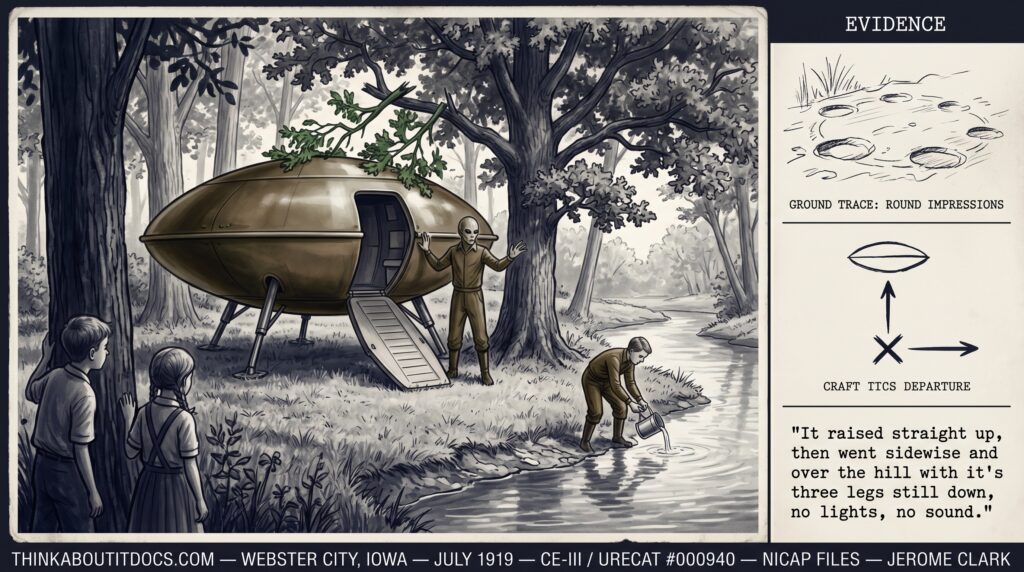
Webster City, Hamilton County, Iowa — July 1919, 11:00 AM. Two children observe a brown-green craft with two humanoid occupants: tall figure at deployed door protesting, shorter figure collecting creek water in tin can. Silent vertical departure on three legs, tree branches broken at ascent point, round cane-mark soil impressions at landing site. Source: NICAP files; Jerome Clark, Strange Magazine #10; URECAT Case #000940.
THINK ABOUTIT UFO | UAP | ENTITY | ENCOUNTER REPORT
1919: WEBSTER CITY, IOWA CE-III
On a summer morning in July 1919, a brother and sister playing near a farm creek in Webster City, Iowa heard what sounded like sparrows feeding — a chirping that was wrong in a way neither child could immediately name. When they turned, seventy-five feet away beneath a tree at the creek bank, a brown-green object sat on the ground with its door lowered and steps deployed. The tall, stern figure standing in the doorway was not looking at them. He was looking at his shorter companion, who was already running fast toward the water — too fast — and who would scoop creek water in something resembling a small tin can despite the audible protests of the figure in the door. Within seconds the door slammed shut with a metallic clang, the craft rose straight up without a sound and struck the tree branches overhead, and was gone. When the children returned to the landing site, the soil where the craft had stood was covered in a wide area of round impressions resembling cane marks, and three legs had been down the whole time — still deployed on departure, still there when the craft went sideways and over the hill and out of sight. The year was 1919. There was no cultural framework for any of it.
Date: July 1919
Sighting Time: 11:00 AM
Day/Night: Day
Location: Webster City, Hamilton County, Iowa, USA
Urban or Rural: Rural — near a farm creek
No. of Entity(‘s): 2
Entity Type: Humanoid
Entity Description: Two humanoid figures in close-fitting brown-green clothing. Figure 1: tall, stern-looking, standing at the lowered doorway making strange guttural sounds directed at Figure 2. Figure 2: shorter than Figure 1, identical brown-green clothing, ran at very high speed to the creek and scooped water into a small tin-can-like container approximately the size of a soup can. Figure 1 verbally protested the water collection. Figure 2 collected the water regardless. Figure 1 then helped Figure 2 back into the craft and slammed the door shut with a metallic sound. No facial details reported. No skin color reported.
Hynek Classification: CE-III
Duration: Brief — minutes from initial observation to departure
No. of Object(s): 1
Description of the Object(s): Brown-green craft resting beneath a tree near a creek, door lowered to the ground with steps deployed, three landing legs extended into the soil. No motor sound at any point during the encounter or departure.
Shape of Object(s): Not fully described — door with deployed steps implies a vertical entry hatch; three legs indicate tripod landing gear configuration
Size of Object(s): Door height sufficient for a tall humanoid figure to stand in; craft top struck overhead tree branches during vertical ascent
Color of Object(s): Brown-green
Distance to Object(s): Approximately 75 feet at initial observation; children ran toward it before stopping
Height & Speed: Ascent straight up, very fast, no sound; craft then moved sideways and over the hill, rapidly out of sight
Number of Witnesses: 2 — a brother and sister, children
Special Features/Characteristics: Initial sound resembling sparrows feeding or chirping; door lowered to ground with steps deployed on arrival; guttural vocalizations from tall figure; water collection behavior by shorter figure using tin-can container; metallic door slam on departure; silent vertical ascent with no motor sound; three legs remained deployed throughout departure sequence; ground traces — round impressions resembling cane marks distributed across a wide soil area at landing site; broken tree branches at ascent point above craft
Case Status: Unexplained
Source: NICAP files; Clark, Jerome, Strange Magazine #10; Rosales, Albert, Humanoid Encounters catalogue (pre-1947 volume); URECAT Case #000940 (Patrick Gross, ufologie.patrickgross.org)
Summary/Description: In July 1919 at 11:00 AM, a young brother and sister playing near a farm creek in Webster City, Iowa heard a chirping sound resembling feeding sparrows. Turning toward the source approximately 75 feet away, they observed a brown-green craft resting beneath a tree near the creek with its door lowered to the ground and steps deployed. A tall stern figure in brown-green clothing stood in the doorway making guttural sounds directed at a shorter companion. The shorter figure was running at very high speed toward the stream, where it scooped water into a small tin-can-like container. The taller figure vocally protested the water collection. The shorter figure collected the water regardless. The taller figure then helped the shorter one back into the craft, slammed the door shut with a metallic sound, and the craft rose straight up very fast, striking tree branches at the top of its ascent. Three legs remained deployed throughout. No motor sound was heard at any point. The craft then moved sideways and departed over the hill, rapidly disappearing from view. The children followed up the hill but lost sight of it. Returning to the landing site, they found a wide area of the soil covered in round impressions resembling cane marks. The sister later wrote a detailed account preserved in NICAP files and subsequently catalogued by Jerome Clark in Strange Magazine #10 and Albert Rosales in his pre-1947 humanoid encounters catalogue. URECAT Case #000940.
Related Cases: 1906: Mitchell, South Dakota — airship crew observed collecting water from horse trough (HUMCAT) | 1919: Barron, Wisconsin — twenty bald humanoid entities on moonlit road (Jerome Clark) | 1920: Mattawa River, Ontario — Albert Coe tripod disc encounter (Timothy Good) | 1919: Central NSW, Australia — entity working on craft, witness knocked unconscious (Jerome Clark).
DETAILED REPORT
The Webster City, Iowa encounter of July 1919 is one of the most analytically significant CE-III cases in the pre-1947 record, and its significance rests on a specific evidentiary quality that few reports from the era can match: the behavioral specificity of the occupant activity. The events as recorded in the sister’s written account — preserved in NICAP files and subsequently catalogued by Jerome Clark in Strange Magazine #10 — are not a description of lights or shapes at a distance. They are a close-range observation of two entities engaged in a specific, purposeful task, interrupted by the witnesses’ approach, completing the task over the vocal objection of the taller figure, and departing in a controlled sequence with physical traces left behind.
The setting was a farm creek bottom in Hamilton County, Iowa — a landscape of hardwood gallery forest along a stream, open farm fields above the creek bank. The time was 11:00 AM, full summer daylight. The two child witnesses were playing in the farm area when they heard what the sister later described as a chirping sound resembling sparrows feeding. This initial auditory signal — wrong enough to draw attention, familiar enough to initially misidentify — is consistent with a small category of pre-1947 approach sounds in entity encounter cases.
At approximately 75 feet, the children turned and saw a brown-green object beneath a tree near the creek. The door was already lowered to the ground with steps deployed, suggesting the craft had been on the ground for some time before the children noticed it. The tall figure standing in the door was stern-looking and making guttural sounds — not toward the children, who had not yet been noticed, but toward his companion. The shorter figure was already running toward the stream at high speed.
The sister’s account is precise on the water collection detail: the shorter figure ran very fast and scooped water from the stream into something resembling a tin can approximately the size of a small soup can. The taller figure’s protests were explicit enough that the sister recorded them as a distinct behavioral event — an argument between the two entities over the water collection. The shorter figure collected the water regardless of the objection. This is the behavioral interior logic of the case: a crew task being performed under time pressure, an interpersonal disagreement between two entities that is resolved by the smaller figure completing his task despite the larger one’s objections.
The taller figure then helped the shorter one back into the craft — a physical assist, not simply a direction — and slammed the door shut with a metallic sound that the sister specifically noted. The craft rose straight up, very fast, and without any motor sound throughout. The top of the craft struck tree branches during the vertical ascent, breaking several small ones — a physical trace at height in addition to the ground traces. The three landing legs remained deployed throughout the departure sequence: during the vertical ascent, during the sideways movement, and as the craft disappeared over the hill. The children followed to the hilltop but could not keep pace.
At the landing site, the soil across a wide area showed round impressions resembling cane marks — the sister’s description, preserved verbatim in the NICAP record. The pattern of round impressions distributed across a wide area does not straightforwardly match a three-legged craft’s expected tripod impression pattern. This discrepancy is not necessarily exculpatory — the impression pattern may reflect the craft’s field effect on the soil surface rather than direct mechanical contact — but it is an unresolved detail in the physical evidence record. The broken branches at the ascent point are consistent with the sister’s description of the craft striking the tree top during its vertical rise and represent a corroborating trace at a second location.
The source chain runs from NICAP files through Jerome Clark’s Strange Magazine #10 publication to Albert Rosales’s pre-1947 humanoid catalogue and URECAT case #000940. The earliest known record of the case in the research literature dates to approximately 1969, suggesting the sister’s written account was submitted to NICAP approximately fifty years after the event — consistent with the pattern of pre-modern cases whose witnesses maintained silence during the years when no framework existed for such a report.
RESEARCHER’S NOTES
- The Pre-Contamination Behavioral Signature — Webster City 1919 and the Occupied Craft Record: The analytical value of the Webster City case rests specifically on what was NOT available in 1919. The sister’s written account describes behavioral details that have no available cultural source in rural Iowa in 1919: a craft with deployed steps and a lowered door, a crew engaged in resource collection, an interpersonal disagreement between two entities resolved by the smaller one completing a task over the larger one’s objection, and a silent vertical ascent with landing legs remaining deployed throughout departure. No 1919 newspaper, popular science publication, or fiction pulp provides a template for this specific sequence. The pre-contamination marker — the absence of any available cultural source for the specific details reported — is the case’s primary analytical credential.
- The Water Collection Pattern — Comparative Analysis: The water collection behavior at Webster City is not unique in the entity encounter record. A 1906 Mitchell, South Dakota case catalogued in HUMCAT records airship occupants collecting water from a horse trough, explicitly stating it was for use in making electricity. The Webster City case adds no such explanation, but the behavioral act — a crew member moving urgently to collect a specific resource from a natural water source, under time pressure, while a second crew member monitors or objects — appears in a small but consistent thread across the pre-1947 occupied-craft record. Whether this reflects a genuine operational requirement of some kind or a pattern artifact of culturally isolated witness reporting, the recurrence across geographically and temporally separated cases is a data point the archive should track.
- Physical Trace Evidence Assessment: The Webster City case carries two categories of physical trace: ground impressions at the landing site and broken tree branches at the ascent point. The ground impressions are described as round and distributed across a wide area, which does not straightforwardly match a three-legged craft’s expected tripod impression pattern. This discrepancy is an unresolved detail in the physical evidence record. The broken branches at the ascent point are consistent with the sister’s description and represent a corroborating trace at a second location independent of the ground evidence.
- Source Chain and Credibility Assessment: The case source chain is NICAP files → Jerome Clark, Strange Magazine #10 → Albert Rosales pre-1947 catalogue → URECAT #000940. The sister’s written account is quoted directly by Clark, giving the case a first-person primary document preserved in a major research organisation’s files. The primary weakness is the delay between event (July 1919) and first known record (approximately 1969) — approximately fifty years. Against this, the behavioral specificity of the account — details that do not improve on the standard UFO template of 1969 and in some respects are less dramatic than contemporary CE-III reports — supports rather than undermines its credibility. A fabricator in 1969 would almost certainly have produced a more spectacular account.
The Webster City case closes where it opened: two children at a farm creek in July 1919, standing in a wide area of round soil impressions, watching the spot over the hill where the brown-green craft had just disappeared. The door slam, the broken branches, the cane-mark impressions, the guttural argument between two entities over a can of creek water — none of it found a framework in 1919, and the sister kept it to herself for approximately fifty years before writing it down and sending it to NICAP. The record does not resolve what landed in Webster City that morning. It records what two children saw, what physical traces they found, and what the taller figure said to the shorter one before slamming the door. That is the archive’s position on this case, and it is the honest one.