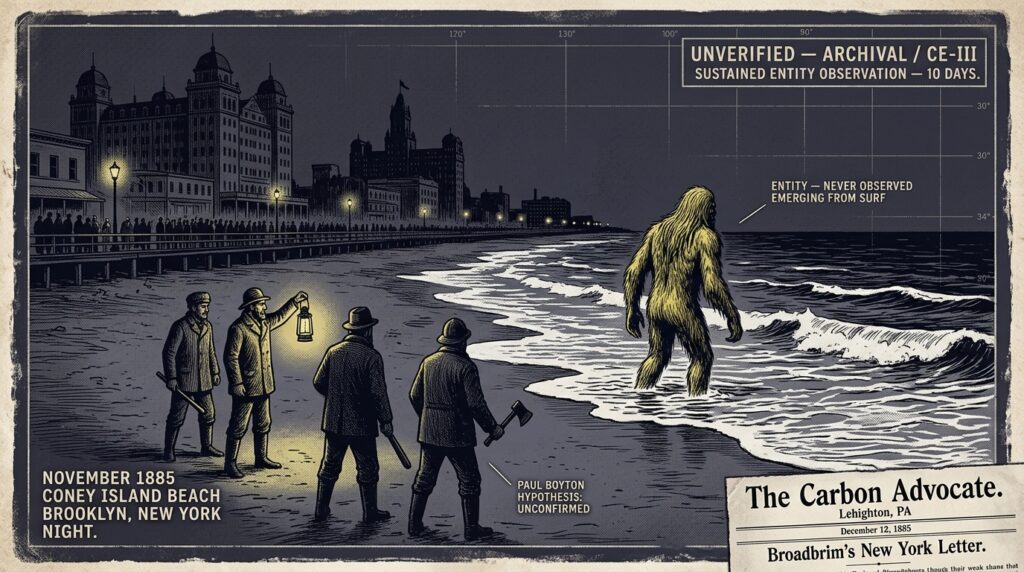
Coney Island beach, Brooklyn, New York — November 1885. For approximately ten days, a hairy bipedal figure with waist-length hair and yellow body hair as long as a horse's mane was observed walking the off-season beach at night and entering the surf whenever approached — never seen to emerge. Armed men patrolled. Hundreds watched. Reported in Broadbrim's New York Letter, The Carbon Advocate, December 12, 1885. The Paul Boyton publicity stunt hypothesis was raised by the source but never confirmed.
THINK ABOUTIT UFO|UAP SIGHTING REPORT
1885: Coney Island Merman Sighting
For approximately ten days in November and early December 1885, something was living on the beach at Coney Island. It walked the sand at night — seen by many, men and women — and when approached it dashed into the breakers and was not seen to come out again. Its head hair reached to its waist. The yellow hair covering its body was as long as a horse’s mane. Armed men began patrolling the beach at night with hatchets and clubs, afraid it might seize them and drag them into the sea. Women and children kept indoors. The Carbon Advocate of Lehighton, Pennsylvania ran the account on December 12, 1885, under its “Broadbrim’s New York Letter” column, noting that Brooklyn was greatly exercised about a wild man of the sea and that the sighting, if believed, suggested mermen were not entirely extinct. The correspondent also suggested — without confirmation — that it might be Captain Paul Boyton in some kind of publicity stunt for his life-saving rubber suit. It was not confirmed as Boyton. It was not confirmed as anything else either. Whatever it was, it was seen by many, it used the water with the ease of a native element, and nobody caught it.
Date: November–December 2, 1885 (sightings span approximately ten days; December 2 is the publication reference date, not the encounter date)
Sighting Time: Night — entity observed walking the sand at night; observed entering the surf; not seen to emerge
Day/Night: Night
Location: Coney Island beach, Brooklyn, New York
Urban or Rural: Urban coastal — Coney Island was New York City’s primary beach resort in 1885
No. of Entity(‘s): 1
Entity Type: Aquatic humanoid — wild man of the sea; male-presenting; bipedal on land; apparently fully aquatic in water
Entity Description: Male-presenting humanoid figure; hair on head reaching to the waist; body covered in yellow hair as long as a horse’s mane; bipedal — observed walking the sand; moved into breaking surf when approached and was not seen to emerge; described as appearing at ease in the water as if it were his native element; seen on multiple occasions over approximately ten days; specific facial or limb details not recorded in the source
Hynek Classification: CE-III (Close Encounter III) — animate non-human being observed at close enough range for detailed description by multiple witnesses on multiple occasions
Duration: Approximately ten days of repeated sightings — November into early December 1885
No. of Object(s): 0 — no craft
Description of the Object(s): N/A
Shape of Object(s): N/A
Size of Object(s): N/A — approximately human scale implied by bipedal walking description
Color of Object(s): N/A — entity description: yellow body hair
Distance to Object(s): Close enough for witnesses to attempt approach on multiple occasions; entity fled into surf before being caught; exact distances not recorded
Height & Speed: Approximately human height implied; capable of moving into breaking surf faster than pursuers could close the distance
Number of Witnesses: Multiple — described as many; men and women; hundreds reportedly watching at times; armed patrols formed
Special Features/Characteristics: Sustained ten-day presence — not a single fleeting observation; entity never seen to emerge from the water after entering the surf — implying extended or indefinite submersion capability; community behavioral response of genuine fear — armed patrols, women and children indoors, reign of terror described; Paul Boyton publicity stunt hypothesis raised by the source correspondent but not confirmed; Boyton was a notorious showman with motive and capability for such a stunt; however Boyton’s whereabouts in November 1885 were not confirmed as Coney Island and the hypothesis was speculative; no capture, no physical evidence; reported in Broadbrim’s New York Letter, Carbon Advocate (Lehighton, PA), December 12, 1885
Case Status: Insufficient Data — multiple witnesses over ten days, contemporaneous newspaper account, community-level behavioral response; Paul Boyton hoax hypothesis plausible but unconfirmed; genuine aquatic humanoid hypothesis unconfirmed; no physical evidence; entity not captured
Source: Broadbrim’s New York Letter, The Carbon Advocate (Lehighton, PA), December 12, 1885
Summary/Description: For approximately ten days in November-early December 1885, a hairy bipedal figure with waist-length head hair and yellow body hair as long as a horse’s mane was repeatedly observed on the Coney Island beach at night, walking the sand and entering the surf when approached — never seen to emerge. Multiple witnesses including armed patrols. The community was in a state of genuine fear. The Carbon Advocate suggested but did not confirm that the sightings might be a publicity stunt by showman Captain Paul Boyton. Entity was never captured. No physical evidence recovered.
Related Cases: 1880 Coney Island bat-man — same beach, five years earlier | 1833 Isle of Yell Scotland mermaid — six fishermen, three hours | 1830 Benbecula Scotland — physical recovery and burial | 1814 West Coast Scotland mermaid — two-hour observation | 1855 Waldoboro Maine 18-inch hairy humanoid
DETAILED REPORT
Coney Island in November 1885 was New York City’s primary ocean resort — in summer a raucous place of bathhouses, hotels, and amusement concessions; in late autumn nearly deserted, the season over, the beach largely empty. It was precisely the kind of place where something that used the ocean as its home could come ashore in the off-season with some degree of cover.
The Carbon Advocate of Lehighton, Pennsylvania, carried the account under its “Broadbrim’s New York Letter” column — a syndicated feature reporting New York City news to a Pennsylvania readership. The correspondent described something he characterized as a “wild man of the sea”: bipedal, using the beach at night, seen by many men and women over a ten-day period, with head hair reaching to the waist and yellow body hair as long as a horse’s mane. The entity walked the sand when it thought it was alone and entered the breaking surf whenever anyone approached — and was never observed to come back out.
This last detail is the most analytically significant feature of the case. Over ten days of repeated observation by multiple witnesses, including people who clearly approached closely enough to attempt interception, the entity was never seen to emerge from the water after entering it. Whatever it was, it was capable of extended or indefinite submersion in the surf — which eliminates a human being in any normal state of dress or undress as an explanation, since no person can remain indefinitely submerged in Atlantic Ocean surf.
The community response escalated over the ten days to genuine social disruption. Hundreds of people were reportedly watching for the wild man. Armed men patrolled the beach at night with hatchets and clubs — a response to a specific fear that the entity might seize a person and drag them into the sea. Women and children were keeping indoors. The Carbon Advocate used the phrase “reign of terror” — not as hyperbole, but as a description of the functional state of New York’s favorite beachside community in the off-season.
The newspaper was careful to note that people were afraid to shoot the entity because they might be charged with killing a harmless lunatic. This is a legally specific concern in an 1885 context: it implies the entity was sufficiently human-looking from a distance to raise genuine ambiguity about its legal status, while its behavior — the waist-length hair, the yellow body hair, the easy submersion — was sufficiently non-human to make conventional identification impossible.
The source correspondent raised the Paul Boyton hypothesis — suggesting the sightings might be another publicity device from the aquatic showman — but explicitly left it unconfirmed. Boyton was indeed a notorious self-promoter whose stunts in his rubber life-saving suit had captivated international audiences; he was the kind of man who would have found a ten-day merman impersonation amusing if it generated coverage. However, Boyton was in a period of considerable personal controversy in late 1885 following the Robert Odlum Brooklyn Bridge death and the subsequent public dispute with the Odlum family. His whereabouts in November 1885 were not confirmed as Coney Island in the available source, and the correspondence left the hypothesis as speculation.
The archive holds the Boyton hypothesis as the most plausible conventional explanation while noting it was not confirmed. It holds the aquatic humanoid hypothesis as unconfirmed but not eliminated. And it holds the ten-day sustained multi-witness community-terror event as documented, regardless of which hypothesis is ultimately correct.
RESEARCHER’S NOTES
The Wild Man of the Sea — The 1885 Coney Island Merman and the Honest Hoax Hypothesis
Paul Boyton Context: Captain Paul Boyton (1848–1924) was one of the most famous aquatic showmen of the 19th century, known for crossing the English Channel and multiple other bodies of water in his Merriman life-saving rubber suit. In late 1885 he was embroiled in the controversy surrounding Robert Emmet Odlum’s fatal Brooklyn Bridge jump, which Boyton had allegedly encouraged; the Odlum family publicly blamed him and he published defensive letters in the New York Times. The timing of the Coney Island sightings — November 1885, during the height of this controversy — could support a theory that Boyton was generating positive publicity through the merman sightings. However this is speculation by the newspaper correspondent, not a confirmed identification.
Ten-Day Duration as Analytical Factor: The sustained ten-day duration of the sightings distinguishes this case from a single misidentification event. If this was a human being — Boyton or otherwise — in a suit or disguise, that person maintained the performance for ten days, at night, in late-autumn Atlantic surf, repeatedly evading capture by armed groups of watchers. The sustained duration and consistent description across multiple witnesses over ten days provides more evidentiary weight than a single sighting would.
Never Emerging from the Surf: The consistent detail that the entity was never seen to emerge from the water after entering it is the most analytically challenging feature for any conventional explanation. In late November 1885, the Atlantic Ocean at Coney Island would be approximately 50–55°F — survivable for an experienced swimmer in a wetsuit but extremely challenging for extended periods without thermal protection. Boyton’s rubber suit provided some insulation. A genuine aquatic humanoid would have no such limitation.
Hynek Classification Note: CE-III is correct — animate being observed repeatedly at close range by multiple witnesses with sufficient proximity for detailed description. No craft was involved. The classification is retained.
 Nobody caught it. For ten days it walked the off-season beach and went into the surf whenever anyone got close, and nobody ever saw it come back out, and the women and children stayed indoors and the men with hatchets kept their watch and the hundreds of watchers watched.
The Carbon Advocate ran the story and suggested maybe it was Boyton. Maybe it was. Boyton never confirmed it and nobody proved it, and the entity with the waist-length hair and the yellow mane never came back after early December — or if it did, nobody wrote it down.
The archive holds both possibilities: the showman’s stunt that generated just enough coverage before going quiet, and the thing that was never quite human and used the ocean like a birthright. One of them is probably right. The record does not say which one.