The Gray stone — a single claimant's 1969 fossil artifact claim, no original photograph survives
400 MILLION YEARS AGO:
THE MELVIN GRAY KENTUCKY FOSSIL ARTIFACT REPORT
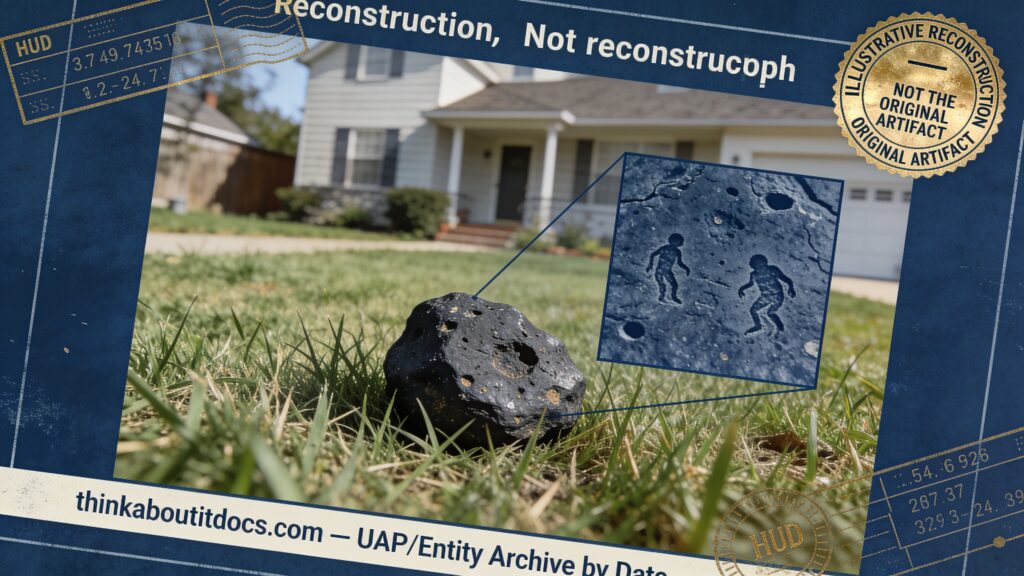
Note: the image accompanying this page is illustrative only and is not a photograph of the alleged artifact. No photographs of the original stone were ever published.
In January 1969, a Louisville, Kentucky reader named Melvin R. Gray submitted a stone to the American periodical Beyond Magazine, claiming it bore fossilized indentations of tiny humanoid and ape-like figures alongside what he interpreted as the imprint of a small craft. The claim was picked up and expanded a second time by a Kentucky-based UFO research group. No photograph of the actual stone has ever been published in either source; all published imagery of this case, including any accompanying this page, is illustrative reconstruction only.
Date: Claimed 400 million years ago (Devonian period); reported find and publication, 1969
Sighting Time: Not applicable — alleged fossil artifact discovery, not a witnessed event
Day/Night: Not applicable
Location: Louisville, Kentucky (backyard discovery; exact original find site not otherwise documented)
Urban or Rural: Suburban residential yard
No. of Entities: 7 (as claimed in the stone’s alleged imprint)
Entity Type: Four described as humanoid, three described as ape-like
Entity Description: All seven figures were approximately three inches in height. Investigators Ratliff and Gray speculated the three ape-like figures could represent humanoids in pressurized suits rather than a distinct species.
Hynek Classification: Not applicable — this is a claimed fossil-artifact discovery, not a live witnessed sighting, and falls outside the Hynek sighting-classification scale
Duration: Not applicable
No. of Objects: 1 (the stone itself, interpreted as a fossilized craft impression)
Height & Speed: Not applicable
Size of Object: Described by Gray as no larger than a washbasin or dishpan
Distance to Object: Not applicable
Shape of Object: Described as resembling a small chunk of meteor, cindery in texture
Color of Object: Not recorded
Number of Witnesses: One primary claimant (Melvin R. Gray); reviewed secondhand by columnist Brad Steiger and researcher Buffard Ratliff
Source: Beyond Magazine, January 1969; Buffard Ratliff, “A Fossilized Alien Spaceship and its Occupants,” Flying Saucers magazine (Ray Palmer, publisher)
DETAILED REPORT
Columnist Brad Steiger reported that Melvin R. Gray of Louisville, Kentucky, had discovered a stone with what Gray considered suspicious indentations. No photographs accompanied the original article; Gray described the stone as resembling “a small chunk of meteor.” To better document what he believed the impressions showed, Gray produced plaster, fiberglass, and aluminum castings taken directly from the rock’s surface.
Gray’s own account, as quoted by Steiger, described the fossilized figures as “humanoid in appearance, looking very much like ourselves, and approximately three inches tall,” and speculated that the stone’s cindery texture suggested it had “hurtled through a long trail of space, melting as it went” before landing in a river or lake, leaving a fossil-like imprint as “a permanent record to tell the world… that we had visitors to our earth… who had met with some terrible calamity.” Steiger himself remained skeptical, noting only that under magnification he could make out what appeared to be “a tiny human pilot sitting in a bucket-type seat” on the casts Gray sent him, while acknowledging this could plausibly be a trick of natural rock formation. Steiger found no reason to believe Gray had fabricated the object himself.
A second article, “A Fossilized Alien Spaceship and its Occupants,” appeared in Ray Palmer’s Flying Saucers magazine, authored by Buffard Ratliff, Executive Director of the Kentucky-based National UFO Research and Investigation Committee. Ratliff wrote that after reading Steiger’s piece, he contacted Gray directly and examined the stone. Gray told Ratliff that he and his wife had found the stone while cutting grass in their backyard, and that he had studied it for approximately seven months before concluding it might be extraterrestrial in origin.
Ratliff and Gray together identified seven small figures on or within the stone — three ape-like, four humanoid — all approximately three inches tall. They proposed the three ape-like figures might represent humanoids in specialized suits rather than a separate species, and noted these figures, along with one of the humanoids, appeared confined to a section of the object they labeled “B,” distinct from a second section labeled “A.” They interpreted this apparent division as evidence of “intelligent construction and design by intelligent beings.”
RESEARCHER’S NOTES
The Gray Stone — A Single-Source Claim With No Surviving Photograph
- Source authors verified: Brad Steiger (born Eugene E. Olson, 1936–2018) was a real, prolific American paranormal and UFO writer with over 170 books to his name; his work is widely regarded by academics and skeptics as making unverified, sensationalized claims. This does not confirm or deny the Gray stone claim itself, but establishes Steiger as a genuine, if consistently uncritical, source for fringe-ufology material of this era.
- No photograph exists: neither Beyond Magazine nor Flying Saucers published a photograph of the stone itself — only Gray’s own descriptions and secondhand accounts of plaster, fiberglass, and aluminum castings. This is a single-witness claim with no independently examinable physical evidence.
- Even Steiger was unconvinced: the original columnist who broke the story explicitly declined to endorse it, describing the “pilot” figure he could make out as possibly “a trick of nature.”
- No Hynek classification applies: this is a claimed fossil-artifact discovery examined after the fact, not a live witnessed sighting, and is catalogued outside the standard Hynek scale accordingly.
- Correction from prior version: this rebuild adds a Detailed Report section, Researcher’s Notes, and full SEO/image metadata absent from the page’s previous form, and preserves the original “not a photo of the artifact” disclosure prominently rather than as a passing note.
The Gray stone remains, on the record, exactly what it has always been: a single claimant’s interpretation of natural rock indentations, relayed through two fringe-ufology publications with no surviving photographic evidence and no independent physical examination. It is preserved here as part of the documented record of 1969-era UFO literature, not as a verified artifact.
“The stone looks rather cindery as if it may have hurtled through a long trail of space, melting as it went and finally splashing into some river or lake before it was entirely consumed, leaving… a fossil-like imprint for a permanent record to tell the world… that we had visitors to our earth… who had met with some terrible calamity.”
Melvin R. Gray, as quoted by Brad Steiger, Beyond Magazine, January 1969