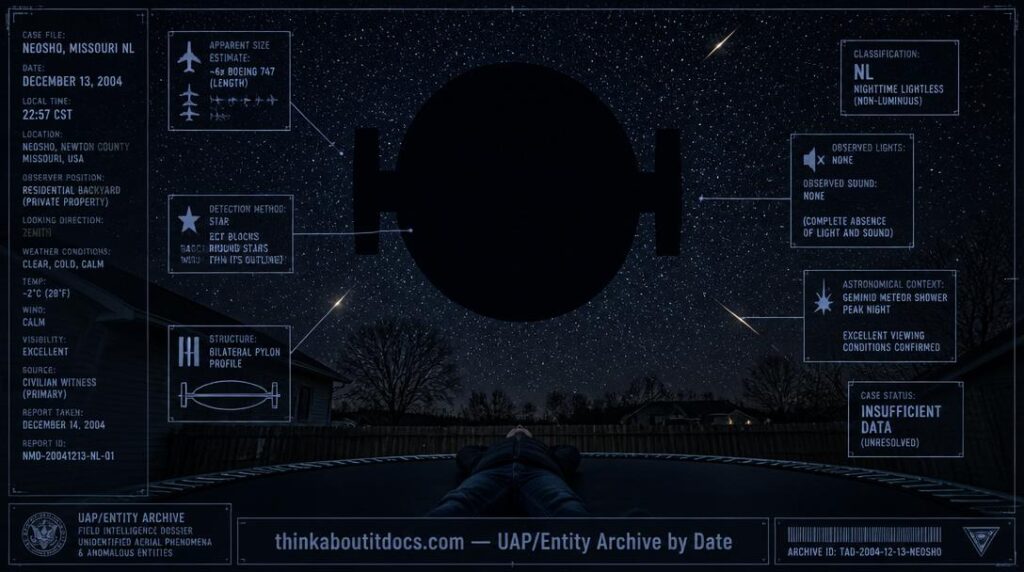
December 13, 2004 — Neosho, Missouri. A massive, completely dark and silent oval object with bilateral pylons blocks out stars as it transits south to north during the Geminid meteor shower. Detected solely by star occlusion. NL. Insufficient Data.
THINK ABOUTIT UFO|UAP SIGHTING REPORT
2004: Neosho, Missouri — A Massive Silent Dark Object Transits the Sky During the Geminid Meteor Shower
On the night of December 13, 2004, a witness lying in his backyard watching the Geminid meteor shower noticed stars disappearing in sequence across the sky — not behind clouds, but behind something solid, enormous, and completely dark that was moving slowly and silently from south to north over the town of Neosho, Missouri. When the object passed nearly overhead, the witness was able to resolve its shape against the starfield: a roughly oval or egg-shaped form with a pylon or similar structure protruding from each side, at least six times larger than a 747 at cruising altitude, carrying no lights whatsoever and producing no sound despite its massive apparent size.
This is a single-witness NUFORC report with no independent corroboration. The witness’s observational method — tracking the object by star occlusion — is analytically sound, and the Geminid meteor shower context establishes that the witness was an active sky-watcher with eyes already adapted to dark-sky conditions, but the case rests entirely on one anonymous account.
Completed Template
Date: December 13, 2004
Sighting Time: 10:00 p.m.
Day/Night: Night
Location: Neosho, Missouri
Urban or Rural: Small town / suburban
No. of Entity(‘s): None observed
Entity Type: Not Applicable
Entity Description: Not Applicable
Hynek Classification: NL (Nocturnal Light) — Extended source observed at night (object itself was dark; classification by observational context)
Duration: 15 to 30 seconds
No. of Object(s): 1
Description of the Object(s): Massive, completely dark solid object with no lights, no exhaust, and no sound. Resolved against starfield as roughly oval or egg-shaped with a pylon or similar structure on either side.
Shape of Object(s): Oval / egg-shaped with bilateral pylons
Size of Object(s): Approximately 6 times the apparent size of a 747 at 30,000 feet
Color of Object(s): Completely dark / black — no illumination of any kind
Distance to Object(s): Estimated several thousand feet altitude
Height & Speed: Several thousand feet; slow, steady south-to-north transit
Number of Witnesses: 1
Special Features/Characteristics: Completely lightless — no navigation lights, no collision strobes, no exhaust glow; tracked by star occlusion method (stars disappeared and reappeared as object passed); bilateral pylons visible when object was near overhead; complete silence despite large apparent size; witness waited several minutes for delayed sound — none arrived; observed during Geminid meteor shower with clear, cloudless sky
Case Status: Insufficient Data
Source: NUFORC (National UFO Reporting Center), Peter Davenport, Director
Summary/Description: A single witness observing the Geminid meteor shower from his backyard in Neosho, Missouri tracked a massive, completely dark and silent object by star occlusion as it transited south to north. The object was resolved as oval or egg-shaped with bilateral pylons, approximately six times the apparent size of a 747 at cruising altitude, and produced no sound or light of any kind.
Related Cases: 2005 St. Louis Cylindrical Object | 2000 Busch Wildlife Blue Ionized Gas Craft
Detailed Report
On the night of December 13, 2004, the witness was outdoors watching the Geminid meteor shower from his residential backyard in Neosho, Missouri. The sky was completely clear with no clouds in any direction, providing excellent dark-sky conditions for meteor observation. At approximately 10:00 p.m., he noticed a distortion in the sky — stars were disappearing from view in a systematic pattern, then reappearing as something large and dark moved past them.
The object was traveling from south to north over the town. It carried no lights of any kind — no navigation lights, no collision strobes, no exhaust glow, nothing. It was detectable only because it occluded the stars behind it as it moved. The witness tracked it by watching the sequential disappearance and reappearance of starfield elements along its path. The object was also completely silent. Despite its large apparent size, there was no audible sound during the transit, and the witness waited several minutes after it passed out of sight to listen for delayed sound — none arrived. There was no masking ambient noise in the area that could have obscured engine sound.
When the object was nearly overhead, the witness was able to make out its shape against the sky. It appeared roughly oval or egg-shaped, with a pylon or similar structure protruding from either side. The witness estimated its apparent size at approximately six times what a 747 looks like at 30,000 feet, placing it either at very high altitude and enormous size, or at lower altitude and merely very large. The altitude was difficult to determine precisely, but the witness estimated at least several thousand feet based on its apparent angular rate.
The witness tracked the object for approximately fifteen to thirty seconds as it moved from about forty degrees above the southern horizon, passed overhead, and continued northward until it was obscured by trees across the street. He did not have time to go inside to alert anyone else. The object maintained a steady altitude and heading throughout — no maneuvers, no acceleration, no changes in trajectory. It simply moved straight north and disappeared.
Researcher’s Notes
The Neosho Dark Transit — Southwest Missouri 2004 and the Problem of Lightless Objects
Classification Note — NL Anomaly: This case presents an unusual classification challenge. The NL (Nocturnal Light) category is defined as a luminous source observed at night, but this object produced no light whatsoever. It was detected solely by star occlusion. Strictly speaking, a completely dark object observed at night does not fit the NL definition. However, the Hynek system does not include a dedicated category for large, structured, non-luminous nocturnal objects observed at distance, and NL is the closest available classification for a nighttime observation at several thousand feet. The classification is retained with this caveat noted.
Observational Method — Star Occlusion: The witness’s detection method — tracking the object by sequential star disappearance and reappearance — is an analytically sound technique used by professional astronomers to detect occultation events. The Geminid meteor shower context is significant: the witness was already engaged in active sky observation with dark-adapted vision, looking upward at a clear starfield. This is the optimal condition for detecting a lightless object, and it explains why this witness noticed something that others in the area — not engaged in sky-watching — would have missed entirely. The object’s complete darkness means it could have overflown populated areas routinely without detection.
Physical Profile — Silent, Dark, Massive: The object’s physical characteristics — no lights, no sound, no exhaust, bilateral pylons, oval form, very slow transit — do not match any conventional aircraft profile. Military stealth aircraft are designed for low radar cross-section, not visual invisibility, and they carry required navigation and collision avoidance lighting when operating in domestic airspace. A blimp or airship could account for the slow speed and relative silence but would typically carry some form of illumination and would not present an oval-with-pylons profile. The six-times-747 apparent size estimate, if accurate, implies either an extremely large craft at high altitude or a very large craft at moderate altitude — neither of which has a prosaic explanation for the combination of darkness, silence, and slow transit.
Evidentiary Limitations — Single Anonymous Witness: This case is classified as Insufficient Data. It rests on a single anonymous NUFORC self-report with no investigator follow-up, no corroborating witnesses, and no physical evidence. The witness account is internally consistent and technically credible — the star-occlusion detection method, the careful size comparison, the acknowledgment of altitude uncertainty, and the honest admission that the witness could not go inside to get another observer all suggest a sincere report. But sincerity alone does not constitute sufficient evidence. Without corroboration, the case cannot be classified as Unexplained.
The Neosho dark transit sits in the archive as a well-described but uncorroborated observation — a reminder that the most effectively concealed objects are the ones that carry no lights at all, and that the best evidence for their presence may be nothing more than a sequence of stars that briefly stopped shining.
Wrap-Up
One man, one clear night, one meteor shower, and something enormous and completely dark moving between him and the stars. No lights, no sound, no corroboration. The record holds it as Insufficient Data — not because the witness is disbelieved, but because one pair of eyes watching stars disappear is not enough to build a case on. The archive notes what he saw, files it honestly, and waits for anyone else who was watching the Geminids from Neosho that night to come forward.