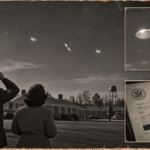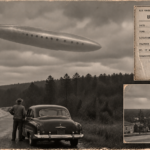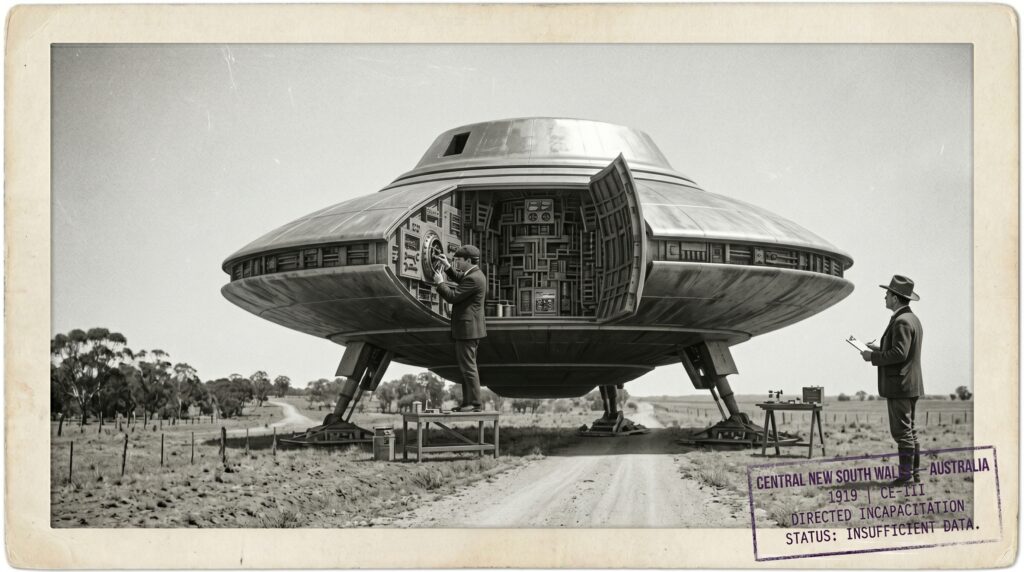
Central New South Wales, Australia, 1919 — a traveller stopped to help a man working on a strange silvery machine. The stranger turned as if surprised and directed a device at him, causing immediate unconsciousness. Both were gone when he woke. His memory was never the same again. Source: Keith Basterfield, UFOs: The Image Hypothesis, Reed, Sydney, 1981. Case status: Insufficient Data.
THINK ABOUTIT UFO | UAP | SIGHTING REPORT
1919: CE3 in Central New South Wales, Australia
In 1919 on a country road in rural Australia, a traveller came upon a man working on a strange silvery machine at the roadside. Being the kind of person who stops to help, he pulled up and offered his assistance. The stranger turned — as if surprised — and pointed something at him. The traveller lost consciousness where he stood. When he came back to himself the stranger was gone. The silvery machine was gone. The road was empty. What was not gone was the damage. His memory was never the same again. Keith Basterfield documented it in 1981. The archive holds it here — the cost of stopping to help a stranger on a road in 1919 Australia.
Sighting Time: Insufficient Data — not recorded in available source
Day/Night: Insufficient Data — not recorded in available source
Location: Rural country road, central New South Wales, Australia. Note: the post summary references Western Australia — the post title and category specify Central New South Wales. The source is Keith Basterfield’s 1981 book covering Australian cases. The archive retains Central New South Wales per the post title pending primary source verification.
Urban or Rural: Rural — country road
No. of Entity(‘s): 1
Entity Type: Human in appearance — described as a man; the archive notes human in appearance rather than confirmed human, as the entity’s behaviour — operating an unknown silvery machine, directing a weapon at a witness causing unconsciousness and permanent neurological damage — is inconsistent with a human operator in 1919
Entity Description: Male in appearance; working on a strange silvery machine at the roadside when the witness approached; turned as if surprised when the traveller stopped; directed an unspecified device or instrument at the witness that rendered him unconscious immediately; departed with the machine before the witness regained consciousness; no physical description of height, build, clothing, or facial features recorded in available source beyond the human male appearance
Hynek Classification: CE-III (Close Encounter III) — close observation of an animate being associated with an unknown craft; directed weapon discharge causing unconsciousness; lasting neurological effect on the witness. Note: the directed weapon causing permanent neurological damage elevates this toward CE-II physical trace simultaneously — the physical effect persisted long after the encounter. The archive retains CE-III as the primary classification with the neurological damage noted as a CE-II-equivalent physical consequence.
Duration: Sufficient for the traveller to stop, approach, offer assistance, be rendered unconscious, and regain consciousness — the entity and machine were gone by the time the traveller recovered; exact duration of unconsciousness not recorded
No. of Object(s): 1
Description of the Object(s): A strange silvery machine — no further structural description recorded in available source beyond the silvery coloration and the entity’s apparent maintenance or repair activity
Shape of Object(s): Insufficient Data — not recorded in available source
Size of Object(s): Insufficient Data — not recorded in available source
Color of Object(s): Silvery
Distance to Object(s): Close — the traveller stopped and approached to offer assistance; exact distance not recorded but sufficient for direct interaction and the directed weapon to be used effectively
Height & Speed: Ground level — the entity was working on the machine at roadside; departure method not recorded
Number of Witnesses: 1 — unnamed traveller; account documented by Keith Basterfield
Special Features/Characteristics: Directed incapacitation weapon — the entity used an unspecified device that caused immediate loss of consciousness in the witness; this is among the earliest documented cases of a directed incapacitation weapon used by a UAP-associated entity in the Australian record; permanent neurological damage — the traveller’s memory was never the same again after the encounter; this lasting cognitive impairment is the most significant physical consequence in the case and places it in the same category as the 1913 Barossa Council directed energy case where the farmer was left with lasting paralysis; the entity’s surprise response — turned as if surprised — suggests the traveller’s approach was not anticipated, which argues against a staged encounter; the entity’s immediate weapon use rather than communication or departure suggests a security or concealment protocol
Case Status: Insufficient Data — unnamed witness, secondary source only, no primary documentation; Keith Basterfield’s credentialed research provides the source chain; the directed weapon and permanent neurological damage are specific consequences inconsistent with fabrication
Source: Keith Basterfield, UFOs: The Image Hypothesis — Close Encounters of An Australian Kind, Sydney, New South Wales, Reed, 1981
Summary/Description: In 1919 on a rural country road in central New South Wales, an unnamed traveller came upon a human-appearing entity working on a strange silvery machine. When the traveller stopped to offer help the entity turned as if surprised and directed a device at him causing immediate unconsciousness. The traveller regained consciousness to find both the entity and the machine gone. His memory was permanently affected by the encounter. Documented by Keith Basterfield in his 1981 study of Australian UAP cases.
Related Cases: 1913: Barossa Council, South Australia — Directed Energy, Lasting Paralysis | 1912: Australian Humanoid Sighting, Currockbilly Range | 1933: Western Australia Abduction | Australian Sightings Archive
Detailed Report
The Stranger at the Silvery Machine — Central New South Wales, 1919 Source: Keith Basterfield, UFOs: The Image Hypothesis — Close Encounters of An Australian Kind, Sydney, Reed, 1981
In 1919, a traveller passing down a country road in rural Australia came upon a man working on a strange silvery machine at the roadside.
He stopped. He offered his assistance — the natural response of a rural traveller encountering someone apparently in difficulty.
The stranger turned as if surprised. He pointed something at the traveller. The traveller lost consciousness.
When he regained consciousness the stranger was gone. The strange silvery machine was gone. The road was empty.
Subsequently, he found that his memory was never the same again.
Keith Basterfield documented this account in his 1981 study of Australian close encounter cases, UFOs: The Image Hypothesis — Close Encounters of An Australian Kind, published in Sydney. It represents one of the earliest documented directed incapacitation weapon cases in the Australian UAP record and one of the earliest documented cases of lasting neurological consequence from a UAP encounter in any national record.
RESEARCHER’S NOTES
The Stranger at the Silvery Machine — Central New South Wales 1919 and the Directed Incapacitation Weapon in the Pre-War Australian Archive
- The Surprise Response as Operational Intelligence: The entity turned as if surprised. This detail is analytically underappreciated. An entity operating a machine on an open country road with full awareness of its surroundings would not be surprised by an approaching traveller. The surprise response implies either that the entity’s attention was fully absorbed in the repair or maintenance task, or that the entity had some expectation of privacy that the traveller’s unexpected approach violated. Either interpretation is consistent with an operational activity — a maintenance stop, a repair, a task that required ground-level access — rather than a staged encounter. The surprise is the detail that makes the encounter feel real rather than theatrical.
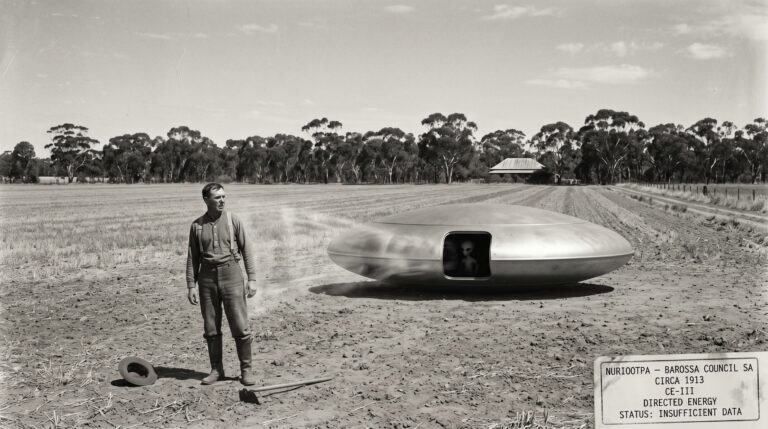
- The Directed Weapon — Pattern Significance: The use of an unspecified directed device that caused immediate unconsciousness is the third documented case of a directed energy or incapacitation weapon used by a UAP-associated entity in the early Australian archive — preceded by the 1913 Barossa Council case in which a farmer was left with lasting paralysis after being zapped by a humanoid from a metallic landed object. The pattern of directed incapacitation as a security response to unexpected human proximity appears across the broader archive in multiple countries and time periods. In each case the response is the same: the entity uses a non-lethal incapacitation method, departs, and leaves no physical evidence of the craft beyond the witness’s altered physiological state. The archive notes the consistency of this response pattern as operationally significant.
- Permanent Neurological Damage — The Most Significant Consequence: His memory was never the same again. In a case with minimal source detail this single sentence is the most important. Temporary unconsciousness from a directed device is a physical effect. Permanent cognitive impairment — specifically memory — is a neurological consequence suggesting damage to or alteration of brain function. The 1919 central New South Wales case is one of the earliest documented instances of lasting neurological damage as a consequence of UAP entity encounter in the Australian record. It sits alongside the Barossa Council lasting paralysis case and the 1930 Alaska case witness who kept the photograph for seventy years and never recovered his certainty about what he had seen, as examples of encounters that did not end when the craft left.
- Source Chain — Keith Basterfield’s Credentialed Research: Keith Basterfield is one of Australia’s most credentialed UAP researchers, with decades of documented fieldwork and published case investigation. His 1981 book represents serious academic-adjacent research into Australian close encounter cases compiled from primary witness interviews and historical records. The case appears in his catalog without fabricated detail — the account is spare, specific, and free of the embellishments that characterize confabulated accounts. The archive holds it at Insufficient Data due to the unnamed witness and secondary-only sourcing, while noting that Basterfield’s research methodology raises the credibility floor above most anonymous submissions.
A traveller stopped to help a man with a machine in 1919 on a quiet Australian country road and woke up alone on that road with the man gone and the machine gone and something missing from inside his own head that never came back. Keith Basterfield wrote it down sixty-two years later. The archive holds it now. Whatever the stranger was working on in that silvery machine, he did not want company, and he made sure of it in a way that lasted longer than the road, longer than the machine, longer than the encounter itself.