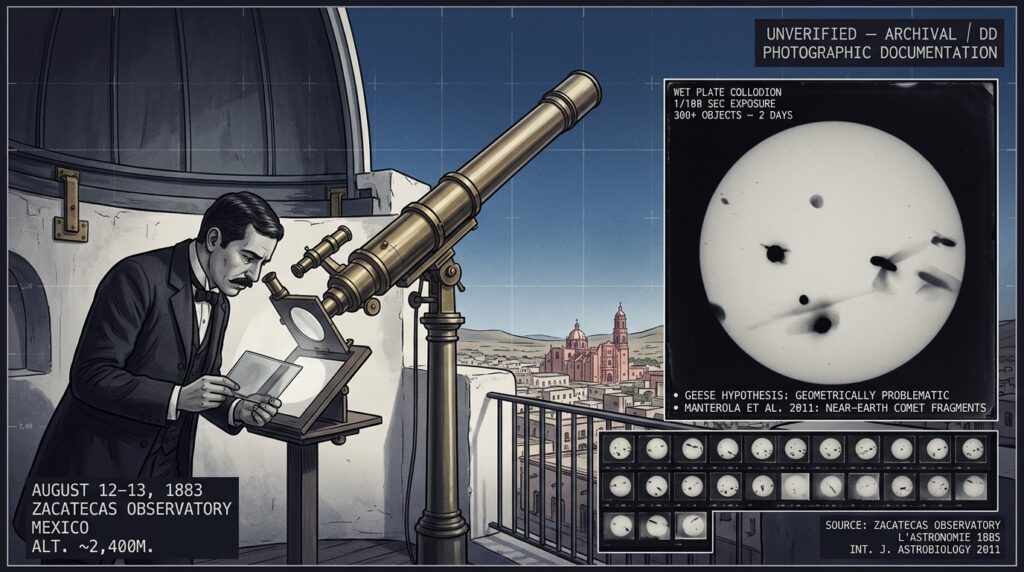
Zacatecas Observatory, Mexico — August 12–13, 1883. Astronomer José Bonilla photographs more than 300 dark objects transiting the solar disc during sunspot monitoring, exposing wet collodion glass plates at 1/100 second. Bonilla's report was published by L'Astronomie in 1885 after a two-year delay, with an editorial suggestion that the objects were high-flying geese. A 2011 peer-reviewed paper in The International Journal of Astrobiology proposed the objects were fragments of a near-Earth comet passing between Earth and Moon — explaining why no other observatory simultaneously reported the transit. The photographs survive. The case remains unresolved.
THINK ABOUTIT UFO|UAP SIGHTING REPORT
1883: Zacatecas Observatory, Mexico Sighting
On August 12, 1883, astronomer José Bonilla at the Zacatecas Observatory in Mexico was conducting routine solar monitoring — specifically watching for sunspot activity — when he noticed something crossing the face of the sun that was not a sunspot. He switched to photographic equipment and began exposing wet-plate collodion glass plates at 1/100 second. Over the course of the observation he counted more than 300 dark objects transiting the solar disc — some individually, some in groups — each displaying a consistent dark profile against the brilliant solar background, some appearing to have a hazy or trailing structure. He sent his report to the editors of L’Astronomie, the leading French astronomical journal. The editors waited two years before publishing it, in the meantime proposing that Bonilla had observed high-flying geese or insects near the objective lens. The photographs survive. They are among the earliest photographs of unidentified objects in recorded history, taken on the first day of a two-day observation series. In 2011, researchers at the National Autonomous University of Mexico published an analysis in The International Journal of Astrobiology proposing that the objects were fragments of a comet or asteroid in a trajectory that passed between the Earth and the Moon — which would explain both the dark silhouette appearance and why no other observatory reported the transit simultaneously.
Date: August 12–13, 1883 (two-day observation; primary photographs August 12)
Sighting Time: Daytime — solar monitoring session; exact start time not recorded
Day/Night: Day
Location: Zacatecas Observatory, Zacatecas, Mexico
Urban or Rural: Urban — observatory on a hilltop above the city
No. of Entity(‘s): 0
Entity Type: None observed
Entity Description: None observed
Hynek Classification: DD (Daylight Disc) — dark objects transiting the solar disc observed through a telescope in full daylight and photographed.
Reclassification note: Existing NL (Nocturnal Light) tag is incorrect — this was a daytime solar observation producing photographs of dark objects crossing the solar disc. DD is the correct classification.
Duration: Two-day observation — August 12 and 13, 1883; over 300 objects counted across both days No. of Object(s): More than 300 — transiting individually and in groups across two observation days
Description of the Object(s): Dark objects of varied morphology transiting the solar disc; some appearing with a blurred or hazy edge suggesting atmospheric scattering or gas/vapor envelope; photographed on wet collodion glass plates at 1/100 second exposure; consistent dark profile against the solar background; did not match sunspot morphology — they were in motion, sunspots are fixed; did not match any known bird species at the altitude implied by solar disc transit geometry
Shape of Object(s): Varied — some appearing roughly elongated, some with trailing or hazy appearance
Size of Object(s): Unknown — apparent size on solar disc photographs; actual size dependent on unknown distance
Color of Object(s): Dark — silhouetted against the solar disc
Distance to Object(s): Unknown — the 2011 Manterola et al. analysis proposed the objects were between Earth and Moon; at that distance they would have subtended a significant angular size relative to the solar disc
Height & Speed: Unknown — transiting the solar disc at apparent speed inconsistent with birds at any plausible altitude
Number of Witnesses: Minimum 1 — Bonilla; assistant may have been present but not documented in available sources
Special Features/Characteristics): First documented photographs of unidentified objects in Mexican astronomical history; wet collodion glass plate photographs survive; objects observed over two consecutive days suggesting sustained event rather than random passage; L’Astronomie editors delayed publication two years and proposed geese/insects hypothesis; geese hypothesis has problems: at the altitude required for solar disc transit geometry, geese would be invisible to the naked eye and would not appear as dark silhouettes against the solar disc through a properly aligned telescope; 2011 Manterola et al. paper in International Journal of Astrobiology proposes near-Earth comet or asteroid fragment swarm passing between Earth and Moon; the comet fragment hypothesis explains why no other observatory simultaneously reported the transit — the objects would have been close enough that parallax would place them outside the solar disc as seen from other latitudes
Case Status: Insufficient Data — photographs exist but have not been subjected to modern digital analysis with definitive results; geese hypothesis is widely cited but analytically problematic; comet fragment hypothesis is scientifically credentialed but unconfirmed; case remains genuinely unresolved
Source: Zacatecas Observatory records; L’Astronomie (1885); Manterola et al., International Journal of Astrobiology (2011)
Summary/Description: On August 12–13, 1883, astronomer José Bonilla at the Zacatecas Observatory photographed more than 300 dark objects transiting the solar disc during solar monitoring. He exposed wet collodion plates at 1/100 second. The French journal L’Astronomie delayed publication two years and attributed the objects to geese or insects. The geese hypothesis is analytically problematic given the transit geometry. A 2011 peer-reviewed paper proposed the objects were fragments of a comet or asteroid passing between Earth and Moon — which would explain why no other observatory reported the transit simultaneously.
Related Cases: 1882 Great Saucer — Royal Observatory Greenwich formal report |1874 Prague Schafarick solar disc transit |1839 Rome De Cuppis solar transit | 1879 Henry Harrison New York — institutional dismissal of professional astronomer | 1847 Bonn Schmidt solar disc transit
DETAILED REPORT
José Bonilla was the director of the Zacatecas Observatory — a serious professional astronomer working at an institution that had been established specifically to conduct systematic solar and meteorological observation. When he began his solar monitoring session on August 12, 1883, he was engaged in routine scientific work: watching the sun for sunspot activity, tracking solar features. He was not looking for anomalous phenomena.
The objects that crossed the solar disc that day were not sunspots. Sunspots are fixed features that move with the solar rotation — they do not transit the disc in the way Bonilla’s objects did. His objects moved independently, in groups and individually, transiting from one edge of the visible solar disc to the other. This distinction was immediately apparent to a professional solar observer.
Bonilla switched to photographic documentation. His wet-plate collodion technique — exposing glass plates coated with a light-sensitive chemical emulsion at 1/100 second — was the fastest photographic technology available in 1883. The resulting images show dark silhouetted objects of varied morphology against the bright solar background. Some appear roughly elongated. Some have a blurred or hazy edge. Some appear in groups. The photographs are among the earliest surviving images of unidentified objects in the history of astronomy.
The count across two days of observation — August 12 and 13 — exceeded 300 objects. This is not a handful of anomalous observations; it is a sustained two-day event of extraordinary volume.
Bonilla reported his findings to L’Astronomie, the leading French popular and professional astronomical journal. The editors — without conducting an independent investigation and without examining the photographs against any alternative hypothesis — waited two years before publishing the report, in 1885. They accompanied it with their own suggested explanation: high-flying birds (specifically geese) or insects near the objective lens of Bonilla’s telescope.
The geese and insects hypothesis has fundamental problems that the archive must document honestly. For objects near the objective lens of a solar telescope to appear as discrete dark silhouettes crossing the solar disc, they would need to be within a very specific focal range of the objective. At that range — essentially sitting on or immediately in front of the lens — they would be badly out of focus and would produce blurred, indistinct smears rather than the distinct dark profiles visible in Bonilla’s photographs. Additionally, a solar telescope is aligned with the sun — insects or birds in the immediate vicinity of the objective would create random, non-transiting appearances rather than the systematic cross-disc passages documented over two days.
For high-altitude geese: the geometry of a solar transit observation requires that an object crossing the solar disc be in the optical path between the telescope and the sun. At any altitude where geese could fly, the angular relationship between geese and the solar disc as seen through a correctly aligned telescope would require the geese to be on an extremely precise trajectory coinciding exactly with the solar disc — which they would cross in a fraction of a second at typical migration speeds. Over 300 such crossings across two days from a geese-migration-height altitude strains the hypothesis beyond plausibility.
The 2011 analysis by Hector Manterola, Maria de la Paz Ramos Lara, and Guadalupe Cordero, published in The International Journal of Astrobiology, proposed an alternative: the objects were fragments of a fragmenting comet or asteroid in a trajectory that passed between the Earth and the Moon. At that distance — roughly 40,000 to 80,000 kilometers — the objects would subtend a significant angular size relative to the solar disc, their blurred edges would be consistent with gas and dust envelopes around icy or rocky fragments, and — critically — they would only be visible in transit against the solar disc from a very narrow band of geographic latitude. This last point explains the most puzzling aspect of the case: no other observatory anywhere in the world reported the same transit on August 12–13, 1883. If the objects were at comet-fragment distance, parallax would have displaced them entirely outside the solar disc as seen from any other latitude. The Zacatecas Observatory’s specific position in the Mexican highlands placed it in the narrow window of visibility. The archive retains this as the strongest available hypothesis while noting it has not been confirmed.
RESEARCHER’S NOTES
Bonilla’s Photographs — The 1883 Zacatecas Solar Transit and the Hypothesis Problem
Hynek Reclassification — Critical: The NL (Nocturnal Light) classification on this page is wrong in both components of the label. The observation was not nocturnal — it was a daytime solar monitoring session. The objects were not lights — they were dark silhouettes transiting a bright solar disc. The correct classification is DD (Daylight Disc): dark objects observed in daylight crossing the solar disc through a telescope, photographically documented. This should be corrected in the page tags.
The Geese Hypothesis — Analytical Problems: The L’Astronomie editors’ geese hypothesis has been uncritically accepted in many secondary sources including the existing page summary. The archive documents the specific problems: wrong focal geometry for objects near the objective lens producing distinct rather than blurred profiles; wrong angular precision requirements for high-altitude geese in solar disc transit geometry; wrong volume for a two-day sustained event exceeding 300 crossings. The hypothesis is worth noting as the historical institutional response, not as the accepted explanation.
The 2011 Manterola et al. Hypothesis: The comet/asteroid fragment swarm hypothesis published in The International Journal of Astrobiology is a peer-reviewed scientific paper, not a UFO researcher’s speculation. Its authors are affiliated with the National Autonomous University of Mexico. The paper applies standard orbital mechanics and photographic analysis. Its key testable prediction — that the objects would only be visible from a specific geographic window — matches the observed fact that no other observatory reported the transit. The archive notes this as the most analytically credible hypothesis currently available while acknowledging it has not been definitively confirmed.
Photography as Evidentiary Tier: The existence of surviving wet-plate photographs elevates the Bonilla case above virtually every other pre-aviation anomalous aerial observation in the archive. The 1883 Zacatecas photographs are arguably the earliest surviving photographic evidence of an anomalous astronomical observation anywhere in the world.
 José Bonilla photographed them and sent the plates to Paris and waited two years for L’Astronomie to tell him he had photographed geese. The geese explanation has problems the editors did not address and most secondary sources have not examined. The photographs are still there. The count was over 300 across two days.
A 2011 paper in a peer-reviewed astrobiology journal proposed a comet fragment swarm between Earth and Moon — which would explain why nobody else saw them, and why they looked the way they looked. The archive holds the photographs, the institutional dismissal, the alternative hypothesis, and the open question. After 140 years, the Zacatecas solar transit of August 12–13, 1883 has not been definitively resolved. That is the honest position, and the archive takes it.