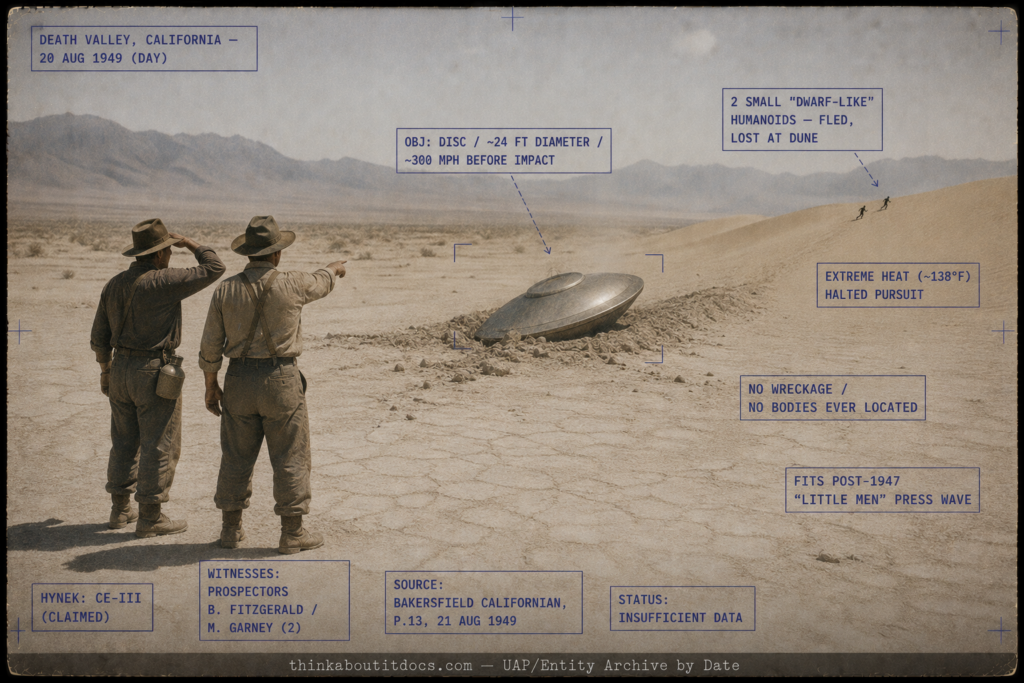
Two prospectors claim a 24-foot disc crashed and two dwarf-like beings fled into the Death Valley heat, August 1949 — a thin, single-source period tall tale.
THINK ABOUTIT CRASH REPORT
1949: Death Valley California UFO Crash
In the killing August heat of Death Valley — 138 degrees by their telling — two prospectors named Buck Fitzgerald and Mace Garney watched a disc about twenty-four feet across streak past at perhaps three hundred miles an hour and slam into the desert floor. From the wreck, they said, two small “dwarf-like” creatures pulled themselves free and ran. The men gave chase, but the heat beat them back, and the little figures vanished around a sand dune. The story ran on page thirteen of the Bakersfield Californian the next morning and then, like the creatures, disappeared: no recovered wreck, no recovered bodies, no follow-up, no one who could find the spot again. It is a small, vivid fragment of the late-1940s “little men from a downed saucer” newspaper craze — a tale that left nothing behind but the telling.
Date: August 20, 1949
Sighting Time: Daytime (extreme heat noted, ~138°F)
Day/Night: Day
Location: Death Valley, California
Urban or Rural: Rural (open desert)
No. of Entity(‘s): 2
Entity Type: Humanoid (“dwarf-like” small beings)
Entity Description: Two small, “dwarf-like” humanoid creatures that reportedly extricated themselves from the crashed object and fled on foot across the desert before disappearing around a sand dune. No further detail (clothing, features, color) recorded.
Hynek Classification: CE-III (Close Encounter of the Third Kind) — animate beings reported in association with a craft. (Held by the nature of the claim; the account is single-source and uncorroborated — see notes.)
Duration: Brief (a fast pass, crash, and short pursuit cut off by the heat)
No. of Object(s): 1
Description of the Object(s): A disc-shaped object roughly 24 feet in diameter that reportedly sped past the witnesses at about 300 mph and crashed in the desert. No color, surface, or structural detail recorded.
Shape of Object(s): Disc
Size of Object(s): ~24 feet in diameter
Color of Object(s): Not recorded
Distance to Object(s): Near enough to observe the crash and the fleeing occupants; not specified
Height & Speed: ~300 mph in level flight before impact; low altitude
Number of Witnesses: 2 — prospectors Buck Fitzgerald and Mace Garney
Special Features/Characteristics: Daytime desert crash with two surviving small occupants fleeing on foot; extreme heat (~138°F) cited as preventing pursuit; occupants lost around a sand dune; no wreckage or bodies ever located or removed; later visits to the area found no trace; single contemporaneous newspaper source; fits the post-Scully 1949 “little men from a crashed disc” newspaper genre
Case Status: Insufficient Data (single uncorroborated newspaper report, no physical evidence, no follow-up; consistent with the period’s “little men” tall-tale wave)
Source: The Bakersfield Californian (Bakersfield, California), p. 13, August 21, 1949
Summary/Description: According to a page-13 item in the Bakersfield Californian on August 21, 1949, two prospectors, Buck Fitzgerald and Mace Garney, reported seeing a disc-shaped object about 24 feet in diameter speed past at roughly 300 mph and crash in the Death Valley desert on August 20, 1949. They said two small, “dwarf-like” humanoid creatures extricated themselves from the wreckage and ran; the men gave brief chase but were stopped by the ~138°F heat and lost the figures around a sand dune. No wreckage or bodies were ever reportedly located or removed, and later visits to the area found no evidence of a crash.
Related Cases: 1948 Aztec, NM crash (Scully) | 1948 Dreamy Draw, AZ crash | 1950 UFO Crash near Albuquerque; “Tomato Man”/Laredo 1948 | broader 1948–50 “little men from a crashed saucer” newspaper genre
DETAILED REPORT
This is a brief, single-source newspaper account from the height of the late-1940s “crashed saucer with little men” press wave. The sole documentation is a page-thirteen item in the Bakersfield Californian of August 21, 1949, reporting an event the previous day in the Death Valley desert. By that account, two prospectors — named as Buck Fitzgerald and Mace Garney — saw a disc-shaped object, approximately 24 feet in diameter, speed past them at about 300 miles per hour and crash into the desert. From the wreckage, they said, two small “dwarf-like” humanoid creatures extricated themselves and ran across the desert. The prospectors attempted to give chase, but the extreme heat — they cited 138°F — quickly stopped them, and they lost the creatures after the figures rounded a sand dune.
The page itself notes the limits frankly: no attempt to rebut the story is known to have been made, but equally there is no indication that any wreckage or the creatures were ever located or removed, and later attempts to visit the area reportedly found no evidence of a crash. That combination — an unrebutted but also entirely unverified tale, with no physical residue and no recoverable site — is the defining feature of the case.
Set in context, the account bears the clear signature of a recognizable genre. In the two years following Frank Scully’s crashed-saucer claims and the saturation press coverage of the 1947 wave, American newspapers ran a string of brief, colorful “little men from a downed flying disc” stories, many of them silly-season filler, regional tall tales, or outright hoaxes (the Aztec and Dreamy Draw legends and the “Tomato Man” affair belong to the same period and milieu). The Death Valley item has every hallmark: remote desert setting, unverifiable lone-pair witnesses, a conveniently small and fast-vanishing craft and crew, a built-in reason the witnesses couldn’t pursue (the heat), and occupants who escape rather than leaving recoverable bodies. The detail of the prospectors as witnesses, the precise-sounding figures (24 feet, 300 mph, 138°F), and the matter-of-fact newspaper framing lend it surface texture, but none of it is independently corroborated.
The honest assessment is that this cannot be elevated. There is exactly one contemporaneous source, no named investigator, no second witness beyond the two prospectors, no photograph, no recovered material, and no locatable site — and the story sits squarely within a known wave of period tall tales. It is not provably a hoax (no debunking was undertaken, and the witnesses may sincerely have seen something they interpreted dramatically in the disorienting Death Valley heat), but it carries none of the markers that would lift it toward credibility. It is retained as a documented period report and a representative specimen of the 1948–50 “little men” newspaper genre.
RESEARCHER’S NOTES
Little Men in the Heat — Death Valley 1949 and the Post-Scully “Crashed Saucer” Press Wave
- Classification Basis: CE-III is defensible strictly by the nature of the claim — animate beings reported in direct association with a crashed craft — and is retained on that basis. The qualifier is essential: the classification describes what was alleged, not what is established. With a single uncorroborated source and no evidence, the CE-III label should be read as “claimed CE-III,” and the case’s standing rests on Case Status, not the Hynek tag.
- Source Assessment (Thin): The case rests on one contemporaneous newspaper item (Bakersfield Californian, p. 13, Aug. 21, 1949) and nothing else. There is no named investigator, no second independent source, no photograph, and no recovered material. The page-13 placement and brief treatment suggest the paper itself regarded it as a minor human-interest curiosity rather than hard news. Under the archive hierarchy this is a thin, single-source report — preserved for the record but not corroborated.
- Genre Context — The Tell: The decisive analytical point is that this account conforms precisely to the late-1940s “little men from a crashed disc” newspaper genre that proliferated after Scully and the 1947 wave. Its features are the genre’s stock furniture: a remote, hard-to-check desert location; an unverifiable pair of rugged-loner witnesses (prospectors); a small craft and small occupants; occupants who flee and vanish rather than leaving bodies; and a tidy reason the witnesses couldn’t follow up (lethal heat). Several contemporaneous cousins (Aztec, Dreamy Draw, “Tomato Man”) are established hoaxes or legends. This pattern does not prove the Death Valley item false, but it strongly conditions how much weight it can bear.
- Physical Evidence and Evidentiary Weight: There is none — no wreckage, no bodies, no photographs, and a site that could never be relocated. The “no one rebutted it” point cited on the page is not evidence of truth; obscure regional filler is rarely formally debunked. With a lone source, no corroboration, no trace, and a textbook genre profile, the case cannot approach Unexplained. Insufficient Data is the accurate standing, with the explicit notation that the report fits a known wave of period tall tales and may well be one.
The Death Valley crash is a vivid scrap of late-1940s saucer folklore: two prospectors, a 24-foot disc down in the desert, two dwarf-like survivors sprinting into the heat, and a story that ran once on page thirteen and then evaporated — no wreck, no bodies, no relocatable site, no second source. It is unrebutted only because no one bothered to rebut it, and it matches, point for point, the post-Scully newspaper genre of “little men from a downed disc” that gave the era its Aztecs and Dreamy Draws. The archive logs it as a claimed CE-III, Case Status Insufficient Data — retained as a documented period report and a clean specimen of how the crashed-saucer tall tale traveled through small-town newspapers in 1949, while making no claim that anything fell in Death Valley but the story itself.