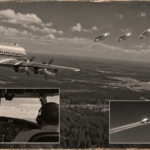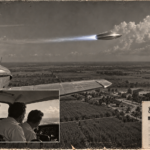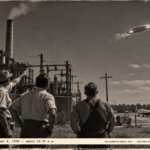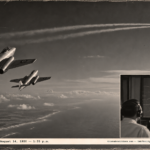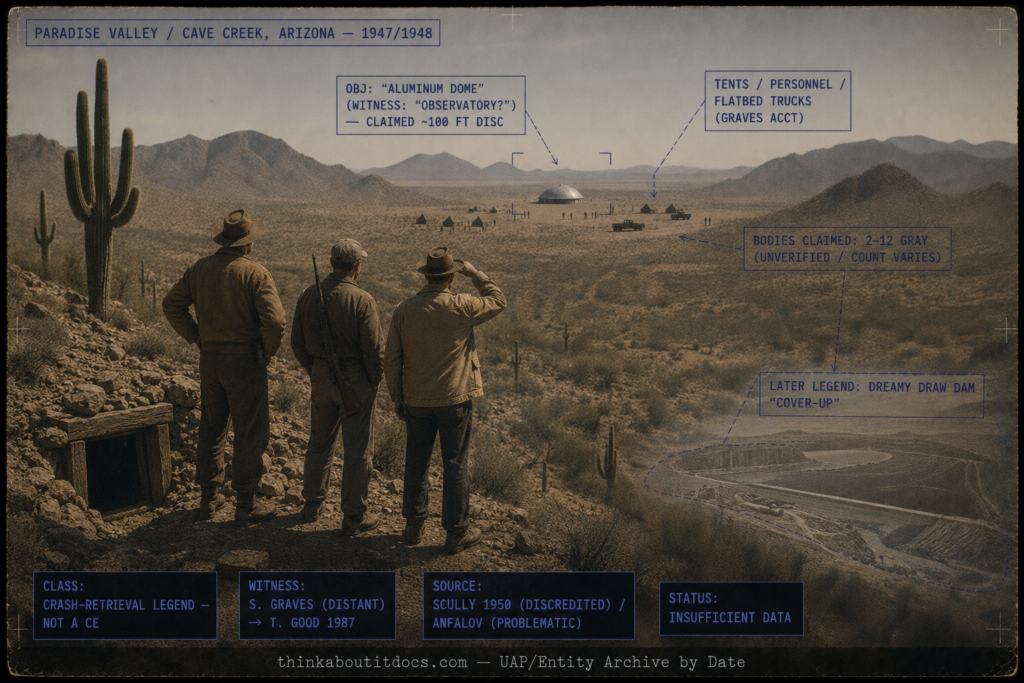
A distant desert "dome" Selman Graves first took for an observatory — the seed of the Dreamy Draw crash legend, north of Phoenix, 1947–48.
THINK ABOUTIT CRASH REPORT
1948: Dreamy Draw area, Arizona, UFO Crash
On a hunting morning in Paradise Valley, Arizona, in the late 1940s, businessman and pilot Selman Graves climbed a hill for a better vantage and saw, off in the direction the Air Force had just declared off-limits, “a large, aluminum, dome-shaped thing” about the size of his friend’s house, ringed by tents and men moving about. At the time he took it for an observatory dome and thought no more of it — until years later, reading Frank Scully’s notorious Behind the Flying Saucers, he became convinced he had glimpsed a crashed craft from another world. From that recollection, relayed to researcher Timothy Good in 1987, grew the Dreamy Draw legend: a hundred-foot domed disc, twelve small gray bodies, flatbed trucks hauling the wreckage to Muroc, and a flood-control dam supposedly built years later for the sole purpose of burying the saucer in plain sight. It is one of the American Southwest’s most enduring crash tales — and one with no verifiable craft, no named bodies, and a tangle of sources that runs straight back through a famous hoax.
Date: 1948 (also reported as early October 1947 in the Graves account — see notes)
Sighting Time: Morning (Graves observation)
Day/Night: Day
Location: Paradise Valley / Cave Creek area, near Dreamy Draw, Arizona (north of Phoenix)
Urban or Rural: Rural (at the time)
No. of Entity(‘s): Reported variously — 2 bodies recovered on-scene in one account; 12 small gray bodies “inside the craft” in another
Entity Type: Gray (small)
Entity Description: As claimed: small gray humanoid bodies, all dead; numbers and details vary between tellings (2 vs. 12), with no examination record or named witness to the bodies
Hynek Classification: None — this is a crash-retrieval legend, not a Close Encounter; there is no verified observation of a proximate object with physical effects on a witness. (The distant “dome” Graves reported is unconfirmed as a craft.)
Duration: Not applicable
No. of Object(s): 1 (claimed)
Description of the Object(s): As claimed: a disc-shaped craft about 100 ft in diameter with a dome on top, “aluminum”-colored; in the Graves account a large dome-shaped object roughly house-sized seen at distance, surrounded by tents and personnel. Said to have been trucked to Muroc AFB, dismantled into six sectors, studied at North Edwards into the 1970s, and later moved to Nevada.
Shape of Object(s): Disc with dome
Size of Object(s): ~100 ft diameter (claimed)
Color of Object(s): Aluminum / metallic (as claimed)
Distance to Object(s): Graves’s observation was from a hilltop at some distance
Height & Speed: Not applicable (crash claim)
Number of Witnesses: Selman E. Graves (distant daytime observation) plus unnamed/unverified parties in the recovery and cover-up portions; no named witness to the bodies or craft up close
Special Features/Characteristics: Distant “aluminum dome” with tents and moving personnel; Air Force area restriction that morning; reported flatbed trucks leaving the area; claimed altered topographic maps relocating Cave Creek Road; the Dreamy Draw Dam cover-up legend (dam allegedly built to bury the craft); a reported “humming” beneath off-limits ground; explicit entanglement with Frank Scully’s “Behind the Flying Saucers” and its “Dr. Gee” composite source
Case Status: Insufficient Data (crash-retrieval legend; no verifiable craft or bodies; sources include the discredited Scully chain and Anton Anfalov)
Source: Selman E. Graves account to Timothy Good (1987); Frank Scully, “Behind the Flying Saucers” (1950); Anton Anfalov (as cited on the record); associated Dreamy Draw Dam urban legend
Summary/Description: Reports describe a 1948 (or, per Selman Graves, early-October-1947) crash of a domed, disc-shaped craft roughly 100 ft across in the Paradise Valley / Cave Creek area near Dreamy Draw, north of Phoenix. Graves, a businessman and pilot on a hunting trip, reported seeing from a hilltop a large aluminum dome the size of a house surrounded by tents and men, which he took at the time for an observatory; reading Frank Scully’s book years later, he reinterpreted it as a crashed craft and gave his account to Timothy Good in 1987. Various tellings claim 2 to 12 small gray bodies recovered, wreckage trucked to Muroc AFB and dismantled in six sectors, altered topographic maps, and a cover-up via the later construction of Dreamy Draw Dam. No verifiable craft, named body-witnesses, or physical evidence exists, and the lineage runs through Scully’s discredited account and the problematic Anfalov source.
Related Cases: 1948 Aztec, New Mexico crash | 1947 Roswell incident | 1950 Crash Near Del Rio, Mexico | 1949 Death Valley, California crash
DETAILED REPORT
The Dreamy Draw crash is best understood as a regional crash-retrieval legend assembled from a distant daytime observation, a famous hoax, and a later cover-up folklore tradition — not as a documented event. Its most concrete element is the testimony of Selman E. Graves, a businessman and private pilot. By his account, on a hunting morning in Paradise Valley (which he placed in early October 1947), he and companions found their planned hunting ground north-west of their position newly off-limits, the Air Force having restricted the area and barred the firing of weapons. Graves and two others went instead toward some mine shafts and a small hill, from which he could see across the valley. In the direction they had meant to hunt, he reported a “large, aluminum, dome-shaped thing” about the size of his friend’s house, surrounded by “pitched buildings, tents, and men moving about.” At the time, he and his companions assumed it was an observatory dome and thought little of it.
The reinterpretation came years later. Reading Frank Scully’s 1950 book “Behind the Flying Saucers” — and specifically its Paradise Valley material — Graves came to believe the “observatory dome” had been a crashed extraterrestrial craft, the same one Scully described. He pursued his own inquiries, reportedly met at least one of Scully’s sources, and eventually put his account on record through researcher Timothy Good in 1987, offering a fuller but admittedly speculative narrative: that his host that morning, an ex-military man named Walt Sayler, had likely found the craft while scouting the hunt and alerted the military; that flatbed trucks Graves saw leaving the area carried away two alien bodies; that a local legend held a man had stored the bodies in his freezer until the military arrived; that topographic maps were later altered to relocate Cave Creek Road away from the crash site, with originals said to be unavailable; and that a government “renovation” project years later bulldozed the site for the purpose of destruction rather than excavation.
The most popular layer of the legend concerns Dreamy Draw Dam itself. In this telling, the flood-control dam was built specifically to bury a craft too large to move covertly — concealment “in plain sight” — with the surrounding recreation area’s abundant “No Trespassing” signage and a reported persistent “humming” beneath off-limits ground offered as supporting folklore. The record’s harder claims — a 100-foot domed disc, twelve small gray dead occupants, wreckage trucked to Muroc AFB, dismantled into six sectors, studied at North Edwards into the 1970s, and later moved to Nevada — appear in the summary tradition and, on this page, are tied to Anton Anfalov, a source whose Soviet/CIS-area attributions are widely treated with caution in the research community.
The evidentiary problems are fundamental and compounding. Graves’s firsthand observation was of a distant object he himself initially took for an observatory; its identification as a crashed craft is an after-the-fact reinterpretation prompted by reading Scully. And Scully is the legend’s poisoned well: “Behind the Flying Saucers” was built on the accounts of Silas Newton and Leo GeBauer — con men exposed by San Francisco Chronicle reporter J.P. Cahn — and its key “scientist” source, “Dr. Gee,” was a composite/fiction. The page’s own text concedes Scully’s sources were dubious while arguing genuine information might be “sifted” from disinformation; that is a hopeful posture, not corroboration. There is no recovered craft, no named witness to any body, no examination record, no verifiable altered map, and no physical evidence for the dam cover-up. The numbers themselves are unstable (two bodies vs. twelve). What remains is a vivid, layered legend rooted in a misidentified distant object and propagated through a discredited book and a problematic catalog source.
RESEARCHER’S NOTES
The Observatory That Became a Saucer — Dreamy Draw and the Architecture of a Crash Legend
- Classification Basis: No Hynek Close Encounter category applies, and the CE-II label sometimes attached here is a category error: there is no verified observation of a proximate object leaving physical traces on a witness. Graves’s distant “dome” was, by his own initial judgment, an apparent observatory; the crash, bodies, and recovery are claims, not witnessed close-encounter events. The correct log is a crash-retrieval legend, with Case Status Insufficient Data.
- Source Chain Assessment: The chain is compromised at multiple points. The popularized “100-ft disc / 12 gray bodies / Muroc / North Edwards / Nevada” core is tied on this page to Anton Anfalov, a problematic-tier source. The narrative spine traces to Frank Scully’s “Behind the Flying Saucers” (1950), a documented hoax built on the con men Silas Newton and Leo GeBauer and the fictitious composite “Dr. Gee,” exposed by J.P. Cahn of the San Francisco Chronicle. The most grounded element — Selman Graves’s account via Timothy Good (1987) — is a credible relaying of a genuine memory, but the memory is of a distant unidentified object reinterpreted decades later under the influence of Scully’s book. Good is a serious researcher; that lends the relaying credibility, not the underlying crash claim.
- The Ruppelt Quote — Handle With Care: The legend leans on a quote attributed (via Scully’s wife) to Project Blue Book’s Edward Ruppelt, that Scully’s book “was the closest to the truth.” This is hearsay-of-hearsay, undocumented, and inconsistent with Ruppelt’s own published skepticism; it should be treated as unverified folklore, not as endorsement.
- Pattern Context: Dreamy Draw is a textbook example of how Southwest crash legends accrete: a real, mundane-seeming observation (a distant dome and a military area closure — itself unremarkable in 1947–48 Arizona) becomes the seed; a famous published hoax supplies the crash-and-bodies template; and a local cover-up tradition (the dam, altered maps, off-limits humming) supplies the conspiratorial scaffolding. It shares DNA with Aztec (the same Scully source), Roswell, and the broader “buried craft beneath a government facility” motif. Its value to the archive is as folklore and as a case study in legend formation, not as evidence.
- Physical Evidence and Evidentiary Weight: There is none. No craft, no body, no examination record, no verifiable altered map, no engineering anomaly at the dam, and no contemporaneous documentation of a crash. The body count is internally inconsistent (2 vs. 12). The single firsthand witness saw a distant object he first judged to be an observatory. Under any honest weighting this cannot approach Unexplained; it is held as Insufficient Data, with the explicit notation that its principal sources (Scully; Anfalov) are discredited or problematic, and that it is retained for its documented place in Southwest UFO folklore.
The Dreamy Draw crash is a legend with a long shadow and a hollow center. Strip it to what can actually be attributed and you have one man’s distant glimpse of an “aluminum dome” he took at the time for an observatory, reinterpreted years later as a saucer after he read Frank Scully’s “Behind the Flying Saucers” — a book long since exposed as resting on con men and a fictitious “Dr. Gee.” Around that seed grew the rest: a hundred-foot disc, a dozen gray bodies whose count won’t stay still, flatbeds to Muroc, altered maps, and a flood-control dam supposedly built to bury a spaceship. None of it is corroborated by a craft, a named body-witness, an examination, or a document, and its catalog sourcing runs through the problematic Anfalov line. The archive logs it as a crash-retrieval legend, Case Status Insufficient Data — retained not as evidence but as one of the American Southwest’s most instructive examples of how a crash myth is built, layer by borrowed layer.
Check out the video below. It looks at the legends that surround Dreamy Draw Dam, and whether or not it really conceals a crashed UFO.
Check out the video below, a recent news broadcast that looks at the UFO crash in Paradise Valley in a little more detail.