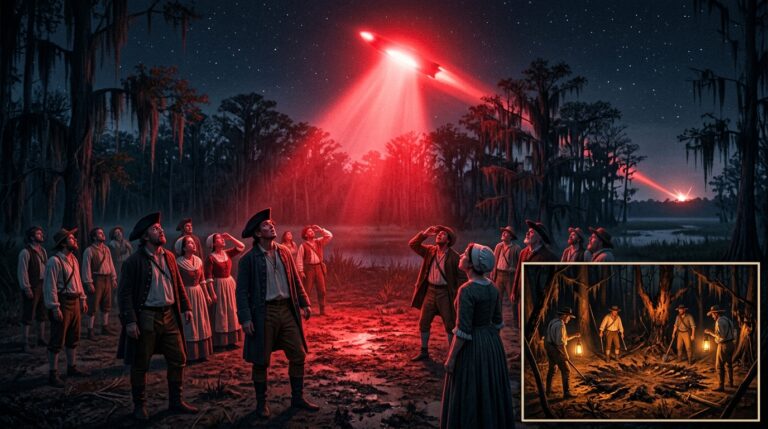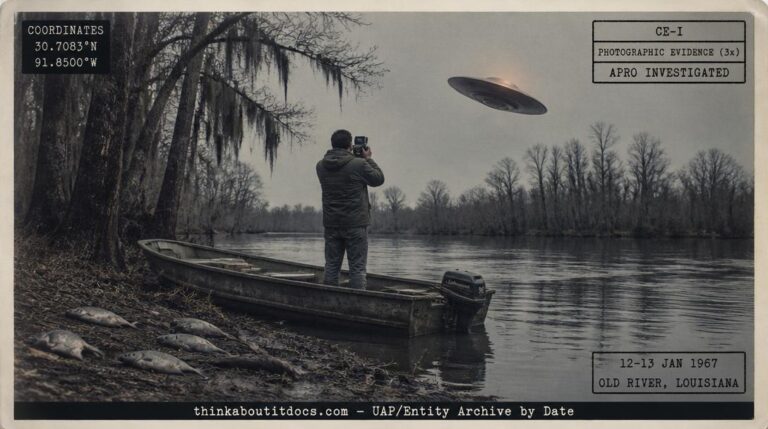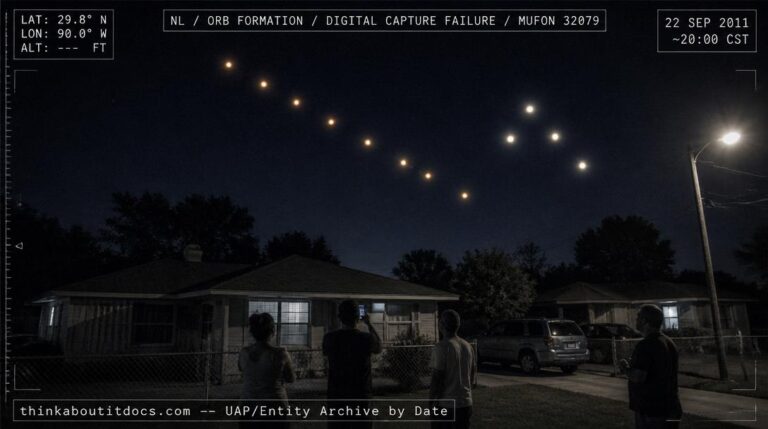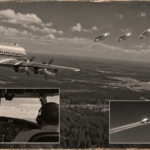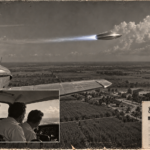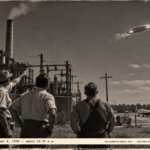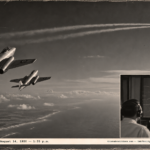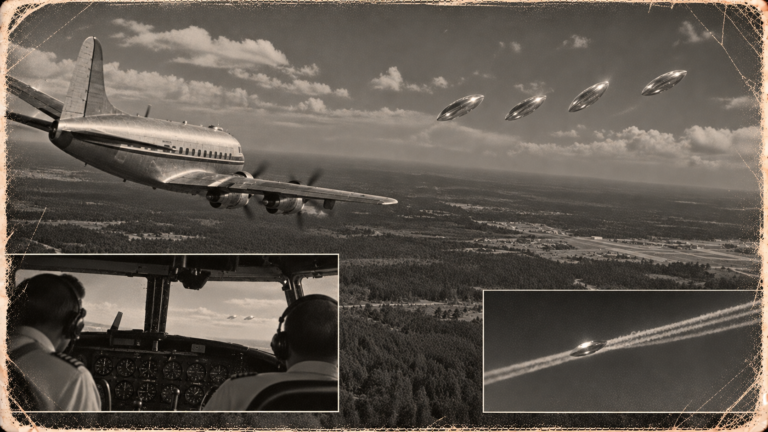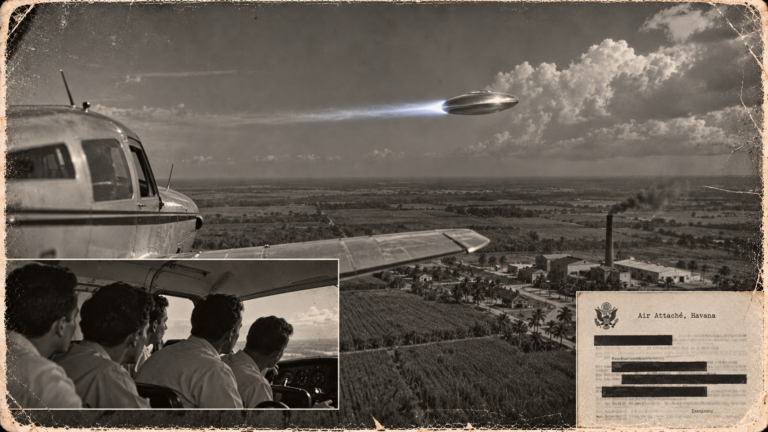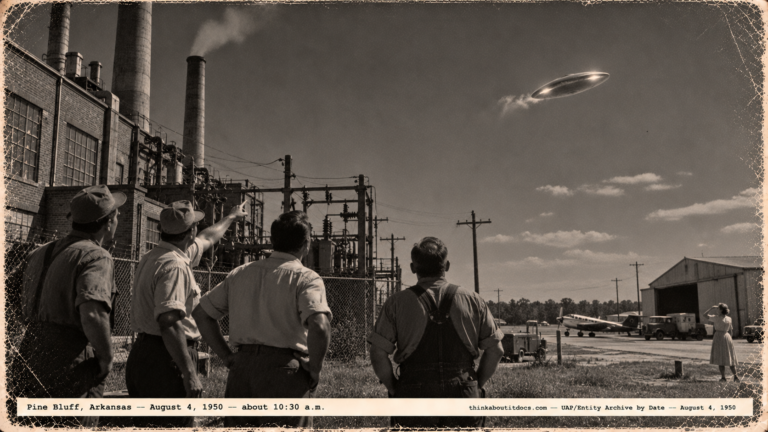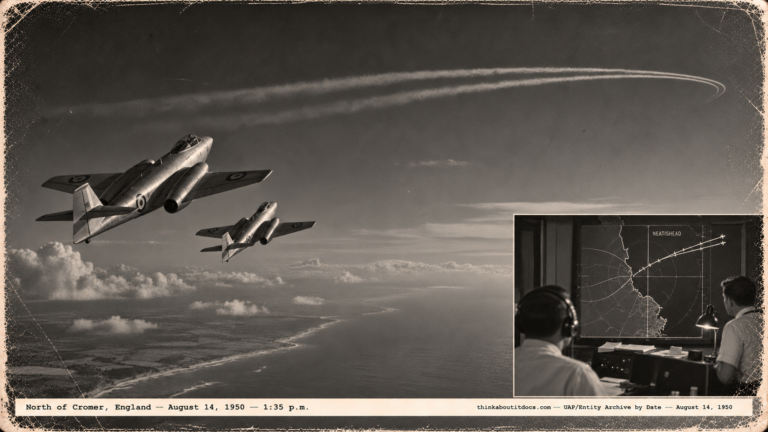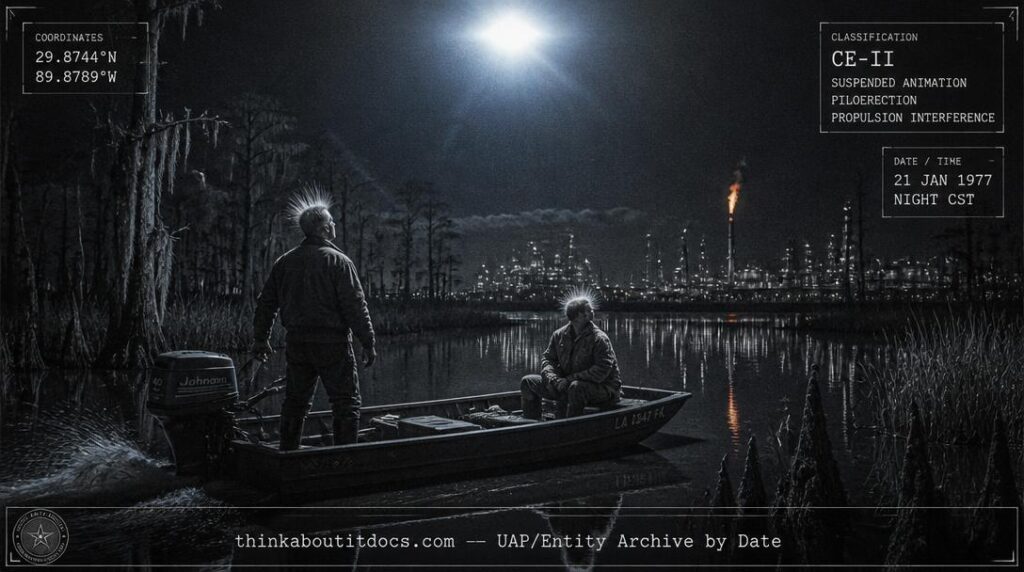
A dossier-style reconstruction of the Yscloskey suspended-animation encounter of January 21, 1977 — the centerpiece of the 1977 Louisiana UFO flap, where two hunters were physically immobilized by a hovering object above their boat in the bayous near the Shell refinery.
THINK ABOUTIT UFO|UAP SIGHTING REPORT
1977 Louisiana UFO Flap: The Yscloskey Suspended Animation Case
On a Friday night in January 1977, two nutria hunters motoring through the bayous near the Yscloskey Shell refinery in southeastern Louisiana were overtaken by a giant light that dropped to 65 to 75 feet above their boat — and then something happened that has no comfortable explanation. Their hair stood on end. The boat stopped moving forward even though the outboard motor continued to churn water. Their bodies locked in place — unable to move, though they could still speak — as though held in suspended animation by an unseen force. When the light suddenly departed, the boat lurched forward with such violence that both men were thrown to the deck. The object then spent the next thirty minutes conducting what witnesses described as an “inspection tour” of the Shell refinery and the Yscloskey water tower. This event was the centerpiece of a broader Louisiana UFO flap spanning January and February 1977, investigated by APRO field researcher Ted Peters and documented in the APRO Bulletin, that produced at least eight independent sighting clusters across the New Orleans metropolitan area and the surrounding bayou country.
CE-II Physical Effects Case: The Yscloskey encounter involved documented physical effects on the witnesses (immobilization, piloerection) and the environment (boat propulsion interference, violent forward surge upon departure). These effects elevate the case from a simple sighting to a Close Encounter of the Second Kind (CE-II) with possible physiological interaction.
Date: January 21, 1977 (Yscloskey event); wave period January 15 – February 9, 1977
Sighting Time: Multiple (mostly nighttime; February 8 was daytime)
Day/Night: Both
Location: Louisiana — Yscloskey (primary CE-II), Chalmette, New Orleans, and surrounding areas
Urban or Rural: Both (New Orleans urban areas and rural bayous)
No. of Entity(‘s): None observed
Entity Type: Not Applicable
Entity Description: Not Applicable
Hynek Classification: CE-II (Close Encounter II) Observation of an object in close proximity to the witness, where physical effects on the environment or witnesses are noted
Duration: Yscloskey encounter: several minutes of direct overhead presence plus 30 minutes of object activity around the refinery. Individual sightings across the wave ranged from 15 seconds to 30 minutes.
No. of Object(s): Multiple objects across the wave (individual events involved single objects)
Description of the Object(s): Variable across the wave — intensely bright light source (Yscloskey), dome-shaped craft with red and yellow lights and rotating propeller-like structures (Chalmette), upside-down saucer with a dome and rotating rim lights in blue, green, and white (Rodriguez sighting), cigar-shaped phosphorus-green glowing object (Wetta sighting), chained lights at 500 feet (Digangi sighting).
Shape of Object(s): Disc / Dome-shaped / Cigar-shaped (varies by event)
Size of Object(s): Variable — from compact-car size to significantly larger than commercial aircraft
Color of Object(s): Silvery, reddish-orange, phosphorus green, amber, blue-white
Distance to Object(s): Yscloskey: 65 to 75 feet overhead. Other sightings ranged from 2,000 feet to overhead positions.
Height & Speed: Yscloskey object dropped to 65–75 feet; other sightings included hover, erratic movement, and instantaneous departure
Number of Witnesses: Multiple named witnesses across the wave — Irwin Menesses and Robert Melerine (Yscloskey); Peter and Mrs. Digangi (Chalmette); Mrs. Gayle Rodriguez and Brian Rodriguez; Mark and Damian Boudreaux; Mrs. Claire Wetta; a car of six witnesses including three adults (Chalmette near-landing); Officer Hubert Roberts
Special Features/Characteristics: Yscloskey: heat emission, piloerection (hair standing on end), suspended animation (witnesses immobilized but able to speak), boat propulsion interference (motor running but boat stationary), violent forward surge upon object departure. Chalmette near-landing: dome-shaped craft with propeller-like rotating structures descended behind trees. Rodriguez: saucer with rotating rim lights that changed color, three antenna-like protrusions with lights atop the dome, movement in uneven spurts with stops. Wetta: cigar-shaped phosphorus-green object that “blinked out” in place without flying away. Post-flap: the object spent 30 minutes around the Shell refinery and Yscloskey water tower, suggesting interest in energy infrastructure.
Case Status: Unexplained
Source: Ted Peters, APRO Bulletin, Vol. 25, No. 9, March 1977
Summary/Description: The first two months of 1977 produced a concentrated wave of UFO activity across southeastern Louisiana, investigated by APRO field researcher Ted Peters and documented in the March 1977 APRO Bulletin. The peak event occurred on January 21 near the Yscloskey Shell refinery, where two nutria hunters — Irwin Menesses and Robert Melerine — experienced physical immobilization, piloerection, and boat propulsion failure when an intensely bright object descended to 65–75 feet above their vessel. Supporting sightings across the wave included multi-witness observations in Chalmette, a near-landing witnessed by six people, a daytime saucer observation by the Rodriguez family, a cigar-shaped green object over City Park, and multiple independent observations by named witnesses. The wave’s geographic concentration around energy infrastructure (Shell refinery, water towers) and its independent multi-cluster structure argue against mass hysteria or media contagion as explanations.
Related Cases: 1977: Flora, MS — Deputy Creel CE-I | 1977: Six Witnesses — Jayess, MS | 1967: Baton Rouge — Old River Encounters
Detailed Report
The 1977 Louisiana UFO flap is one of the most thoroughly documented regional wave events in the civilian research record, owing to the field investigation conducted by APRO researcher Ted Peters, who interviewed witnesses, examined landing sites, and compiled the results into a detailed article for the APRO Bulletin.
The wave began on January 15, 1977, when Peter and Mrs. Digangi of Chalmette observed a bright light hovering near a water tower along Judge Perez Highway. Through their windshield, driving west, they watched what appeared to be three lights chained together at approximately 500 feet altitude, steady and close, for 10 to 15 minutes. Three days later, on January 18, the Digangis’ teenage daughter and a friend saw the same object near the family home on Jackson Boulevard.
The most dramatic event of the wave occurred on Friday, January 21. Irwin Menesses and Robert Melerine, nutria hunters, were motoring along a bayou near the Yscloskey Shell refinery when an intensely bright object emitting heat descended to an altitude of 65 to 75 feet directly above their boat. The physical effects were immediate and extraordinary. Melerine’s hair stood on end — a piloerection response consistent with exposure to a strong electrostatic field. The boat stopped forward motion despite the outboard motor continuing to operate and churn water — a selective propulsion failure suggesting the object was generating a field that immobilized the vessel without affecting the engine mechanically. Most dramatically, both men found their bodies locked in place. They were conscious and able to speak, but unable to move — a state they described as suspended animation.
When the light suddenly departed, the boat lurched forward with such force that both men were thrown to the deck — consistent with a sudden release of the immobilizing field while the engine was still generating thrust. The object remained visible for another 30 minutes, conducting what the witnesses described as an inspection tour of the Shell refinery and the Yscloskey water tower — suggesting operational interest in energy infrastructure.
The following night, January 22, produced two independent sightings. Mark and Damian Boudreaux stood on the porch of Mark’s house on Milan Street and watched a reddish-orange light hover, move south, stop, reverse direction, and head north over western New Orleans. Damian, who had worked at the airport and knew how conventional aircraft appear at night, stated the object was much bigger and brighter than any airplane and performed maneuvers no airplane could execute.
On the same night, a car carrying six people — three adults and three children — turned north off Judge Perez Highway onto Jean Lafitte Parkway in Chalmette. Through the left windows, they observed a dome-shaped craft with red and yellow lights and what appeared to be rotating propeller-like structures, bouncing and dipping above the trees approximately 2,000 feet ahead. The witnesses parked in the middle of the boulevard and watched through the windshield for 10 minutes as the craft repeatedly bounced behind the trees before angling sharply down into the forest. The group drove home in awe and decided to tell no one. They were not contacted by investigators until February 12. An examination of the potential landing area revealed no traces.
On January 25, Mrs. Claire Wetta spotted a cigar-shaped, phosphorus-green glowing object north of the I-10 expressway near City Park. The object was longer and narrower than the Goodyear Blimp and emitted two different shades of bright green. After approximately 15 seconds, it blinked out — not flying away but simply turning off in place, too high to have dropped behind a tree or building.
On February 8, the wave produced its only confirmed daytime sighting. Mrs. Gayle Rodriguez and her son Brian were driving east on St. Bernard Highway when they observed a silvery craft fly across the highway in front of them and begin a parallel course. The object moved in uneven spurts — shooting forward, then stopping. During one stop it tilted toward the car, revealing a flat-bottomed, dome-topped saucer shape. Near the bottom edge, a row of individual lights merged into a blur when rotating, changing between blue, green, and bright white. Atop the dome were three antenna-like protrusions with lights — two small white and one larger red.
The wave extended eastward into Mississippi on February 9, where the Madison County law enforcement sighting near Flora occurred, and continued with the Jayess family sighting on February 5 — collectively establishing a cross-state corridor of UAP activity spanning the entire Mississippi-Louisiana Gulf Coast.
Researcher’s Notes
The Yscloskey Suspended Animation — Louisiana 1977 and the Physics of Immobilization
- Classification — CE-II Confirmed with Physiological Component: The Yscloskey event satisfies CE-II criteria decisively: physical effects on the witnesses (immobilization, piloerection), the environment (boat propulsion interference despite a running engine), and a violent kinetic release upon departure. The piloerection — hair standing on end — is a physiological response consistent with exposure to a strong electrostatic or electromagnetic field. The immobilization with preserved consciousness and speech is one of the most commonly reported physiological effects in CE-II and CE-III literature, often described in terms consistent with a field-based restraint rather than chemical or neurological paralysis. The boat propulsion failure is particularly informative: the engine continued to operate, the propeller continued to churn water, but the vessel did not move forward — suggesting an external force acting on the boat’s hull or the water itself rather than on the mechanical systems.
- Source Chain Assessment — APRO Field Investigation: This wave was investigated on the ground by Ted Peters, a trained APRO field investigator who conducted in-person interviews with multiple witness groups and examined a potential landing site. The results were published in the APRO Bulletin, Vol. 25, No. 9, March 1977 — a peer-reviewed civilian research publication. Named witnesses include Irwin Menesses, Robert Melerine, Peter Digangi, Mrs. Digangi, Mrs. Gayle Rodriguez, Brian Rodriguez, Mark Boudreaux, Damian Boudreaux, Mrs. Claire Wetta, and Officer Hubert Roberts. The diversity of the witness pool — hunters, families, an airport worker, a police officer, children — and the geographic spread of the sightings across multiple municipalities argue strongly against coordinated fabrication or single-source contamination.
- Infrastructure Interest Pattern — Refineries and Water Towers: The Yscloskey object’s 30-minute post-encounter activity around the Shell refinery and the local water tower fits a documented pattern in the UAP literature of apparent interest in energy infrastructure, water sources, and military installations. Similar concentrations around power plants, nuclear facilities, reservoirs, and industrial complexes have been reported globally. The refinery-and-water-tower focus suggests either direct operational interest in these facilities or the use of their electromagnetic or thermal signatures as navigational or operational reference points.
- Wave Structure — Independent Cluster Analysis: The 1977 Louisiana wave is analytically significant because its constituent events are structurally independent. The Digangi sightings (January 15 and 18) preceded media coverage. The Yscloskey event (January 21) involved witnesses in an isolated bayou environment unlikely to have been influenced by urban media. The Chalmette near-landing witnesses (January 22) explicitly decided to tell no one and were not contacted until February 12. The Rodriguez daytime sighting (February 8) described a morphologically different craft from other events. This independence of observation — different witnesses, different locations, different dates, different object descriptions — is the strongest structural argument against media contagion or mass suggestion as explanations for the wave.
The 1977 Louisiana flap is a case study in what a regional wave looks like when a trained investigator gets to the witnesses before the stories cool. Ted Peters talked to the hunters, the families, the airport worker, the children. He examined the landing site. He documented eight independent sighting clusters across a three-week window and published the findings in a peer-reviewed bulletin. The Yscloskey event sits at the center — two men in a boat, hair standing on end, bodies locked, the motor screaming against something that would not let them move. When the field released, the boat threw them to the deck. The object then spent half an hour touring the Shell refinery. Whatever it was doing, it was not random. Whatever it was, it was interested in something specific. The record stands, and the bayou is still dark.