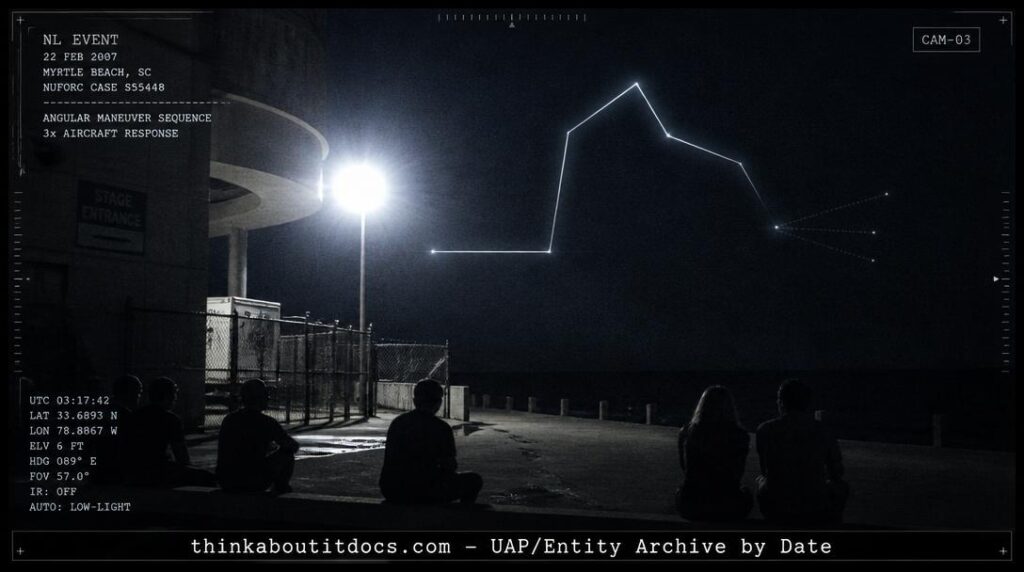
February 22, 2007 — A faint white ball of light executes a series of sharp angular maneuvers over the Atlantic Ocean east of Myrtle Beach, South Carolina. Three aircraft converged on the area approximately 5–7 minutes after the light disappeared. Observed from behind the House of Blues; filed with NUFORC.
THINK ABOUTIT UFO|UAP SIGHTING REPORT
2007: White light over ocean in Myrtle Beach, SC
At approximately 11:30 p.m. on February 22, 2007, a concert-goer sitting on the curb behind the House of Blues in Myrtle Beach, South Carolina, watched a small, faint, hazy white ball of light travel at extraordinary speed over the Atlantic Ocean, execute a series of sharp angular turns — including a near-90-degree vertical ascent, a sharp angled climb, a downward turn, and a backward-angled descent — all without any deceleration, resume its original horizontal path, fade out and reignite twice, and then disappear for good. Five to seven minutes later, three aircraft converged on the area from different directions, circled, and returned — behavior the witness interpreted as an investigative response.
Filed with the National UFO Reporting Center under the directorship of Peter Davenport, this is a straightforward nocturnal light report from a single anonymous witness. Its analytical interest lies primarily in the described flight dynamics — sharp angular course changes at sustained high speed — and the subsequent aircraft activity, which, if accurately observed, suggests the light was detected by other means as well.
Date: February 22, 2007
Sighting Time: Approximately 11:30 p.m.
Day/Night: Night
Location: Myrtle Beach, South Carolina — behind the House of Blues, facing east over the Atlantic Ocean
Urban or Rural: Urban — commercial/entertainment district, oceanfront
No. of Entity(‘s): None observed
Entity Type: Not Applicable
Entity Description: Not Applicable
Hynek Classification: NL (Nocturnal Light) — Point luminous source observed at night at distance over the ocean
Duration: 25–30 seconds (primary observation); several additional minutes observing subsequent aircraft activity
No. of Object(s): 1
Description of Object(s): Small, faint, hazy white ball of light; resembled a star in character; no structural detail discernible at distance
Shape of Object(s): Point source / ball of light
Size of Object(s): Not determinable — appeared as a point source at estimated distance of 1+ miles
Color of Object(s): White — hazy, faint
Distance to Object(s): Estimated at least one mile or more over the ocean (shoreline approximately 0.7 miles from witness position per Google Earth measurement; object was beyond the shore)
Height & Speed: Speed described as extremely fast — initially mistaken for a high-speed jet but faster than any aircraft the witness had observed; executed sharp angular turns without deceleration
Number of Witnesses: 1 (anonymous; approximately 30 people were present in the area but witness chose not to alert them)
Special Features/Characteristics: Sharp angular course changes at sustained high speed (near-90-degree turns without deceleration); traveled in straight-line segments between turns; faded out and reignited twice during observation; three aircraft converged on the area 5–7 minutes after the light disappeared, circled, and departed — behavior interpreted as an investigative response
Case Status: Unexplained
Source: NUFORC (National UFO Reporting Center), Report S55448, Peter Davenport, Director
Summary/Description: A single witness observed a small, faint white ball of light traveling at extreme speed over the Atlantic Ocean east of Myrtle Beach, SC, at approximately 11:30 p.m. on February 22, 2007. The light executed a series of sharp angular course changes — including near-vertical ascents and descents — without any visible deceleration, then resumed its original horizontal path, faded out and reignited twice, and disappeared. Approximately 5–7 minutes later, three aircraft converged on the general area from different directions, circled, and departed. The witness documented the sighting the following morning and filed with NUFORC.
Related Cases: 1981 Newberry, SC — Cigar-Shaped Object on Water | 1980 Easley, SC — Garrett Daylight Disc
Detailed Report
The witness, who remains anonymous, had attended a Slayer concert at the House of Blues in Myrtle Beach, South Carolina, on the evening of February 22, 2007. After the show, the witness was sitting on the curb behind the venue, facing due east toward the Atlantic Ocean, waiting in a crowd of approximately 30 people for band autographs. The witness described himself as perfectly sober though fatigued from the concert.
The weather was windy and relatively clear. It was between 11:30 p.m. and midnight. The witness was watching the sky, noting typical air traffic and seagulls. Behind the venue, a fence taller than the witness stood approximately 20–30 feet away; beyond it, a light pole and distant hotels were visible along the coastline.
The witness noticed a small, faint, hazy white light moving across the sky at extraordinary speed. His initial reaction was that it was a jet traveling faster than any he had seen before, but the light’s star-like character — a featureless white ball with no navigation lights, no strobe, and no sound — quickly eliminated conventional aircraft. The witness estimated the light was well over the ocean, at least a mile or more from his position (the shoreline being approximately 0.7 miles east of the House of Blues per the witness’s later Google Earth measurement).
The light’s path began as a horizontal traverse lasting approximately five seconds. It then executed a series of sharp angular turns in rapid succession: a near-90-degree turn upward (appearing to go straight up), then a sharp angled turn continuing upward and away, then a downward-angled turn, and another turn downward and backward. These turns occurred within approximately 1–3 seconds. The maneuvers were performed in straight-line segments — no curves, no spiraling — connected by sharp angular changes. The light showed no visible deceleration during any turn.
After completing this maneuver sequence, the light resumed its original horizontal trajectory. It then faded out gradually — like a lightbulb dimming — and instantly reignited at full brightness. The witness tracked it past the interference of the light pole and continued watching. On the far side of the light pole, the light faded out a second time and did not reappear.
The witness continued watching the sky. Approximately 5–7 minutes after the light’s disappearance, two aircraft appeared from the north, traveling along or near the coastline in the direction of the light’s last position. At approximately the same time, a third aircraft appeared from the southwest or a similar bearing. The two northern aircraft continued south past the area, then turned and returned. The southwestern aircraft continued north for several minutes before also reversing course. The witness interpreted this convergent aircraft activity as an investigative or search response.
The witness chose not to alert the approximately 30 people nearby, citing reluctance to draw attention or lose track of the object. He also did not think to use the camera in his pocket until after the event. He documented the sighting the following morning and subsequently filed a report with NUFORC, including reference to supplementary files with diagrams of the light’s flight path.
Researcher’s Notes
The Myrtle Beach Light — South Carolina 2007 and Angular Dynamics Over the Atlantic
- Classification Confirmation — NL Appropriate: This is a textbook NL (Nocturnal Light) case. The object was observed as a point luminous source at a distance exceeding one mile, with no structural detail discernible. The classification is straightforward and correct. The analytical interest lies not in proximity but in the described flight dynamics — the sharp angular course changes at sustained speed that distinguish this from a conventional aircraft or satellite.
- Flight Dynamics — The Angular Maneuver Problem: The witness describes a flight path consisting entirely of straight-line segments connected by sharp angular turns executed without visible deceleration. If the observation is accurate, this pattern eliminates all conventional explanations that rely on aerodynamic flight: conventional aircraft, birds, balloons, and drones all exhibit curved flight paths during course changes due to the physics of turning in a fluid medium. Sharp-angle, no-deceleration turns imply either a propulsion system that can instantaneously redirect momentum (non-inertial flight), or an observational artifact at extreme distance where subtle curves appear as angles. The latter is plausible at 1+ mile range, where angular resolution is poor and short segments of a gradual curve could appear as distinct straight segments. However, the witness’s description of the maneuver pattern — up, up-and-away, down, down-and-back, resume — is highly specific and suggests deliberate controlled flight rather than random drift.
- The Aircraft Response — Convergent Activity: The appearance of three aircraft from multiple directions within 5–7 minutes of the light’s disappearance, converging on the same general area and executing search-pattern behavior, is the strongest secondary detail in this account. Myrtle Beach is within the airspace of Shaw Air Force Base, and military coastal surveillance operations are common along the South Carolina coast. If the aircraft were responding to the same anomalous target, it would imply detection through independent means (radar, coastal surveillance systems, or separate visual observation) — which would constitute a form of indirect corroboration. However, the aircraft activity could also be routine coastal patrol unrelated to the light, and the witness’s interpretation of their behavior as “investigative” may reflect post-hoc pattern-matching.
- Source Assessment — NUFORC Filing: The report was filed with the National UFO Reporting Center (NUFORC), the longest-running civilian UFO reporting database in the United States, under the directorship of Peter Davenport. NUFORC reports are self-submitted and generally unedited, providing a raw record of witness testimony without investigative verification. The witness demonstrates analytical habits — using Google Earth to calculate distances, documenting the sighting the following morning, waiting to see if others reported the same event — that suggest a methodical disposition. The account is internally consistent and avoids embellishment, though the witness acknowledges prior belief in UFO phenomena.
- Myrtle Beach Pattern — Coastal Hotspot: Myrtle Beach and the Grand Strand corridor of South Carolina have generated a steady stream of nocturnal light reports over the past two decades, including recurring descriptions of orange orbs over the ocean that became prominent in the 2010s. The 2007 report predates the peak of this more recent activity and describes a different type of observation (fast-moving white point source rather than slow-drifting orange orbs), but it contributes to the broader pattern of anomalous nocturnal light activity along the South Carolina coast. The oceanfront orientation — lights observed over open water where conventional ground-reference distance cues are absent — is a recurring factor in coastal NL reports and complicates observational precision.
The Myrtle Beach light of February 2007 is a minor entry in the South Carolina archive — a single anonymous witness, a brief observation of a distant point source, and no physical evidence. What lifts it slightly above the baseline is the specificity of the flight-path description, the witness’s methodical documentation habits, and the convergent aircraft activity that followed. It is the kind of case that can neither be proved nor dismissed, and it occupies the space the archive was built to hold: the honest uncertainty between the explained and the extraordinary.