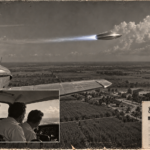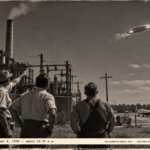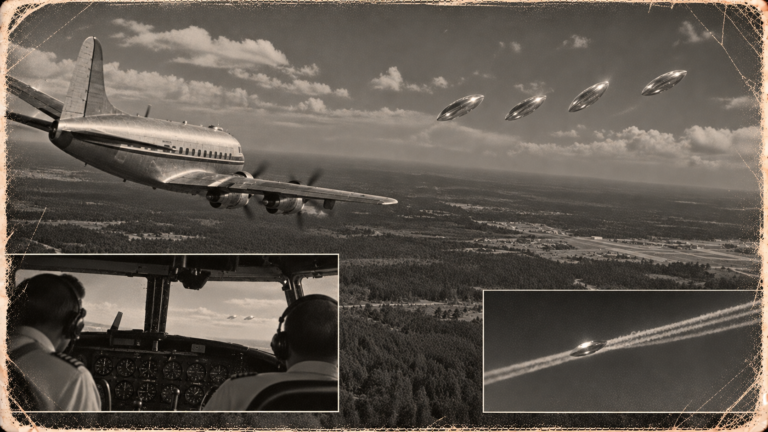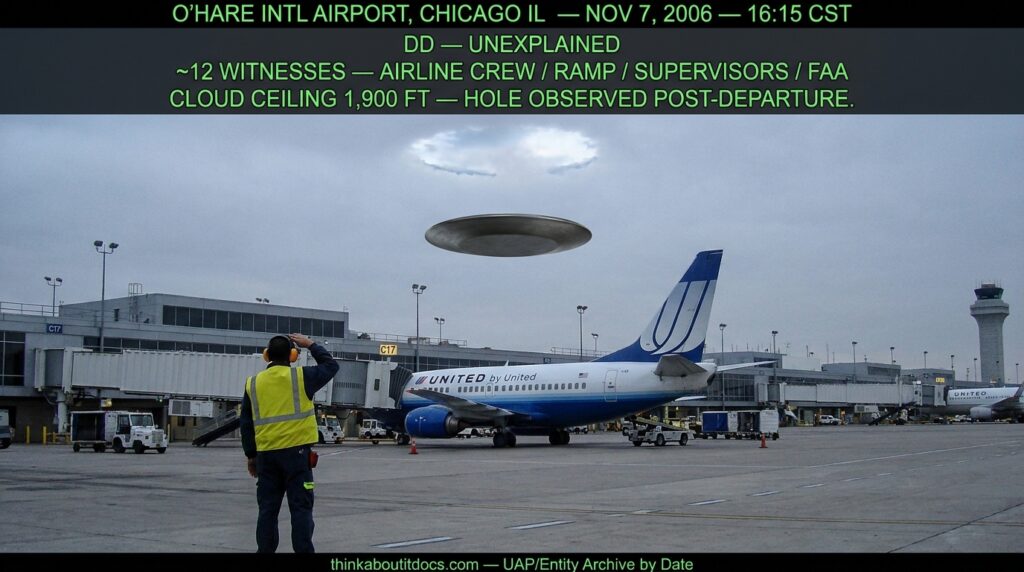
O'Hare International Airport, Chicago, Illinois, November 7, 2006, 4:15 PM — Approximately twelve witnesses including United Airlines ramp crew, flight crew of Flight 446, and supervisors observe a dark gray metallic disc hovering silently at 1,400 feet above Gate C17 before it accelerates vertically through the 1,900-foot overcast, leaving a persistent hole in the cloud ceiling.
THINK ABOUTIT UFO|UAP SIGHTING REPORT
2006: Multiple witnesses observe disc-shaped object over Chicago O’Hare Airport
At approximately 4:15 PM on November 7, 2006, a United Airlines ramp employee pushing back Flight 446 at Gate C17 of Chicago O’Hare International Airport — one of the busiest airports on earth — looked up and saw a dark gray, metallic, disc-shaped object hovering silently directly above his position at an estimated 1,400 to 1,500 feet, just below the 1,900-foot cloud ceiling. He notified the flight crew of Flight 446, whose pilot and copilot observed the object. He notified his supervisors, who also observed it. Federal authorities at O’Hare — both the FAA and the Transportation Security Administration — were notified while the event was still in progress, and personnel in one or more control towers may have observed the object with binoculars. Approximately a dozen witnesses in total watched the disc hover motionless for an estimated two to five minutes before it accelerated straight upward at extreme velocity and punched a clearly visible hole through the solid overcast cloud layer — a hole that persisted and was observed by multiple witnesses after the object had vanished. The FAA declined to investigate, calling the object a “weather phenomenon.” The case, broken by the Chicago Tribune in January 2007, became one of the most widely reported American UFO events of the twenty-first century and generated the single highest volume of traffic in the history of the Chicago Tribune’s website.
Date: November 7, 2006
Sighting Time: Approximately 4:15–4:30 PM CST
Day/Night: Late afternoon / daylight (just before sunset, solid overcast)
Location: Chicago O’Hare International Airport, Gate C17, Chicago, Cook County, Illinois
Urban or Rural: Urban — major international airport environment
No. of Entity(‘s): None observed
Entity Type: N/A
Entity Description: N/A
Hynek Classification: DD (Daylight Disc) Metallic or solid object observed in daylight
Duration: Estimated 2–5 minutes of hovering; some witnesses reported observing for up to 18 minutes; the hole in the cloud ceiling persisted after the object departed
No. of Object(s): 1
Description of Object(s): Dark gray, metallic, well-defined disc or saucer shape. Described by some witnesses as resembling a “rotating Frisbee.” No lights observed. Appeared to be spinning or rotating. Hovered silently and motionlessly beneath the cloud ceiling before departing straight upward at extreme velocity, punching a clearly visible hole through the solid overcast.
Shape of Object(s): Disc / saucer
Size of Object(s): Estimates varied widely — from 6 feet to 88 feet in diameter; the most commonly cited estimate was approximately 24 feet. The first witness estimated its angular size as equivalent to a U.S. quarter held at arm’s length.
Color of Object(s): Dark gray, metallic
Distance to Object(s): Hovering approximately 1,400–1,500 feet above ground level, directly above Gate C17
Height & Speed: Hovering motionless at 1,400–1,500 feet AGL, just below the 1,900-foot cloud ceiling. Departed by accelerating straight upward at extreme velocity through the solid overcast, leaving a visible hole in the cloud layer.
Number of Witnesses: Approximately 12 or more — including United Airlines ramp workers, supervisors, the pilot and copilot of Flight 446 (Chicago to Charlotte), and possibly FAA control tower personnel observing with binoculars
Special Features/Characteristics: Object appeared to be spinning or rotating; hovered motionless below cloud ceiling; departed straight upward at extreme velocity; punched a clearly visible, persistent hole through the 1,900-foot solid overcast cloud layer upon departure; no lights observed; FAA reported object was not visible on radar (unconfirmed); both FAA and TSA were notified while the event was in progress; multiple aviation-industry professionals among the witnesses; FAA declined to investigate, attributing the sighting to a “weather phenomenon”
Source: NUFORC (National UFO Reporting Center), Peter Davenport, Director; Chicago Tribune (Jon Hilkevitch, January 1, 2007); multiple subsequent media outlets
Case Status: Unexplained
Summary/Description: On November 7, 2006, at approximately 4:15 PM, approximately twelve witnesses — including United Airlines ramp employees, flight crew of Flight 446, airline supervisors, and possibly FAA tower personnel — observed a dark gray, metallic, disc-shaped object hovering silently at 1,400–1,500 feet directly above Gate C17 at Chicago O’Hare International Airport. The object hovered motionless below the 1,900-foot cloud ceiling for an estimated 2–5 minutes before accelerating straight upward through the overcast, punching a clearly visible hole in the cloud layer. Both the FAA and TSA were notified during the event. The FAA reported the object was not visible on radar and declined to investigate, calling it a “weather phenomenon.” The case was broken by Chicago Tribune reporter Jon Hilkevitch in January 2007 and generated the highest web traffic in the Tribune’s history.
Related Cases: Grayslake Silver Saucer (January 17, 2007) — same metropolitan area, two months later, witness explicitly connected his sighting to O’Hare | Northbrook Disc Formation (May 27, 2006) — same area, same year
Detailed Report
The O’Hare Airport UFO incident of November 7, 2006, is one of the most significant American UFO cases of the twenty-first century — distinguished by the quality and professional credentials of its witnesses, its occurrence in a highly controlled and surveilled environment, the physical trace evidence (the hole in the cloud ceiling), and the institutional response that followed.
The National UFO Reporting Center (NUFORC), directed by Peter Davenport, received the initial report from a source who wished to remain anonymous but whose credentials and documentation Davenport described as satisfactory to establish the report’s veracity. NUFORC delayed public release of the case to allow for investigation and to secure documentation before it could be “concealed, or destroyed.”
The sequence of events began at approximately 4:15–4:30 PM Central Standard Time on Tuesday, November 7, 2006. A United Airlines ramp employee was engaged in pushing back Flight 446, scheduled to depart Gate C17 for Charlotte, North Carolina. While performing his duties, the employee looked up and observed a disc-shaped object hovering essentially motionless directly above his position at Gate C17. The object was dark gray and metallic in appearance, appeared to be perfectly round, and its angular size was approximately equivalent to a U.S. quarter held at arm’s length. The object appeared to be spinning.
The ramp employee immediately notified the flight crew of Flight 446, and both the pilot and copilot are believed to have observed the object. He also contacted his supervisors, who witnessed it as well. In total, approximately a dozen individuals observed the object during its presence above Gate C17. Both the Federal Aviation Administration and the Transportation Security Administration were notified while the event was ongoing. Personnel in one or more of O’Hare’s control towers may have observed the object, possibly using binoculars.
The object hovered for an estimated two to five minutes (some witnesses reported longer durations of up to eighteen minutes). It then accelerated straight upward at very high velocity, passing through the solid overcast cloud ceiling, which stood at 1,900 feet at the time. Multiple witnesses reported that the object’s departure left a clearly visible hole in the cloud layer — a physical artifact that persisted after the object had vanished and was observed by witnesses as a distinct circular break in the otherwise uniform overcast.
The FAA reported that the object was not visible on radar, though this claim has not been independently confirmed. The FAA declined to conduct a formal investigation, attributing the sighting to a “weather phenomenon” — an explanation that does not account for a metallic disc observed by a dozen witnesses hovering motionless below a cloud ceiling and then punching a persistent hole through it upon vertical departure.
The case remained largely unknown to the public until Chicago Tribune transportation reporter Jon Hilkevitch broke the story on January 1, 2007. The resulting article generated the single highest volume of web traffic in the Chicago Tribune’s history, crashing the newspaper’s servers. Subsequent coverage appeared across virtually every major American and international news outlet. The intensity of public interest was widely interpreted within the UFO research community as evidence that the subject resonated far more broadly with the American public than the media and scientific establishments had assumed.
Researcher’s Notes
The O’Hare Disc — Chicago 2006 and the Airport-Environment UFO
- Classification Confirmation: DD (Daylight Disc) is correct. The object was observed in late-afternoon daylight under overcast conditions and described as a metallic, dark gray, solid disc shape — not a luminous source. The observation conditions — daylight, known cloud ceiling providing altitude reference, experienced aviation-industry witnesses — are among the best achievable for a DD observation.
- Source Chain Assessment: The source chain is strong but incomplete. NUFORC (Peter Davenport) received documented verification of the initial report. The Chicago Tribune’s Jon Hilkevitch conducted independent journalistic investigation, confirming multiple witnesses. However, the primary witnesses — United Airlines employees, flight crew, and supervisors — were constrained by employment considerations and largely remained anonymous or pseudonymous. No formal signed witness statements have been published. The FAA acknowledged receiving reports about the object but declined to investigate, which means no official investigative file exists. The case’s evidentiary strength rests on the number and professional credentials of the witnesses (aviation-industry personnel working in a controlled environment with known reference points for altitude, distance, and scale), the physical trace (the hole in the cloud ceiling), and the institutional acknowledgment that reports were received — rather than on any single signed document.
- The Cloud-Hole Physical Trace: The most analytically significant detail of the O’Hare case is the hole punched through the 1,900-foot overcast cloud ceiling upon the object’s vertical departure. This is a physical trace — an alteration of the physical environment observed by multiple witnesses after the object’s departure. A solid overcast cloud layer at a known altitude provides a measurable medium through which the object passed. The persistence of the hole (observed after the object had vanished) suggests a physical displacement or thermal disruption of the cloud layer rather than a simple visual artifact. This detail is difficult to reconcile with the FAA’s “weather phenomenon” explanation: weather phenomena do not hover as metallic discs below cloud ceilings, accelerate vertically, and punch persistent holes through the overcast.
- Institutional Response Pattern: The O’Hare case exemplifies a recurring institutional pattern in American UFO history: an event occurs in a controlled, surveilled environment with multiple credentialed witnesses; federal agencies are notified during the event; the agencies decline to investigate; and the official explanation is grossly inconsistent with the documented observations. This pattern — seen previously in the Wayne City 1963 case (Blue Book Director flies in personally, then explains it as “Venus”), the Illinois Triangle 2000 case (flight path passes within two miles of Scott AFB with no official acknowledgment), and numerous other incidents — raises questions about institutional response protocols that extend beyond the identification of any individual object. The FAA’s position that the object was “not visible on radar” is particularly noteworthy: if accurate, it describes an object with low or zero radar cross-section hovering in the approach corridor of one of the world’s busiest airports — a national security concern regardless of the object’s origin.
The O’Hare disc stands as one of the strongest DD cases in the modern American record. The combination of multiple aviation-industry witnesses, an active airport environment with known altitude references, a physical trace (the cloud hole), and institutional acknowledgment of the event places it in the first rank of documented UAP observations. The determination is Unexplained.