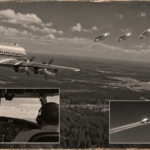
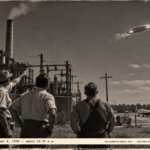
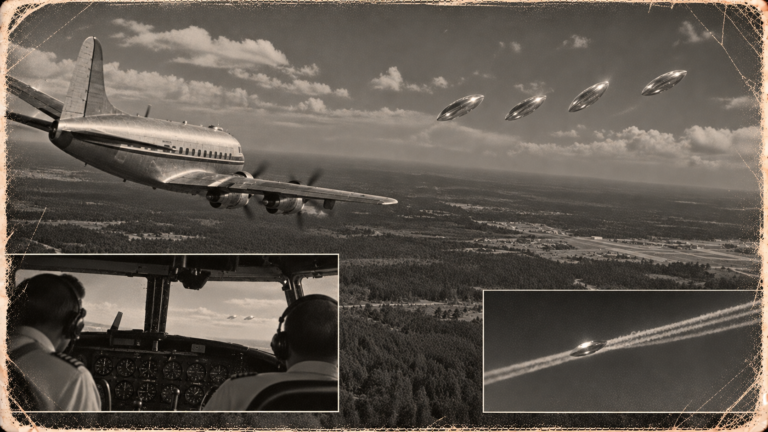
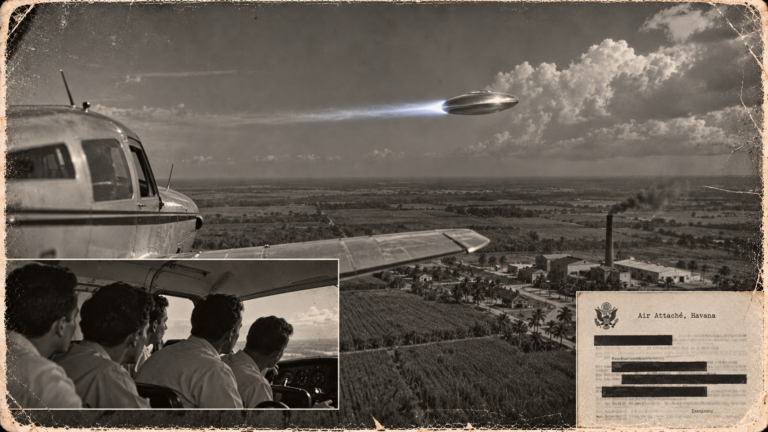
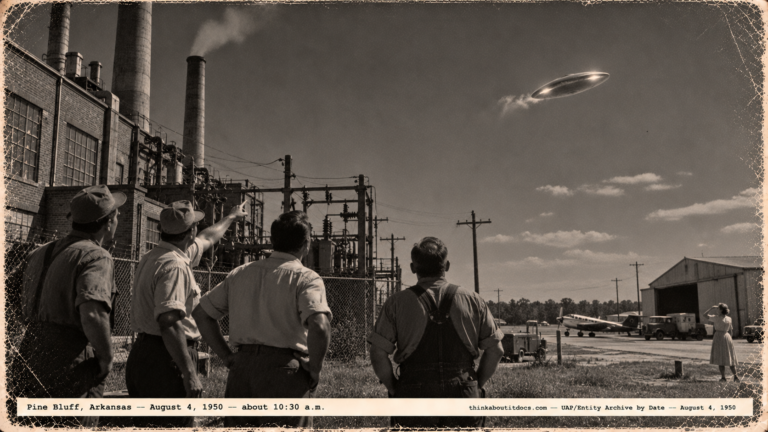
Recreation of the June 1966 Nha Trang, South Vietnam incident, in which a glowing object hovered just 300-500 feet above a US military base as engines across the installation reportedly stopped for four minutes.
THINK ABOUTIT UFO|UAP SIGHTINGS REPORT
1966: The Nha Trang, South Vietnam UFO and Base-Wide Blackout
On the night of June 19, 1966, hundreds of soldiers watching an outdoor movie at Nha Trang Air Base, South Vietnam saw the northern sky light up like daylight as a glowing object dropped from an estimated 25,000 feet to hover just 300-500 feet above the base — and in the same moment, every diesel and gasoline engine on the base, including two aircraft warming up for takeoff and an oil tanker anchored offshore, went dead for roughly four minutes.
Date: June 19, 1966 — the specific day, not given in this site’s original “June 1966” filing, is confirmed by an independent retrospective account; no other source contradicts it.
Sighting Time: 9:45 PM
Day/Night: Night
Location: Nha Trang Air Base, Khánh Hòa Province, South Vietnam — a large coastal joint US/South Vietnamese military installation situated in a valley, with warehouses and an airstrip to the east, fuel storage and hills to the west, and docks along the South China Sea to the south
Urban or Rural: Rural — a large military base set in a coastal valley, not within a civilian urban area
No. of Entity(‘s): Undocumented
Entity Type: Not Applicable — no entity described. The witness’s own letter jokes about “little green men” only to say he wouldn’t argue with anyone who claimed to see one — a hypothetical aside, not a claimed observation.
Entity Description: Not Applicable
Hynek Classification: CE-I (Close Encounter I) — observation of an object in close proximity to the witness, within 500 feet, with no reported physical trace or interaction beyond the associated electromagnetic effects. This fits the reported facts well.
Duration: 2-3 seconds for the object’s final vertical departure specifically; the full event, from initial sighting through the hover and the roughly four-minute engine stoppage, lasted considerably longer, though an exact total is not given.
No. of Object(s): 1
Description of the Object(s): A bright, glowing object first mistaken for an exploding flare, approaching from the north at an altitude jet pilots on base estimated at roughly 25,000 feet, moving from slow to very fast before dropping rapidly and coming to a complete stop 300 to 500 feet above the base. Its light was bright enough to illuminate the surrounding valley and mountains as if in daylight. It then ascended straight up and out of sight within 2-3 seconds.
Shape of Object(s): Undocumented — described only as a bright light source, with no distinct solid shape given in the witness’s account
Size of Object(s): Undocumented
Color of Object(s): Undocumented precisely — initially mistaken for a flare, implying a bright, glowing light, though no specific color is given in the witness’s own account
Distance to Object(s): 300 to 500 feet above the base at its closest, lowest point
Height & Speed: Estimated at approximately 25,000 feet when first noticed by jet fighter pilots on base, descending to 300-500 feet. Speed described as moving from very slow to very fast on approach, then departing straight up and out of sight in 2-3 seconds.
Number of Witnesses: Estimates vary by source, from several hundred to (per this site’s own summary) “possibly thousands” of soldiers stationed on the base at the time. Only one witness, an enlisted Specialist 5, was directly interviewed by the NICAP investigator; he recalled only the nicknames of fellow soldiers present, not their full names.
Special Features/Characteristics: At the moment of the object’s closest approach, diesel and gasoline engines across the base reportedly stopped simultaneously and remained inoperative for approximately four minutes — including the base’s newly installed generators, the engines of two “Sky Raider” propeller aircraft warming up for takeoff on a nearby runway, eight bulldozers operating on nearby hills, and, according to independent retrospective accounts, a Shell Oil tanker anchored offshore, which was reportedly left adrift. Officials reportedly flew in from Washington the following day to investigate, according to the witness’s letter, though this has not been independently confirmed.
Case Status: Insufficient Data — a striking account investigated by a credentialed NICAP researcher and published in 1973, but resting on a single named-to-the-investigator witness with no corroborating documentation or additional witnesses ever located in the more than five decades since, despite NICAP’s own stated efforts to find them
Source: NICAP (National Investigations Committee on Aerial Phenomena), published in the July 1973 issue of NICAP’s “UFO Investigator” newsletter; investigated by Raymond E. Fowler, a credentialed NICAP (later MUFON) researcher separately known for his investigation of the Betty Andreasson Luca case
Summary/Description: The Nha Trang incident, if thorough documentation can be obtained, could become a UFO “classic,” according to one NICAP investigator familiar with the case. The sighting allegedly occurred during one of the most active periods of the Vietnam conflict and understandably received little publicity at the time.
NICAP investigator Raymond Fowler conducted an initial investigation and was able to contact an eyewitness. Nha Trang, at the time, was a heavily defended base along the South Vietnamese coast, home to more than 40,000 troops including 2,000 American GIs, set in a valley with warehouses and an airstrip to the east, a fuel storage area and hills to the west, and docks along the South China Sea to the south. According to the witness, eight bulldozers were cutting roads that night near “Hawk Hill,” roughly half a mile west of the American compound, while two “Sky Raider” propeller aircraft warmed up on the airstrip less than a mile east, and a Shell Oil tanker lay anchored in the bay about a mile southwest.
The witness, an enlisted soldier holding the rank of Specialist 5, had gathered with fellow soldiers around 8 PM to watch an outdoor movie, made possible by newly installed 100 kW diesel generators, one of which powered the projector. At approximately 9:45 PM, the sky to the north lit up. In a letter home, the witness wrote: “At first we thought it was a flare which are going off all the time and then we found that it wasn’t. It came from the north and was moving from real slow to real fast… Some of the jet fighter pilots which were here… said it looked to be about 25,000 feet [in altitude]… then the panic broke loose. It dropped right towards us and stopped dead still about 300 to 500 feet up. It made this little valley and the mountains around look like it was the middle of the day; it lit up everything. Then it went up and I mean up. It went straight up and completely out of sight in about 2-3 seconds. Everybody is still talking about it.”
The witness’s letter continues: “That really shook everyone [was] that it stopped, or maybe it didn’t, but anyway our generator stopped and everything was black. At the Air Force Base about one half mile from here all generators stopped. The engines on two planes that were on the runway ready to take off stopped, and there wasn’t a car, truck, plane or anything that ran for about four minutes.” The eight bulldozers on the nearby hills also stopped, according to the witness. “A whole plane load of big shots from Washington got here this afternoon to investigate. It’s on the radio over here.”
The witness could recall only the nicknames of the fellow soldiers he served with, limiting further corroboration. NICAP was, at the time of the original 1973 report, attempting to contact appropriate Army officials to identify other witnesses and to confirm whether officials from Washington had in fact visited Nha Trang the day after the sighting.
Related Cases: Undocumented as a separate archive entry, though widely discussed in ufology literature alongside other Vietnam War-era military UFO reports
Detailed Report
This is among the more frequently cited Vietnam-era UFO cases in ufology literature, largely on the strength of its two most dramatic elements: a genuinely large potential witness pool (a base of over 40,000 personnel) and a specific, checkable claim of widespread electromagnetic interference. The account comes entirely from a single enlisted soldier, a Specialist 5, who described the event in a letter home shortly after it occurred and was later interviewed by NICAP investigator Raymond Fowler, whose write-up appeared in NICAP’s UFO Investigator newsletter in July 1973 — seven years after the event, once American involvement in the war had ended and, per the site’s original framing, many war-era incidents were beginning to surface publicly for the first time. The core narrative is vivid and specific: an object mistaken at first for a flare, estimated by on-base jet pilots at roughly 25,000 feet, that dropped rapidly to a near-stationary hover just 300-500 feet overhead, bright enough to turn night into day across the surrounding valley, before shooting straight up and out of sight in two to three seconds. What elevates the case beyond a simple light-in-the-sky report is the witness’s further claim that the base’s engines — new diesel generators, two aircraft warming up for takeoff, eight bulldozers, and, per other retrospective accounts, an offshore oil tanker — all stopped simultaneously and stayed dead for roughly four minutes. The witness recalled only the nicknames of the soldiers he served alongside, which has left NICAP (and, in the decades since, other researchers) unable to independently locate additional witnesses or documentary confirmation, despite genuine, stated efforts to do so.
RESEARCHER’S NOTES
The Nha Trang Blackout — 1966, a NICAP Classic, and Fifty Years Without Corroboration
- Classification Assessment: CE-I fits well — a close-range object with no reported physical trace beyond the electromagnetic effects, and no claimed interaction or entity of any kind.
- Source Chain Assessment: This case’s investigator, Raymond E. Fowler, was a genuine, credentialed figure in the field — a NICAP representative who later became MUFON’s Massachusetts State Director and is independently known for investigating the Betty Andreasson Luca abduction case, among others. That lends real institutional weight to the investigation itself. However, the underlying account rests on a single named-to-the-investigator witness whose only documentation is a personal letter home; no second witness, official record, or documentary trail has ever been located, a gap explicitly acknowledged by other ufology researchers who have examined the case since. Readers should also be aware that some other websites describing this case attach invented embellishments not found in the original NICAP investigation or any credible retrospective — including claims of 1967 photographs, radar corroboration, and a 1973 farmer’s field with radiation traces — details that do not appear in Fowler’s original work and should not be treated as part of this case.
- Evidentiary Weight: No photograph exists. As one researcher who has examined this case for a ufology retrospective has put it plainly: there is no documentary evidence or additional witness testimony to back up the claimed electromagnetic effects, and whether a UFO actually triggered a base-wide blackout can’t be confirmed absent a paper trail or further witnesses — a fair and honest summary of where this case actually stands, more than fifty years on.
- Pattern and Comparative Context: Reported electromagnetic interference effects (stalled engines, power failures) coinciding with a close UFO sighting are a well-documented report category internationally, cited in numerous UFO catalogs as one of the more evidentially significant sub-types precisely because such effects are, in principle, independently verifiable — if supporting records exist. In this case, the claimed scale (an entire base’s engines, simultaneously, for four minutes, including two active aircraft) is extraordinary, which makes the total absence of any surviving official incident report or maintenance log all the more notable.
- Geographic and Historical Context: Nha Trang Air Base was a major joint US/South Vietnamese installation on Vietnam’s central coast during one of the most intensive periods of the Vietnam War, a context of heavy military air and ground activity that should be weighed alongside the witness’s own account, though nothing in the described object’s behavior obviously matches conventional wartime aircraft or ordnance.
This is a genuine NICAP investigation, led by a serious researcher, of a story vivid enough to be called a potential “classic” — and yet, more than half a century later, it remains exactly what it was in 1973: one soldier’s letter home, uncorroborated by any second witness, official record, or documentary trail, however hard NICAP tried to find one. That doesn’t make the account false, but it does mean the case has never moved past Insufficient Data, and readers should be wary of other sources online that have quietly added invented details to make it sound more resolved than it is.
“It made this little valley and the mountains around look like it was the middle of the day; it lit up everything.”