May 29, 1955 — Smithfield, near Cairns, Queensland, Australia
THINK ABOUTIT UFO SIGHTINGS REPORT
1955: Smithfield, Australia Case: A Fireball That Landed Four Times
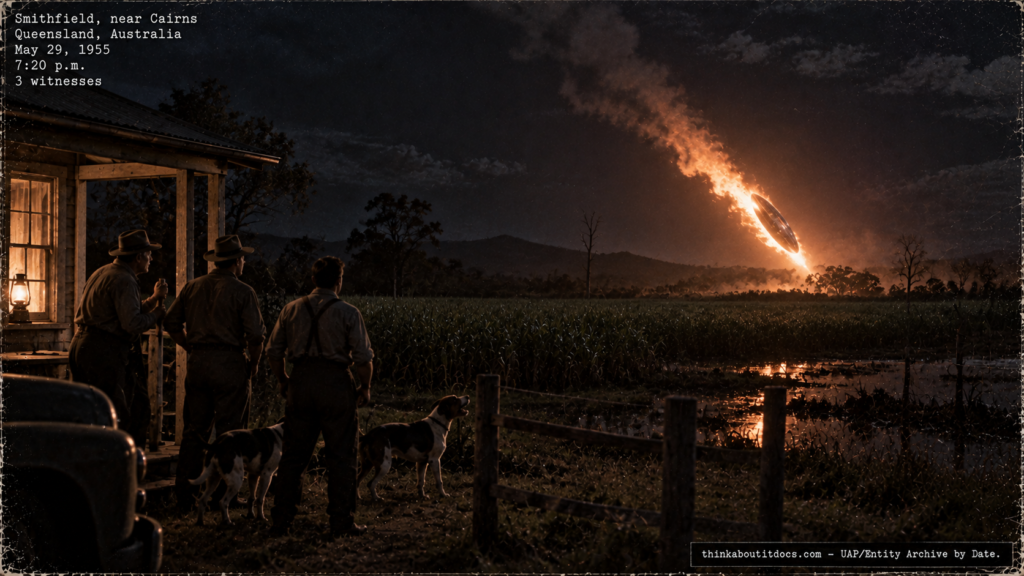
On the evening of May 29, 1955, three farmers near Smithfield, outside Cairns, Australia — among them Thomas Robinson — watched a light grow steadily brighter as it flew between them and nearby Mount Williams, looking for all the world like “a light airplane on fire.” What followed was stranger than a simple flyover: the object lost altitude, trailed flames, touched down and lit up the surrounding countryside, then rose again — and did this four separate times, each landing closer, as it seemed to “feel its way” along the edge of a cane field and swamp directly toward the farmers’ house, coming down once within 100 meters of the men as their dogs ran out barking.
Date: May 29, 1955 (approximate)
Sighting Time: 7:20 p.m.
Day/Night: Night
Location: Smithfield, near Cairns, Queensland, Australia
Urban or Rural: Rural (farmland near cane fields and swamp)
No. of Entity(‘s): Not Applicable
Entity Type: Not Applicable
Entity Description: Not Applicable
Hynek Classification: CE-II (Close Encounter, Second Kind — repeated landings with physical ground effects: illumination of the surrounding area)
Duration: Object visible growing in size for approximately 2 minutes before the sequence of landings and departures began; total encounter duration beyond that not specified
No. of Object(s): 1
Description of the Object(s): A light resembling “a light airplane on fire,” trailing flames as it lost altitude
Shape/Size/Color of Object(s); No solid shape resolved — described as a growing light with a flame-like or fiery appearance; illuminated the surrounding area brightly upon each landing
Distance to Object(s): On its closest approach, landed within approximately 100 meters of the witnesses
Height & Speed: Progressively lost altitude across the encounter, changing course and touching ground on four separate occasions before rising again each time
Number of Witnesses: 3 named/partially named farmers, including Thomas Robinson
Special Features/Characteristics: Object touched down and rose again a total of four times over the course of the encounter; each landing brightly illuminated the surrounding area; the object’s ground path appeared to trace the crooked boundary between a cane field and an adjacent swamp, moving progressively closer to the witnesses’ house with each cycle; farm dogs reacted with agitated barking as the object approached; final landing occurred within roughly 100 meters of the witnesses before the object departed again
Case Status: Unresolved — approximate date, but multiple named/partially-identified witnesses and a specific, unusual repeated-landing behavior pattern distinguish it from a simple single-witness light report
Source: Magonia 363
Summary/Description: On the approximate date of May 29, 1955, at 7:20 p.m., three farmers near Smithfield, outside Cairns, Australia — among them Thomas Robinson — saw a light growing in size over about two minutes as it flew between them and nearby Mount Williams. Resembling “a light airplane on fire,” it changed course, lost altitude, and trailed flames as it touched the ground, brightly lighting up the area before rising again. This landing-and-liftoff sequence repeated a total of four times, with the object appearing to “feel its way” along the crooked boundary between a cane field and a swamp, moving progressively closer to the witnesses’ house. The farm dogs ran out barking as the object landed within about 100 meters of the men before it took off again.
Related Cases: Shares the “repeated landing and ground illumination” pattern with a small number of other mid-1950s Australian and international cases involving objects that appear to touch down multiple times over an extended encounter rather than landing once
Detailed Report
The Smithfield case, sourced to the Magonia catalog, describes an approximately two-minute buildup followed by an unusually extended and repetitive close encounter. Three farmers — named in the record as including Thomas Robinson — were positioned such that they saw a light growing steadily larger as it flew in the space between their location and nearby Mount Williams, outside Cairns in northern Queensland, Australia.
The witnesses’ own comparison was direct: the object looked “like a light airplane on fire.” As they watched, it changed course, began losing altitude, and trailed visible flames as it descended toward the ground.
What happened next is the case’s defining feature. The object touched the ground, brightly illuminating the surrounding area with the contact — and then rose again. This wasn’t a single landing: the sequence of touching down, lighting up the area, and lifting off repeated a total of four times over the course of the encounter.
Between each landing, the object’s path was described in strikingly specific terms — it appeared to “feel its way along the crooked edge of the cane field and the swamp toward our house,” a phrase from the original witness account (as preserved in the Magonia record) that suggests a deliberate, searching quality to the object’s ground-hugging movement rather than a random or erratic flight path.
As the object’s landings brought it progressively closer to the farmhouse, the witnesses’ dogs reacted, running out and barking at its approach. The closest landing occurred within roughly 100 meters of the men before the object took off once more and the encounter ended.
The date is recorded as approximate rather than firmly established, and no further corroborating detail — official investigation, press coverage, or additional witness names — has been located beyond the Magonia catalog entry.
RESEARCHER’S NOTES
The Smithfield Landings — A Deliberate-Seeming Approach Across Four Touchdowns
- The repeated-landing structure is the case’s most distinctive feature. Most UFO ground-contact reports describe a single landing; four separate touchdowns in one continuous encounter, each closer to the witnesses than the last, is a genuinely unusual pattern within this archive.
- The “feeling its way” description implies an interpretation of intent that should be treated cautiously. Whether the object was genuinely following the field/swamp boundary purposefully, or the witnesses’ framing imposed a searching narrative onto essentially erratic movement, can’t be determined from the surviving account alone.
- Multiple named/partially-named witnesses strengthen the case relative to single-witness reports. Three farmers observing the same sequence of events together is a meaningfully stronger evidentiary base than one isolated observer.
- The approximate date and lack of further corroboration are real limitations. No press account, official investigation record, or additional named witness has surfaced beyond the single Magonia catalog citation.
- The animal-reaction detail (dogs barking as the object approached) is a small but recurring corroborating element common across many credible-feeling rural sighting reports. It doesn’t independently confirm the object’s nature, but it does indicate something genuinely present and perceptible enough to trigger an ordinary animal response.
The Smithfield case stands out for its unusual structure — four landings tracing a deliberate-seeming path toward the witnesses — carried by multiple farmer witnesses rather than a single account. It remains unresolved and only lightly corroborated beyond the original catalog entry, but the repeated-landing pattern alone makes it one of the more distinctive reports of the month.
“It began to feel its way along the crooked edge of the cane field and the swamp toward our house.”
— Witness account, Smithfield, near Cairns, Australia