May 13, 1955 — Duluth, Minnesota
THINK ABOUTIT UFO|UAP SIGHTINGS REPORT
1955: Duluth, Minnesota Case:
F-89D Radar Locks a Target That Stops, Then Outruns Its Own Approach
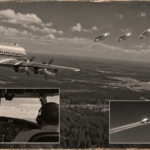
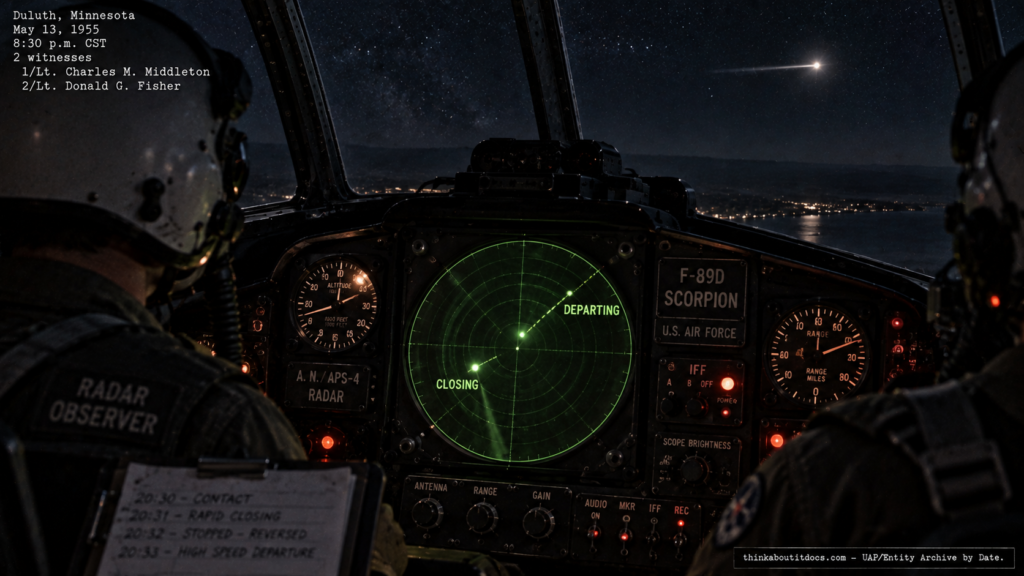
At 8:30 on the night of May 13, 1955, an Air Defense Command F-89D Scorpion out of Duluth, Minnesota locked an unidentified target on its fire-control radar during a live intercept mission — and watched it close from 8 miles out to 6 miles, then to within 6,000 yards, before it simply stopped dead in the air. What happened next is the case’s defining moment: the object didn’t flee slowly or fade out. It reversed and departed faster than it had approached, at a scope-interpreted speed the two “completely reliable” crewmen estimated at over 1,000 knots — nearly a Mach 1.5 exit from a standing stop, tracked the entire way on radar rather than glimpsed with the naked eye.
Date: May 13, 1955
Sighting Time: 8:30 p.m. CST
Day/Night: Night
Location: Duluth, Minnesota
Urban or Rural: Airborne, over the Duluth air defense sector
No. of Entity(‘s): Not Applicable
Entity Type: Not Applicable
Entity Description: Not Applicable
Hynek Classification: RV (Radar-Visual is the archive’s standard label for this tier; strictly this case is radar-only, with no accompanying visual sighting reported — treated here alongside the archive’s other RV-tier intercepts given the fire-control-radar lock and documented target behavior)
Duration: Not precisely stated; covers the closing approach from 8 miles to 6,000 yards and the subsequent high-speed departure
No. of Object(s): 1
Description of the Object(s): No visual description survives — the target was never visually acquired, only tracked via airborne intercept radar
Shape/Size/Color of Object(s): Not Applicable (radar-only contact)
Distance to Object(s): Closed from 8 miles to 6 miles, then to 6,000 yards (roughly 3.4 miles), at which point the target stopped and reversed
Height & Speed: F-89D was flying at 26,000 ft; target’s departure speed, based on scope interpretation and the crew’s interception experience, was estimated at over 1,000 knots
Number of Witnesses: 2 named (1/Lt. Charles M. Middleton, pilot, and 2/Lt. Donald G. Fisher, radar observer, both of the 11th Fighter-Interceptor Squadron, both rated by the Air Force as “completely reliable”)
Special Features/Characteristics: Target closed steadily to within 6,000 yards, stopped dead in the air, then immediately accelerated away faster than its approach; tracked using the F-89D’s onboard AN/APG-40 fire-control radar and APA-84 computing gunsight system, standard equipment for the aircraft’s live-intercept role — meaning the crew was not making a casual observation but actively flying a real interception profile against the target
Case Status: Unresolved — among the most credible cases in this archive’s 1955 collection, given the named, “completely reliable” military aircrew, active fire-control radar tracking with specific equipment models cited, and a scope-documented stop-then-high-speed-reversal behavior
Source: Blue Book files (Dan Wilson); McDonald list
Summary/Description: At 8:30 p.m. CST on May 13, 1955, an F-89D Scorpion of the 11th Fighter-Interceptor Squadron, flying out of Duluth, Minnesota at 26,000 feet on an air intercept mission, locked an unidentified target on its radar observer’s scope. The target closed from 8 miles to 6 miles distance, then continued in to within 6,000 yards before stopping dead. It then immediately began departing faster than it had approached — by scope interpretation and the crew’s own interception experience, at a speed estimated to exceed 1,000 knots. The crew, 1/Lt. Charles M. Middleton (pilot) and 2/Lt. Donald G. Fisher (radar observer), were both rated by the Air Force as completely reliable observers.
Related Cases: One of this archive’s strongest radar-documented intercepts to date, comparable in evidentiary weight to the Dahlgren, Virginia theodolite/radar case earlier the same month and the January 1955 Fairbanks, Alaska GCI radar pursuit — all three share the pattern of a target that reverses course and departs at extreme, scope-confirmed speed after closing to a stopping point
Detailed Report
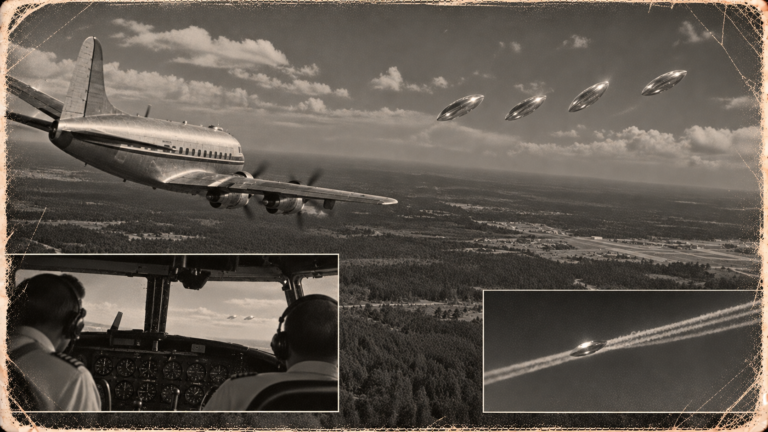
The Duluth case is a genuine air intercept, not a passive observation. On the night of May 13, 1955, an F-89D Scorpion — the Air Defense Command’s dedicated all-weather interceptor of the period, equipped with the AN/APG-40 fire-control radar and APA-84 computing gunsight — was flying at 26,000 feet on a live air intercept mission out of Duluth, Minnesota when the radar observer’s scope locked onto an unidentified target.
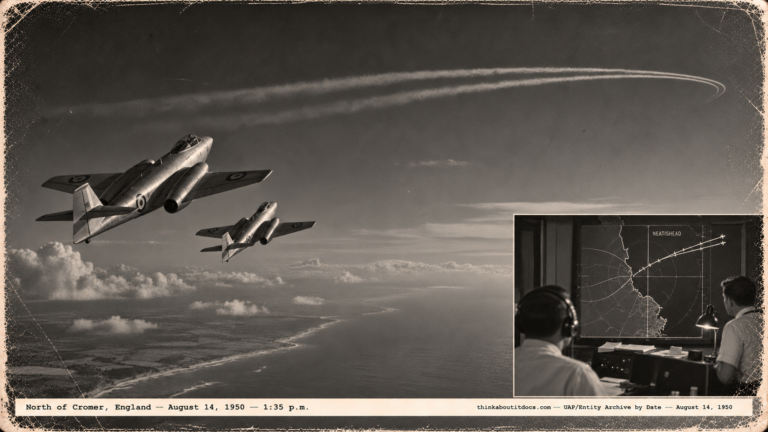
What followed was tracked in real time on the aircraft’s own radar. The target closed from an initial range of 8 miles down to 6 miles. The crew continued their intercept profile, and the target kept closing, eventually coming to within 6,000 yards — roughly 3.4 miles — of the F-89D. At that point, it stopped. Not slowed: stopped, dead in the air, according to the crew’s scope reading.
The target then reversed and began moving away — and did so faster than it had approached. Based on their reading of the scope’s rate of range change, combined with their professional experience running similar interceptions, the crew estimated the departing speed at over 1,000 knots — well over the speed of sound, and a rate of acceleration from a dead stop that no contemporary aircraft of the period could plausibly match.
The case’s credibility rests substantially on its crew. 1/Lt. Charles M. Middleton, the pilot, and 2/Lt. Donald G. Fisher, the radar observer, were both assigned to the 11th Fighter-Interceptor Squadron — a real, historically documented Air Defense Command unit that transitioned into F-89D Scorpions in the fall of 1953 and was actively flying them out of Duluth in exactly this period. Both men were explicitly rated by the Air Force’s own file as “completely reliable” — a designation that carries some institutional weight, since it reflects the Air Force’s own assessment of the witnesses rather than a civilian investigator’s judgment.
No visual sighting accompanies the radar data — the crew never reported seeing an object matching the target’s position, meaning this remains, strictly, a radar-only contact rather than a confirmed radar-visual case. The specificity of the equipment cited (APG-40, APA-84) and the range/behavior data, however, place it well above the documentation level of most entries in this month’s archive.
RESEARCHER’S NOTES
The Duluth Intercept — A Real Interception Mission, Not a Passive Sighting
- This was an active fire-control radar lock during a real intercept mission, not a casual observation. The crew was flying a genuine interception profile with combat-capable radar equipment, meaning the range and speed data comes from an instrument built specifically for this purpose, operated by trained crew during the exact kind of mission it was designed for.
- The “stop, then reverse and accelerate away faster than it arrived” behavior is a distinctive and hard-to-explain pattern. A target that comes to a dead stop and then outpaces its own approach speed on departure is difficult to reconcile with any contemporary 1955 aircraft, balloon, or natural phenomenon.
- The Air Force’s own “completely reliable” rating of both crewmen is a meaningful institutional signal. This is not a civilian researcher’s characterization of the witnesses — it’s the assessment on file from the crew’s own chain of command.
- The absence of a visual sighting is a real limitation, not a minor gap. Without a corresponding visual observation, the case remains radar-only — meaning the possibility of a radar anomaly, equipment malfunction, or misinterpretation of a mundane return can’t be ruled out as cleanly as it could be with an accompanying visual confirmation.
- The original archive page carried this case as two separate entries — one detailed, one a blank duplicate citing only “McDonald list.” These have been merged into the single entry above, since they plainly describe the same incident at the same date, time, and location.
The Duluth case stands as one of the more credible radar intercepts of the archive’s 1955 collection: a live air-defense mission, named and Air-Force-vetted crew, specific equipment, and a target whose stop-and-reverse behavior remains genuinely difficult to explain conventionally. It’s radar-only rather than radar-visual, and that distinction matters — but within that limitation, this is about as solid a case as 1955 offers.
“The object immediately began going out in range faster than it came in.”
— Blue Book case file, Duluth, Minnesota, May 13, 1955