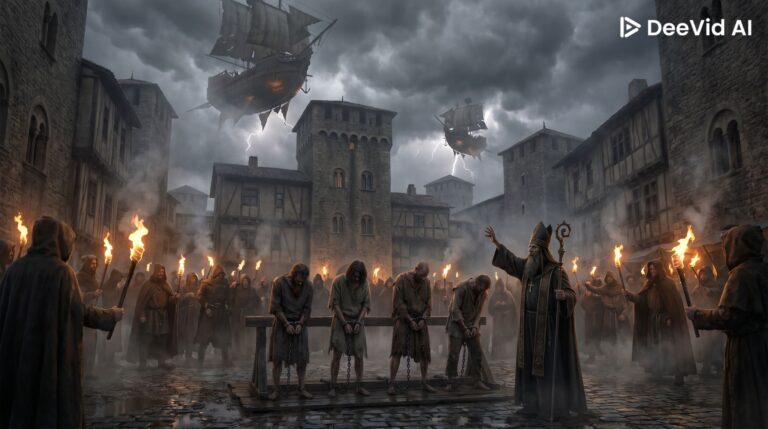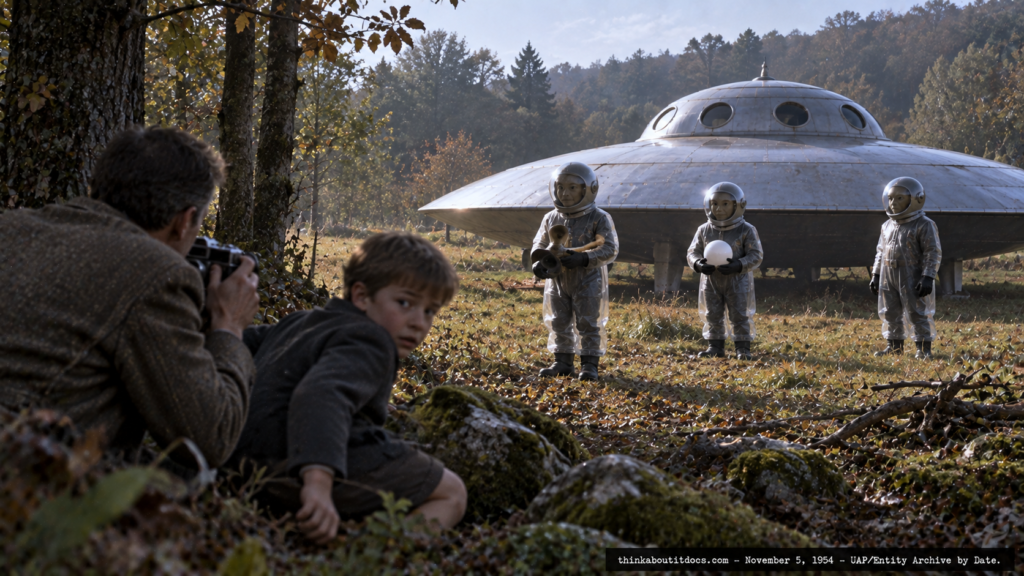
The wooded clearing near La Roche-en-Brenil, France where witnesses photographed three entities and recovered a chemically analyzed powder, November 5, 1954.
THINK ABOUTIT UFO|UAP & ENTITY ENCOUNTER REPORT
1954: The La Roche-en-Brenil, France Encounter — Photographed
A man and a thirteen-year-old boy crept through the woods near La Roche-en-Brenil to within 130 feet of a domed, portholed craft and its three suited occupants — close enough for the man to fire off seven photographs, four of which came out clearly. What followed was not a quiet retreat: a paralyzing green beam swept the fleeing boy off his feet, the craft departed leaving scorched earth and a heavy, sulfur-colored powder behind, and hours later, nine more lights crossed the sky to land in the exact same spot.
A NOTE ON THIS CASE
This case combines more independent forms of evidence than almost any other entry in this archive: contemporaneous photographs, a physical burn site, a recovered substance subjected to actual laboratory analysis, and a documented physical injury (burned fingers) resulting directly from handling that substance. This archive presents each element with the weight its own documentation supports.
Date: November 5, 1954
Sighting Time: 10:10 a.m. (initial encounter); 15:05 (return visit by additional craft)
Day/Night: Day
Location: La Roche-en-Brenil, Cote-d’Or, France
Urban or Rural: Rural (woods)
No. of Entity(‘s): 3
Entity Type: Humanoid
Entity Description: No more than 5 ft tall; wore transparent suits, apparently made of plastic, over black clothing, with dark gray helmets resting on their shoulders; a hump-like protrusion beneath the suit on the back; a small, shiny black box worn on the chest; moved with heavy, deliberate steps
Hynek Classification: CE-III (Close Encounter, Third Kind — entities present and photographed at close range, exceptional physical trace evidence)
Duration: Extended observation before departure; a second craft returned to the same site roughly 5 hours later for approximately 10 minutes
No. of Object(s): 1 (initial encounter); 9 additional orange luminous objects observed later the same day, one of which landed at the same spot
Description of the Object(s): A disc-shaped craft with a large cupola featuring a row of portholes; emitted a humming sound similar to an electrical transformer
Shape/Size/Color of Object(s): Disc-shaped, approximately 30 ft in diameter and 16 ft total height, including a 10-ft cupola
Distance to Object(s): Witnesses approached to within approximately 130 ft through the woods
Height & Speed: Took off vertically with a loud whistling sound approximately 20 seconds after the paralyzing beam swept the fleeing boy
Number of Witnesses: 2 (an adult identified as M. Raymond R. and a 13-year-old boy)
Special Features/Characteristics: One entity emerged first and walked near the craft before re-entering through a base door; two more then emerged in identical suits, one carrying a funnel-barreled pistol-like device, the other a white ball roughly the size of two fists; the two produced a blue luminous smoke at the site where the first entity had stood; the boy, frightened by this, fled toward a nearby road, at which point a porthole in the cupola glowed green and swept a beam across his path, paralyzing him briefly (the effect wore off quickly); the craft then departed vertically with a loud whistle; at the site, the grass was found burnt and the earth blackened and covered in a cinder-like residue across a 3-meter radius; a fragment of the white ball was recovered — a cottony substance unusually heavy for its size — along with a heavy, yellow, sulfur-like powder; collecting this powder caused the witness’s fingers to burn, blistering and blackening by the following day; laboratory analysis subsequently found the powder to consist largely of silver nitrate; at 3:05 p.m. the same day, 9 orange luminous objects crossed the sky, one of which landed at the exact same site with a soft whistling sound before departing again after roughly 10 minutes in a burst of orange light, observed by the witnesses from a cautious 600 ft distance; Raymond R. took seven photographs during the initial encounter, four of which developed successfully
Case Status: Unresolved — a two-witness account combining contemporaneous photographs, physical trace evidence, and a laboratory-analyzed recovered substance, an unusually complete evidentiary combination
Source: LDLN #125; Magonia 329
Summary/Description: At 10:10 a.m. on November 5, 1954, M. Raymond R. and a 13-year-old boy approached to within 130 ft of a 30-ft, portholed, disc-shaped craft in the woods near La Roche-en-Brenil, Cote-d’Or, France. Three humanoid entities, under 5 ft tall, in transparent suits over black clothing with shoulder-resting helmets, were observed near the craft; Raymond photographed the scene seven times, four photographs developing successfully. Two of the entities produced a blue luminous smoke; the frightened boy fled and was struck by a green paralyzing beam from the craft’s cupola before the effect quickly passed. The craft departed vertically with a loud whistle. Investigators found burnt grass and blackened earth across a 3-meter radius, along with fragments of a heavy white “ball” substance and a heavy yellow powder later analyzed as largely silver nitrate; handling the powder burned and blistered the witness’s fingers. At 3:05 p.m. that same day, nine additional orange luminous objects crossed the sky, one landing at the identical spot for roughly 10 minutes before departing.
Related Cases: None known
Detailed Report
M. Raymond R. and a 13-year-old boy were near the woods at La Roche-en-Brenil, in France’s Cote-d’Or department, at ten minutes past ten in the morning on November 5, 1954, when they noticed something gray at the edge of the trees. Curiosity got the better of caution, and the two made their way through the woods until they had closed to within roughly 130 feet of it — close enough to see it clearly for what it was: a disc-shaped craft, about thirty feet across, its total height reaching sixteen feet including a ten-foot cupola fitted with a row of portholes. A steady humming, not unlike an electrical transformer, came from the craft itself.
Standing near it was a figure no more than five feet tall, dressed in what looked like a transparent plastic suit worn over black clothing, a dark gray helmet resting on his shoulders rather than fully covering his head. Something beneath the suit gave him a humped appearance across the back, and a small, shiny black box sat on his chest. He moved with heavy, deliberate steps around the craft before returning through a door at its base.
Raymond, remarkably composed given the circumstances, began photographing the scene — seven exposures in total, four of which would later develop successfully, a genuine rarity among UFO cases of this era. Two more entities then emerged from the craft, dressed identically to the first. One carried a device resembling a pistol with a funnel-shaped barrel; the other held a white ball roughly the size of two clenched fists. They walked to the spot where the first entity had stood, turned their backs to the witnesses, and did something that produced a cloud of blue luminous smoke.
It was at this point that the boy’s nerve broke. He turned and ran for a nearby road. Almost immediately, one of the portholes in the craft’s cupola lit up green, and a beam swept across the ground in the direction of his flight. He was struck and paralyzed — an effect that, fortunately, passed off quickly. Some twenty seconds later, with a loud whistling sound, the saucer took off vertically and was gone.
What remained at the site told its own story. The grass across a three-meter radius was burnt, the earth beneath it blackened and scattered with a cinder-like residue. Among the debris, Raymond found a fragment of the white ball the second entity had carried — a cottony material that felt, impossibly, as heavy as lead — along with a quantity of heavy, yellow powder resembling sulfur. He collected the powder in a piece of paper. Within moments, his fingers began to burn; by the next day, they were blistered and blackened. When the powder was later subjected to laboratory analysis, it was found to consist largely of silver nitrate.
The day’s strangeness wasn’t finished. At five past three that afternoon, nine orange luminous objects crossed the sky — and one of them descended to land in precisely the same spot where the morning’s craft had rested, arriving with the same soft whistling sound. Raymond and the boy, watching from a cautious six hundred feet, didn’t dare approach. After roughly ten minutes on the ground, the object took off again in a burst of orange light.
RESEARCHER’S NOTES
La Roche-en-Brenil — 1954 and an Unusually Complete Body of Evidence
- Contemporaneous photographs are genuinely rare in this archive’s record: Most 1954 photographic claims in this archive describe images that were taken but never independently verified or widely reproduced; here, four developed photographs exist as a direct product of the encounter itself, not a later claim of having once had film.
- A recovered substance subjected to actual chemical analysis: The yellow powder’s laboratory identification as largely silver nitrate is a specific, checkable scientific claim — one of very few instances in this archive where physical trace material from a UFO encounter received formal analytical testing with a stated result.
- A documented injury with a plausible chemical explanation: Silver nitrate is a known irritant and can cause skin staining and burns on contact — meaning the witness’s blistered, blackened fingers are consistent with the substance’s actual identified chemical properties, an unusual instance of a UFO-linked injury correlating physically with its claimed cause.
- A second, independent event the same day at the identical location: Nine additional objects returning to land at the exact same spot hours later is a striking detail — whether read as corroboration of the site’s significance or as a remarkable coincidence, it adds a second data point to a case that already stood on unusually solid evidentiary ground.
- Two witnesses, one very young: The presence of a second witness, even a young one whose fear-driven flight interrupted his own observation, adds some corroboration beyond Raymond’s testimony alone, particularly regarding the paralyzing beam he personally experienced.
This is among the most evidentially rich cases in this archive’s entire 1954 record — photographs, a burn site, a chemically identified substance, and a documented physical injury consistent with that substance’s known properties, combined with a second independent event at the same site hours later. It remains, as with every case in this archive, ultimately a claim resting on witness testimony for its narrative content, but the physical evidence here is substantially more extensive and independently verifiable than in the great majority of entries this archive documents.
“The powder was later analyzed and found to consist largely of silver nitrate.”
— LDLN #125, on the November 5, 1954 La Roche-en-Brenil, France case