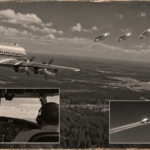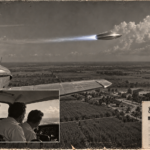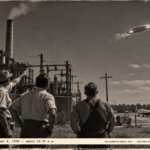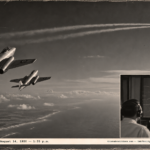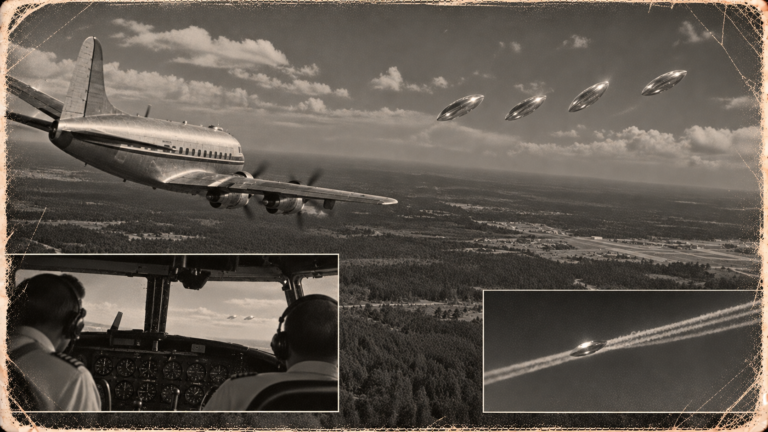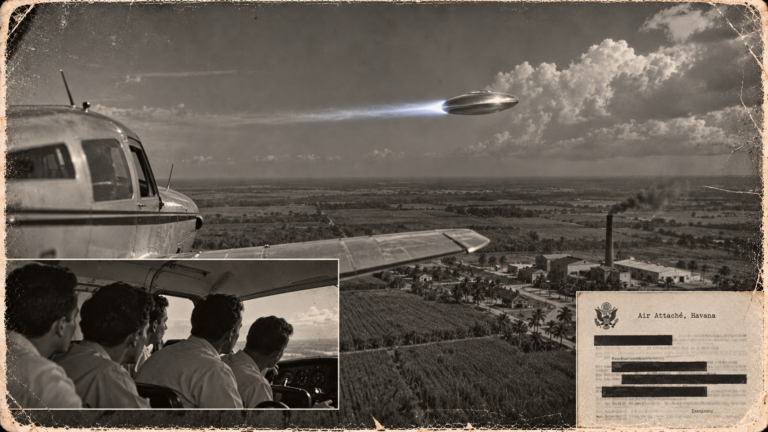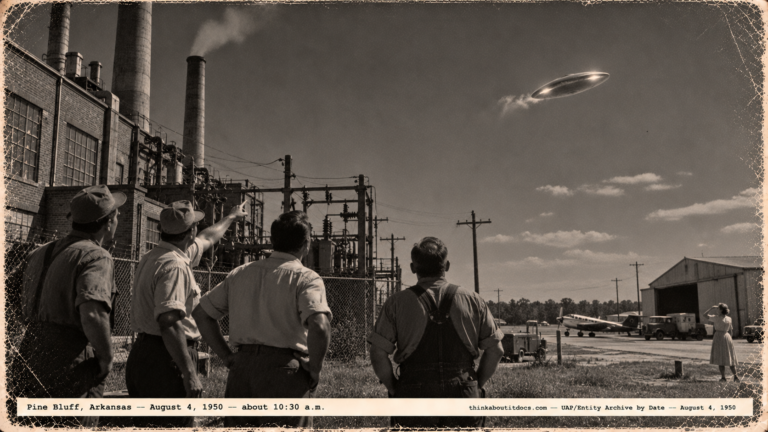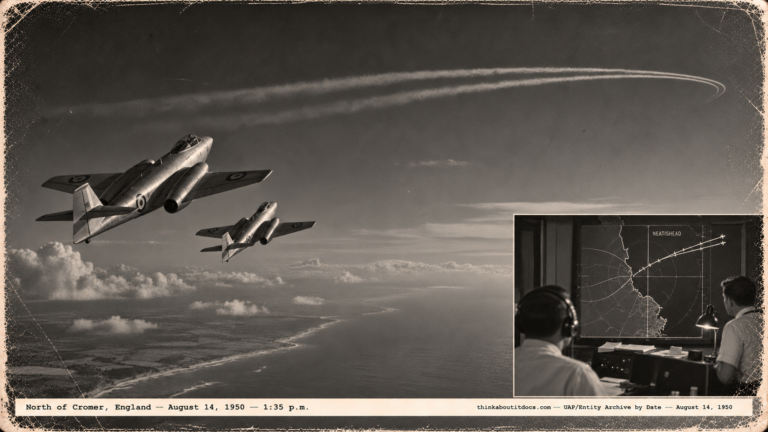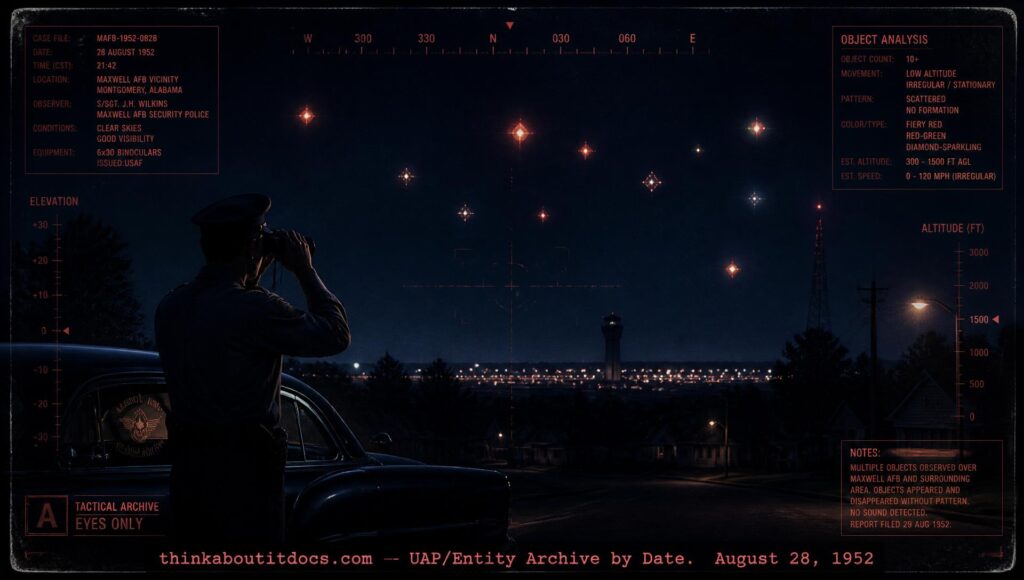
Chickasaw and Brookley AFB, Mobile, Alabama, August 28, 1952 — an AFOSI agent watches the display firsthand.
THINK ABOUTIT UFO|UAP SIGHTINGS REPORT
1952: The Chickasaw and Brookley AFB, Alabama Light Display
When Mobile, Alabama residents reported fiery red lights maneuvering over Brookley AFB, an Air Force intelligence officer didn’t just take the call — he drove out, watched the objects himself for forty minutes, and saw one of them explode.
Date: August 28, 1952
Sighting Time: 9:30–10:20 p.m.
Day/Night: Night
Location: Chickasaw and Brookley AFB, Mobile, Alabama
Urban or Rural: Urban/suburban, adjacent to a military installation
Hynek Classification: NL (Nocturnal Light), with radar corroboration
Duration: Approximately 50 minutes
No. of Object(s): Four to six, varying in count and description across different witness groups and vantage points
Description of the Object(s): Mostly stationary and maneuvering points of light, described by different witnesses as fiery red, red-blue, red-green, and sparkling diamond in appearance; one civilian Air Force employee separately described a flat, oval shape
Distance to Object(s): Estimated 8–12 miles by the investigating AFOSI agent; one object confirmed by GCA radar at 4 miles range, 4,000 ft altitude
Height & Speed: One radar-confirmed target held at 4,000 ft altitude; objects were described as largely stationary with occasional drift and one abrupt figure-8 maneuver
Number of Witnesses: Multiple, independent groups — three civilians in Chickasaw who first reported the objects; an AFOSI (Air Force Office of Special Investigations) agent who personally traveled to the scene and independently observed the objects; a radar operator who visually spotted an additional object; the USAF duty officer and control tower personnel at Brookley AFB; and at least one civilian Air Force employee
Special Features/Characteristics: One fiery red object remained stationary for 15 minutes before drifting 15–20° to the right and then holding stationary again. The AFOSI officer and others watched one object appear to explode and another execute a figure-8 maneuver. A GCA MPN-1 radar unit independently confirmed one of the visually observed objects as a stationary target at a specific range, altitude, and bearing, directly corroborating part of the visual account. Object color and shape descriptions varied meaningfully between witness groups and vantage points — a detail this archive preserves rather than smoothing into a single uniform description.
Case Status: Unexplained — no conventional identification is recorded in the surviving sourcing for this case despite the direct, on-scene investigation by an AFOSI agent, whose own independent sighting matched elements of the original civilian reports.
Source: Berliner; cf. Hynek-CUFOS/Willy Smith files
Summary/Description: Beginning around 9:30 p.m. on August 28, 1952, three civilians in Chickasaw, Alabama reported multiple red, stationary and maneuvering objects to the south, in the general direction of Brookley AFB, to the on-duty USAF Captain there. An Air Force Office of Special Investigations agent arrived in Chickasaw by 9:50 p.m. to investigate and independently observed four objects to the south and southwest, roughly 8–12 miles distant; one fiery red object held stationary for 15 minutes before drifting slightly and holding again. A radar operator separately spotted a red-green object over Chickasaw to the north, while the Brookley AFB duty officer and control tower personnel observed objects to the southwest and west, with the western object confirmed on GCA radar as a stationary target 4 miles out at 4,000 feet altitude. Over the course of the evening, the AFOSI officer and others watched one object appear to explode and another perform a figure-8 maneuver, with four to six objects total described in varying colors — fiery red, red-blue, red-green, and sparkling diamond — while a separate civilian Air Force employee described a flat, oval shape. The full observation period spanned roughly 50 minutes.
Related Cases: Not Applicable
Detailed Report
What sets the Chickasaw/Brookley case apart from most 1952 civilian light reports is the speed and seriousness of the official response. Within twenty minutes of the first civilian call, an Air Force Office of Special Investigations agent was on the ground in Chickasaw — not reviewing a report after the fact, but standing outside looking at the same sky the original witnesses had called in about. That kind of immediate, on-scene field investigation is uncommon in this archive’s 1952 record, where most cases reach Blue Book only as after-the-fact witness statements gathered later.
The case also benefits from multiple independent vantage points converging on parts of the same picture rather than a single observer’s account. The AFOSI agent in Chickasaw, the radar operator who spotted a red-green object to the north, and the Brookley AFB duty officer and control tower staff watching from the base itself were all looking at genuinely different angles and, in some cases, likely different individual objects within the broader display — yet their accounts overlap enough in timing, direction, and general character to describe a single ongoing event rather than several unrelated ones. The GCA MPN-1 radar confirmation of one specific object’s position is the strongest single piece of corroboration: a stationary visual target and a stationary radar target agreeing on the same approximate location is a higher bar than most nocturnal-light reports clear.
At the same time, the variation in described colors and shapes across witnesses — fiery red, red-blue, red-green, sparkling diamond, and a flat oval from one civilian employee — is worth noting honestly rather than glossing over. Some of that variation likely reflects genuinely different objects among the four to six present; some of it may reflect differences in each witness’s viewing angle, distance, or simply how people describe similar things differently. The surviving record doesn’t allow those possibilities to be cleanly separated.
The most dramatic single detail — an object appearing to explode — is reported by the AFOSI agent’s group specifically, one of the more credentialed and presumably observation-trained witness parties present that night, which lends it somewhat more weight than it might carry from an untrained civilian observer alone, though it remains a single-group observation without independent radar or photographic confirmation.
RESEARCHER’S NOTES
Chickasaw and Brookley AFB, Alabama — 1952 and Multi-Vantage Corroboration
- Rapid, on-scene official investigation: An AFOSI agent physically arrived and personally observed the phenomenon within roughly 20 minutes of the initial report — a faster and more direct institutional response than most cases in this archive’s 1952 record receive.
- Radar-visual agreement on at least one target: The GCA MPN-1 confirmation of a stationary object at a specific range and altitude, matching a visual sighting from the same general direction, is a genuine corroboration point rather than two independently uncorrelated reports.
- Honest variation across witnesses, not resolved into uniformity: Different witness groups described different colors and even different shapes (points of light vs. a flat oval). Rather than picking the “most credible” description and discarding the rest, this entry preserves all of them, since with 4–6 objects present across a 50-minute window, some real variation between individual objects is plausible.
- The explosion claim comes from a relatively credentialed source: An AFOSI officer’s report of an object exploding carries more weight than a single untrained civilian’s would, though it remains uncorroborated by radar or photograph.
- No named conventional explanation survives in this archive’s sourcing: Despite the direct field investigation, no specific identification (flares, aircraft lights, astronomical objects) is recorded as having been reached.
Seven decades on, what makes Chickasaw and Brookley worth remembering isn’t any single dramatic detail — it’s that the people paid to investigate these things showed up fast enough, and watched closely enough, to see some of it happen with their own eyes.
“One fiery red object remained stationary for 15 minutes then drifted 15°-20° to the right, then stationary again.”
— AFOSI field report, Chickasaw, Alabama, August 28, 1952