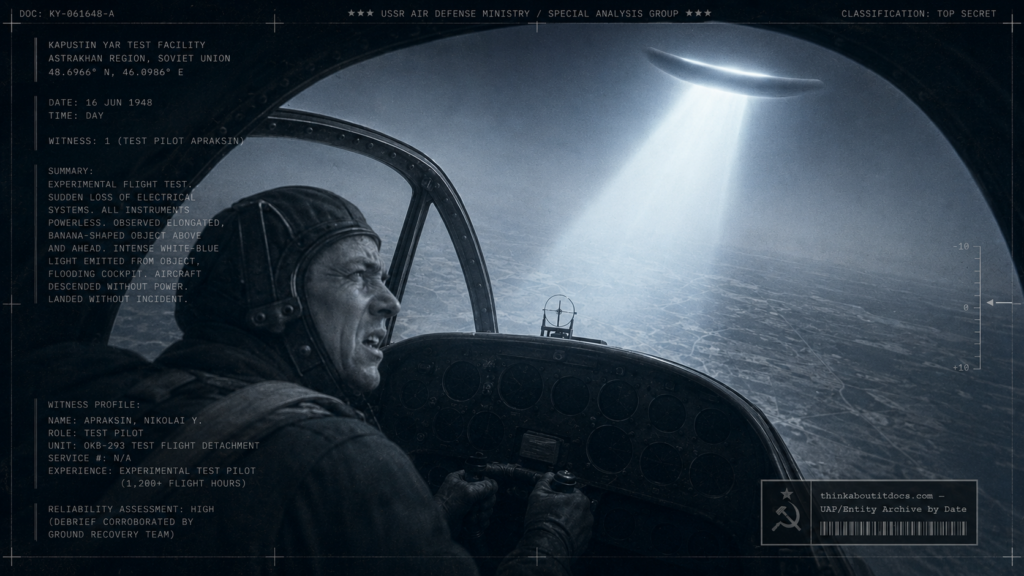
June 16, 1948 — Kapustin Yar, Soviet Union. Test pilot Apraksin's aircraft lost total power the instant a beam of light struck it — radar-tracked and documented independently by researchers in three countries.
THINK ABOUTIT UFO SIGHTINGS REPORT
1948: The Kapustin Yar Electrical Failure — Test Pilot Apraksin
A Soviet test pilot, mid-flight over one of the USSR’s most secretive military installations, found his aircraft’s engine and controls go completely dead the instant a beam of light from an unidentified object struck his plane. Temporarily blinded, he had to glide a powerless aircraft to a landing with nothing working. This is one of the earliest and best-corroborated “vehicle interference” cases in the entire Soviet-era UFO record — documented independently by researchers in three different countries.
Date: June 16, 1948
Sighting Time: Daytime
Day/Night: Day
Location: Kapustin Yar test flight facility, Astrakhan region, Soviet Union
Urban or Rural: Military test facility airspace
No. of Entity(s): Not Applicable
Entity Type: Not Applicable
Entity Description: Not Applicable
Hynek Classification: CE-II — Close Encounter of the Second Kind. A structured object was observed at close range and directly caused a documented physical effect (total electrical failure of the aircraft), meeting the standard definition for a physical-effect close encounter; no entity or landing was involved.
Duration: Not precisely specified; long enough for radar tracking, the light beam contact, the electrical failure, and a successful glide to landing
No. of Object(s): 1
Description of the Object(s): Banana- or cucumber-shaped, emitting beams of light, tracked on radar as it approached Apraksin’s aircraft.
Shape of Object(s): Banana/cucumber-shaped (elongated, curved)
Size of Object(s): Not specified
Color of Object(s): Not specified beyond the emitted light beams
Distance to Object(s): Close enough for direct contact between the object’s light beam and the aircraft
Height & Speed: Matched Apraksin’s own flight altitude closely enough for direct beam contact with his aircraft
Number of Witnesses: 1 — test pilot Apraksin, with radar tracking providing independent instrumental corroboration of the object’s presence and approach
Special Features/Characteristics: The object was independently tracked on radar prior to and during its approach to Apraksin’s aircraft, providing instrumental corroboration beyond the pilot’s own visual account; the cone of light directed at the aircraft caused a total electrical failure — both engine and flight controls — a specific and severe physical effect consistent with the broader category of “vehicle interference” cases documented across UFO literature worldwide; Apraksin was temporarily blinded by the light, another specific physiological effect distinct from the mechanical failure; despite total power loss, Apraksin successfully glided the aircraft to a landing, demonstrating that the failure, however severe, did not extend to catastrophic structural damage or loss of aerodynamic control surfaces in a way that prevented a glide landing.
Case Status: Unexplained
Source: Felix Zigel, unpublished manuscript, p. 124; Geoffrey Falla, BUFORA Vehicle Interference Project, p. 004; Jacques Vallée, UFO Chronicles of the Soviet Union: A Cosmic Samizdat, p. 137
Related Cases: 1948: June UFO|UAP & Entity Sightings Archive
Detailed Report
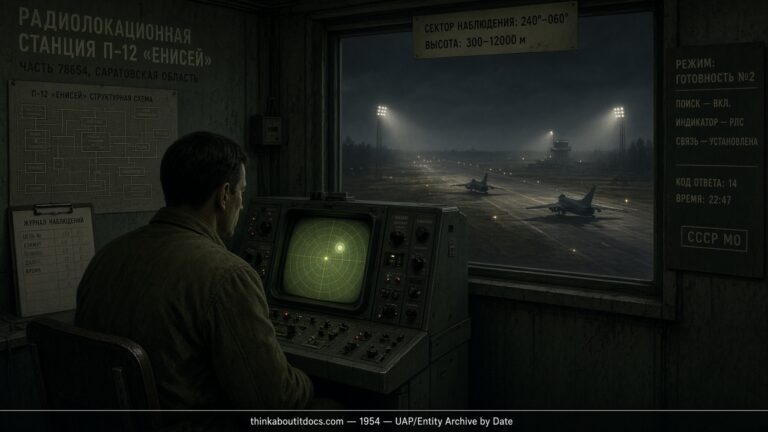
On June 16, 1948, Soviet test pilot Apraksin was flying an experimental aircraft over the Kapustin Yar test flight facility in the Astrakhan region — a site that, within a few years, would become one of the Soviet Union’s most closely guarded rocket and missile testing grounds, and would itself become a recurring subject of later Cold War-era UFO speculation, partly due to its genuine role in cutting-edge and secretive Soviet aerospace testing.
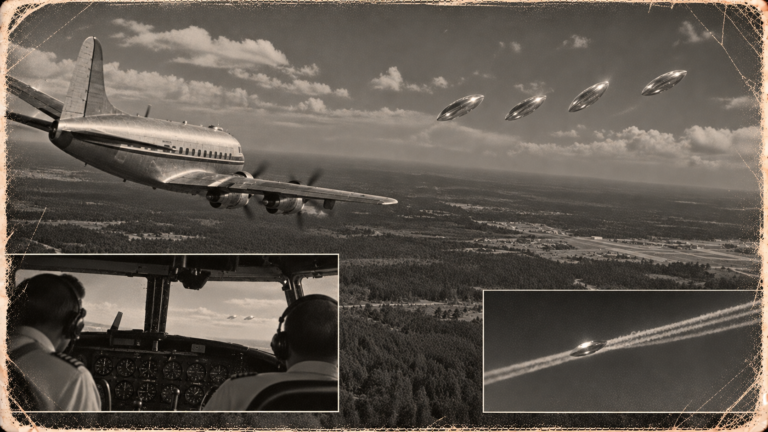
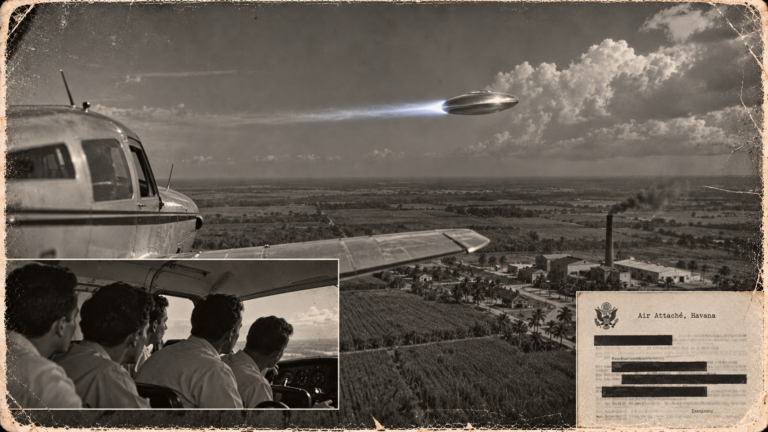
During the flight, radar tracked a banana- or cucumber-shaped object emitting beams of light on a course that brought it into contact with Apraksin’s aircraft. When the object’s light struck the plane in a distinct cone, the aircraft’s electrical systems failed completely — both engine and flight controls went dead simultaneously. Apraksin himself was temporarily blinded by the light at the same moment. Despite having no engine power and, by extension, no powered flight controls, Apraksin was able to glide the aircraft to a successful landing.
The case survives through an unusually broad and independent documentary trail for a Soviet-era incident: Felix Zigel, a prominent Soviet ufologist and aerospace engineering professor whose research into Soviet UFO cases was conducted under considerable political constraint, documented the case in an unpublished manuscript; British researcher Geoffrey Falla independently included it in BUFORA’s Vehicle Interference Project, a dedicated research effort cataloguing cases involving UFO-caused mechanical or electrical effects on vehicles worldwide; and French-Canadian researcher and astronomer Jacques Vallée documented it in his own dedicated study of Soviet-era UFO cases, UFO Chronicles of the Soviet Union: A Cosmic Samizdat. Three independent researchers, working in three different countries and research traditions, converging on the same case is a materially stronger documentary pattern than this archive typically finds for Soviet-era material from this early period.
RESEARCHER’S NOTES
Radar, a Named Pilot, and Three Independent Trails
- On why this case differs from other Soviet-era entries this archive has flagged with caution: This archive has previously flagged several Soviet and post-Soviet UFO accounts — the 1947 Bahamut, Kazakhstan case, the March 1948 Naftalan, Azerbaijan case, and the May 1948 Moscow case — for a recurring pattern: a single uncorroborated witness, and a publication gap of decades between the claimed event and its first appearance in print. The Kapustin Yar case is structurally different. It has independent radar tracking data providing instrumental corroboration beyond the pilot’s testimony, and it is documented not by a single late-life recollection but by three separate researchers working independently in different countries, each drawing on what appear to be different research traditions and source materials. That combination — instrumental data plus multi-national independent documentation — is a meaningfully stronger evidentiary picture.
- On the significance of Felix Zigel as a source: Zigel was a genuine Soviet aerospace engineering professor who conducted UFO research under real political constraint — public UFO discussion carried professional and personal risk in the Soviet system, particularly during the Stalin era, which this archive has noted elsewhere as a factor in the decades-long publication delays common to Soviet-era cases. That Zigel documented this specific case, even in an unpublished manuscript, suggests he considered it credible enough to record carefully despite those broader constraints.
- On the “vehicle interference” category more broadly: Total electrical or mechanical failure attributed to close proximity with an unidentified object is a well-documented category across UFO literature internationally, predating and postdating this specific 1948 case by decades. BUFORA’s dedicated Vehicle Interference Project, which this case appears in, exists specifically because this pattern recurs across many countries and eras independently — a pattern that, whatever its ultimate explanation, is not unique to Soviet reporting or to this particular pilot’s account.
A test pilot over one of the Soviet Union’s most secretive airfields watched his instruments die and his engine go silent the instant a beam of light touched his aircraft — and somehow brought the plane down anyway. Radar caught the approach. Three researchers, working an ocean apart from each other and from the event itself, all found the same story credible enough to record. Whatever struck Apraksin’s aircraft that June day in 1948, it left behind more than just one man’s word for it.