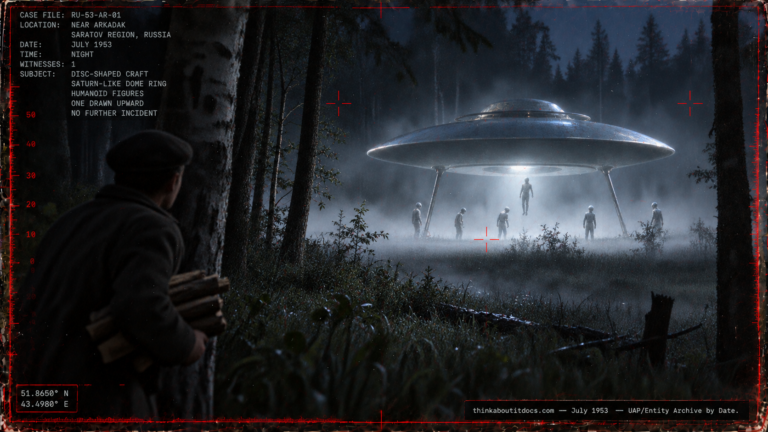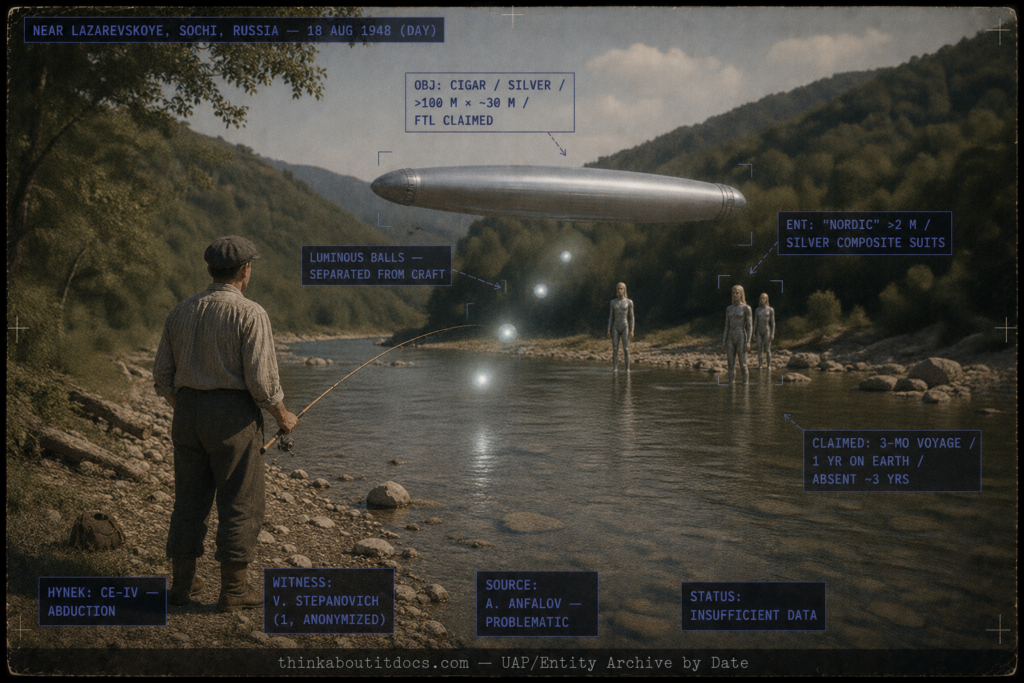
A fisherman turns to a silver cigar craft and its drifting lights near Lazarevskoye, August 18, 1948 — the opening of a sweeping Soviet Nordic contactee epic held as Insufficient Data.
THINK ABOUTIT UFO | UAP SIGHTING REPORT
1948: Near Lazarevskoe, Sochi, Russia
A man named Valentin Stepanovich was fishing a small mountain river near Lazarevskoye on the Black Sea coast in August 1948 when a silver, cigar-shaped craft more than a hundred meters long appeared nearby, shed several luminous balls of light that drifted toward him, and — flanked by tall, smiling, blond women — took him. He blacked out and woke aboard, on a bed in a room, where a “Nordic” woman spoke to him telepathically and he agreed to go along. What followed is one of the most sweeping contactee narratives in the entire Soviet record: a faster-than-light voyage that felt like three months but cost a year on Earth, a home world twice the size of ours divided into three continents, a near-immortal blond race that had annihilated a dwarf-like enemy in an ancient war, a forbidden romance with an alien woman named Liffa that earned him exile to a radioactive moon, an eventual marriage and a child, and a final intrigue in which he helped the aliens neutralize a colony of abducted humans led by a German with Nazi ambitions. He returned to a Soviet Union that had counted him missing for three years, was interrogated by the secret police, and had the notebook in which he wrote it all confiscated. It is a complete romance of the stars — and there is nothing beneath it but the telling.
Date: August 18, 1948 (onset)
Sighting Time: Daytime
Day/Night: Day
Location: Near Lazarevskoye, Sochi, Black Sea coast, Russia (a small river near the mountains)
Urban or Rural: Rural
No. of Entity(‘s): Multiple (a full crew and an entire planetary civilization, as claimed)
Entity Type: Humanoid (“Nordic” tall blond type)
Entity Description: Tall beings, over 2.0 meters, biologically near-human, with a claimed 300–400-year lifespan; resembling Nordic people with blond hair and slightly slanted bluish/greenish/grayish eyes; women described as beautiful. All wore a single-piece, tight-fitting silver suit of multilayered composite material with automatic heating/cooling and waste-extraction systems, said to protect against radiation and weapons, and a chest-mounted multifunction device for audio/visual communication and antigravity control.
Hynek Classification: CE-IV (Close Encounter of the Fourth Kind) — abduction with extended onboard and off-world experience
Duration: Subjective ~3 months aboard/off-world; ~1 year elapsed on Earth (witness absent ~3 years total per the secret-police account)
No. of Object(s): 1 primary craft (plus several luminous balls of light and a fleet of small disc-shaped transports on the home world)
Description of the Object(s): A silver, cigar-shaped craft, more than 100 meters long and approximately 30 meters in diameter, with a power plant at each end and walk-through partitions between compartments colored in different shades; said to travel faster than light, “piercing” space. Accompanied at the outset by several luminous balls of light that separated from it.
Shape of Object(s): Cigar
Size of Object(s): >100 m long, ~30 m diameter
Color of Object(s): Silver
Distance to Object(s): Nearby (appeared close to the witness at the riverbank)
Height & Speed: Claimed faster-than-light travel (“piercing” space); no atmospheric speed/altitude given
Number of Witnesses: 1 (Valentin Stepanovich)
Special Features/Characteristics: Luminous balls of light deploying from a cigar craft; telepathic communication later replaced by learned language; time-dilation (3 months felt / 1 year elapsed / 3 years missing); a twice-Earth-size home world of three continents with hydroponic agriculture and vast underground industry; a near-immortal blond race that had exterminated a dwarf-like race in an ancient war; protective composite suits; a forbidden-romance subplot (Liffa), punishment by exile to a radioactive moon, survival, marriage, and a child; an abducted-human colony led by a Nazi-minded German, exposed and neutralized with the witness’s help; return to Earth, secret-police interrogation, and confiscation of his written notebook
Case Status: Insufficient Data
Source: Anton Anfalov (Ukraine)
Summary/Description: On August 18, 1948, Valentin Stepanovich was fishing a small mountain river near Lazarevskoye, Sochi, when a silver, cigar-shaped craft over 100 meters long appeared nearby and released several luminous balls of light that flew toward him; tall, smiling blond women were present. He blacked out and woke aboard the craft, where a “Nordic” woman communicated telepathically and he consented to travel with them. The faster-than-light voyage subjectively lasted three months but a year passed on Earth. He reached a home world twice Earth’s size, three continents, populated by a tall, near-immortal blond race in composite silver suits, who had long ago destroyed a dwarf-like rival race. Stepanovich was given a suit, learned the language, fell in love with an alien woman, Liffa, was punished for an attempted kiss by temporary exile to a radioactive moon, survived, married Liffa, and had a child. He helped the aliens neutralize a colony of abducted humans whose German leader harbored Nazi ambitions, then returned to Earth — missing three years by terrestrial reckoning — where the secret police interrogated him and confiscated the notebook in which he had recorded the experience.
Related Cases: 1947 Bahamut/Kokchetav, Kazakhstan encounter (Anfalov-sourced contactee narrative) | 1948 Stavropol, North Caucasus abduction (adjacent Soviet CE-IV) | 1989 Sochi, Caucasus close encounter (same region) | broader Soviet/CIS “Nordic” contactee corpus
DETAILED REPORT
This is the most expansive contactee narrative in the Soviet stretch of the archive — a full off-world romance and adventure rather than a brief encounter — and it arrives through a single anonymized witness via a single problematic source. By the account, Valentin Stepanovich was fishing a small river near the mountains outside Lazarevskoye, on the Black Sea coast near Sochi, on August 18, 1948. A silver, cigar-shaped craft, later described as more than 100 meters long and about 30 in diameter, appeared nearby, and several luminous balls of light separated from it and flew toward him; tall, beautiful, long-haired blond women stood nearby, smiling. He lost consciousness and awoke aboard the craft, lying on a bed in a room. A “Nordic” woman entered and communicated with him telepathically, and he agreed to go with them.
The journey occupies the bulk of the narrative and is governed by a time-dilation motif: the flight felt to him like three months, but a year passed on Earth (and by the end he had been absent roughly three years). The craft was said to fly faster than light, “piercing” space, with a power plant at each end and walk-through partitions colored in different shades between compartments. They landed on a home world about twice the size of Earth, divided into three vast continents. Its people were the tall, blond, near-human race described in the entity field — over two meters, with a claimed 300-to-400-year lifespan, slightly slanted pale eyes, and elaborate composite silver suits providing climate control, waste extraction, and protection from radiation and weapons, plus a chest device for communication and antigravity control. Stepanovich was dressed in such a suit, his terrestrial clothing taken away, and he learned the language well enough to converse beyond telepathy. He toured a civilization of hydroponic agriculture, picturesque landscapes, vast underground industry, and small disc-shaped transport craft, and learned its history — including an ancient war in which this blond race had completely destroyed a shorter, dwarf-like race.
The narrative then turns personal and novelistic. Stepanovich met and fell in love with an alien woman named Liffa; when he attempted to kiss her, her skin flushed extremely red and she recoiled, and for this transgression he was briefly exiled to a polluted, radioactive satellite moon. He survived, was permitted to marry Liffa, and they had a child. He also intervened in a political subplot: a small colony of humans taken from Earth was led by a German with Nazi ideas who, with associates, intended to seize control of the planet; Stepanovich alerted the aliens, and the rebels were “quickly and safely neutralized.” He then returned to Earth, where — unable to account for a three-year absence — he was interrogated by the Soviet secret police, who confiscated the unusual notebook in which he had written his account.
As evidence, the case has no foundation beyond the narrative itself. It is single-witness and anonymized (only “Valentin Stepanovich” is given), with no corroboration, no physical trace, no contemporaneous documentation, and a source — Anton Anfalov — whose Soviet/CIS attributions are widely treated with caution in the research community. The story is, moreover, a near-textbook compendium of contactee and science-fiction tropes: the benevolent telepathic Nordics, faster-than-light “piercing” of space, relativistic time-dilation, a utopian hydroponic underground civilization, near-immortality, an ancient genocidal war against “dwarves,” a forbidden interspecies romance culminating in marriage and a child, and a Nazi-colony intrigue with obvious post-war resonance. These are the building blocks of the genre, and their density here marks the account as a constructed narrative far more than an observational report.
RESEARCHER’S NOTES
The Star Romance — Lazarevskoye 1948 and the Soviet Nordic Contactee Epic
- Classification Basis: CE-IV (abduction/onboard) is the correct category by the nature of the claim: the witness is taken aboard, transported, and held in extended direct contact. The label fits the narrative even though the narrative itself is unverifiable; classification describes what is claimed, while Case Status describes how well it is supported.
- Source Chain Assessment: This is the determining weakness. The sole source is Anton Anfalov, whose Soviet and post-Soviet attributions are a recognized caution category, and the witness is a single anonymized individual (“Valentin Stepanovich”) with no second observer, no document, and no physical trace. Under the archive’s hierarchy this sits in the problematic tier at origin. There is nothing in the chain that can be independently checked.
- Pattern Context — Genre Saturation: The account is a compendium of contactee-era and science-fiction motifs rather than a constrained observation. The benevolent, beautiful, telepathic “Nordic” blondes are the signature friendly-alien archetype of the 1950s contactee movement (Adamski and successors); faster-than-light “space-piercing” travel and relativistic time-dilation are pulp-SF staples; the utopian underground/hydroponic civilization, near-immortality, and an ancient war that exterminated a “dwarf” race are familiar mythic furniture; the forbidden interspecies romance leading to marriage and a child is a romance-fiction arc; and the Nazi-colony-on-another-world subplot is a transparent post-WWII resonance. It is a close cousin of the Kokchetav and Stavropol Anfalov-sourced narratives elsewhere in this archive, all sharing the Soviet contactee idiom and the secret-police-confiscation coda.
- Physical Evidence and Evidentiary Weight: There is none — no craft, no artifact, no photograph, no document; even the witness’s own notebook is, within the story, confiscated and gone. The account is carried entirely by a single anonymized narrative from a problematic source, dense with genre conventions. It cannot approach Unexplained. It is held as Insufficient Data and retained for study as a vivid specimen of the Soviet “Nordic” contactee epic — preserved as folklore of the phenomenon, not advanced as a documented event.
The Lazarevskoye account is less a sighting than a full science-fiction saga set down as testimony: a riverbank abduction, a faster-than-light cigar ship, a near-immortal blond civilization on a twice-Earth-size world, exile to a radioactive moon, a marriage and a child among the stars, and a Nazi colony foiled — all closed with the obligatory secret police and the confiscated notebook that conveniently removes the only “evidence.” It rests on one anonymized witness via Anton Anfalov, a problematic source, with no corroboration, no artifact, and a near-complete inventory of contactee and pulp-SF tropes. The archive logs it as CE-IV by the nature of the claim and assigns Case Status: Insufficient Data — kept in full as one of the richest examples of the Soviet Nordic contactee epic, and held firmly apart from the verified record as story rather than fact.