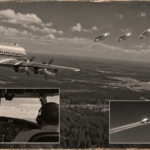
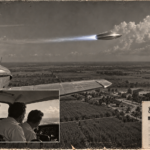
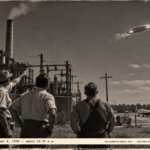
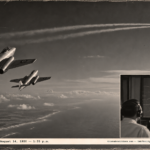
A damaged silver disc and its three-meter crew on the Kazakh steppe, end of June 1947 — the Bodnya contact account, reclassified CE-IV and flagged problematic.
THINK ABOUTIT UFO | UAP SIGHTING REPORT
1947: Bahamut, Kokchetav Region, Kazakhstan Encounter
Near midnight at the end of June 1947, on the open steppe of the Kokchetav region of Kazakhstan, an 18-year-old herdsman named Alexey Romanovich Bodnya was watching his horses when a bright circle lit the grass like a miniature whirlwind and a silver, mirror-bright disc — two deep saucers joined at the rim, a crystalline dome on top, four piston-like legs working up and down — came down wobbling as if its controls were failing. By the account, it landed, three nearly three-meter-tall beings climbed down a ladder to make repairs, and what followed grew into one of the most elaborate contact narratives in the Soviet-era record: telepathic conversation with a towering bearded “leader,” a wolf killed by a beam, a walk into the craft cut short by heat and nausea, a buried cross-shaped metal fragment, a claimed implant, and — decades later, in Crimea in 1990 — a resumption of contact carrying warnings of catastrophe. It is a gripping story. It is also a deeply problematic one, and the record has to say so plainly.
Date: End of June 1947
Sighting Time: About midnight
Day/Night: Night
Location: Bahamut, Kokchetav Region, Kazakhstan
Urban or Rural: Rural
No. of Entity(s): 4 (three emerged; a fourth, possibly female, remained aboard)
Entity Type: Humanoid (giant humanoid)
Entity Description: Very tall beings, close to 3 meters in height, near-identical to one another. Elongated faces, large round eyes, long noses, high foreheads, grayish-bluish skin, thin lips. Dressed in silver, tight-fitting reflective overalls with head coverings, each with a sophisticated device on the chest. One was a leader — gigantic, broad-shouldered, at least a meter taller than the others, with a front “apron” bearing a chest light, even white teeth, a large dense brown beard, light brown hair, light-colored eyes, and a powerful voice; he gave orders to the others.
Hynek Classification: CE-IV (Close Encounter of the Fourth Kind) — reported abduction/onboard examination. (See Researcher’s Notes: live page lists CE-V, which is rejected for pre-modern cases under archive standard.)
Duration: Most of the night (emergency landing through completion of repairs)
No. of Object(s): 1
Description of the Object(s): A silver, almost mirror-like disc about 25 meters in diameter, shaped like two deep saucers joined together, with a transparent crystalline dome on top. Four piston/prop-like landing legs protruded from the bottom and moved up and down in rhythm. A wide cylindrical nozzle-like protrusion about 5 meters in diameter sat beneath the craft, containing a rotating red-yellow flame-like light. The mirror surface reflected the ground and grass; powerful searchlights were visible on approach. The craft appeared unstable, as if its flight-control system was damaged, and seemed about to tumble before landing safely.
Shape of Object(s): Disc (two deep saucers joined, domed)
Size of Object(s): About 25 meters in diameter (nozzle protrusion ~5 meters)
Color of Object(s): Silver, mirror-like
Distance to Object(s): Unknown (witness hidden in nearby shrubs)
Height & Speed: Descended unstably to land; on departure rose and shot up into the sky at extreme speed, vanishing almost instantly
Number of Witnesses: 1 primary (Alexey Romanovich Bodnya); landing traces later viewed by fellow collective farmers the next day
Special Features/Characteristics: Apparent in-flight control damage attributed to a lightning strike; rhythmic piston legs; rotating flame nozzle; crystalline dome opening with a melodic vibrating sound; green beam directed at witness (impression of being photographed); claimed telepathic communication; a beam that killed an approaching wolf; onboard entry halted by heat and nausea; claimed loss of consciousness, examination, and implantation; a small cross-shaped metallic fragment left behind and buried by the witness; physical landing traces; reported threat to keep silent; claimed 1990 resumption of contact in Crimea (moon base, vegetarian/sterile-planet claims, afterlife confirmation, catastrophe prophecies)
Case Status: Insufficient Data
Source: Anton Anfalov and Yuri Pugachev; also cited to A.S. Kuzovkin
Summary/Description: An 18-year-old herdsman, Alexey R. Bodnya, reported that near midnight at the end of June 1947 a damaged silver disc made an emergency landing on the Kokchetav steppe. Three near-identical beings about 3 meters tall, led by a far larger bearded “giant,” descended to repair the craft while a fourth remained aboard. After the witness’s horse gave away his hiding place, the leader established telepathic contact, conversed with him, killed an approaching wolf with a beam, and permitted him to look inside the craft; the witness reported heat, nausea, a blackout, and a belief that he had been examined and implanted. The beings left a cross-shaped metal fragment, which he buried, and warned him to silence. Landing traces were reportedly seen by other farmers. The witness later moved to Crimea, where in 1990 he claimed the contact resumed telepathically, conveying claims about a lunar base, the beings’ origins and diet, an afterlife, and coming catastrophes.
Related Cases: 1948 Stavropol Region, North Caucasus, Russia Abduction | 1914 Astrakhan Steppe, Russia (Government Inquest) | 1985 “Captured by Russian Forces” | 1989 Sochi, Caucasus Close Encounter; broader Anfalov-sourced Soviet/CIS contact corpus
DETAILED REPORT
The account, set near midnight at the end of June 1947 on the Kokchetav steppe in Kazakhstan, centers on a single witness: Alexey Romanovich Bodnya, described as an 18-year-old herdsman from a nearby collective farm. By the account, Bodnya first noticed a brightly lit circle on the grass resembling a micro-tornado, then heard loud metallic clicking and looked up to see a silver, mirror-bright disc roughly 25 meters across — two deep saucers joined at the rim, topped by a transparent crystalline dome, with four piston-like legs moving rhythmically and a wide nozzle-like protrusion beneath containing a rotating red-yellow flame. The craft behaved as though its flight controls were damaged, wobbling and seeming about to crash before it managed a safe landing.
A ladder extended and three beings descended. They were described as nearly three meters tall and almost identical — elongated faces, large round eyes, long noses, high foreheads, grayish-bluish skin, thin lips, in silver reflective overalls with head coverings and chest-mounted devices. One was markedly larger, a bearded “giant” at least a meter taller than the others, wearing a front apron with a chest light and issuing orders; a fourth being, possibly female, was inferred to remain aboard, addressed by the leader through a microphone-like device. The crew opened the crystalline dome (accompanied by a melodic vibrating sound) and began repairs, which the witness attributed, via later telepathic explanation, to a lightning strike that had damaged the flight-control mechanism.
The narrative then escalates well beyond observation. When Bodnya’s horse snorted and gave away his position behind the shrubs, the beings directed a green beam at him and he formed the impression he had been photographed. The leader reportedly established direct telepathic contact, reproaching him for hiding rather than greeting them as guests. A conversation followed — rendered in the source with specific exchanged lines — covering the witness’s offer of food, the leader’s wariness of the horse, and the killing of an approaching wolf with a “thunderous beam.” Bodnya was seated on the craft’s rim, permitted to look inside (a long corridor, frame-like walls, a very high ceiling), but was driven back by intense heat and nausea after a few steps, then reportedly lost consciousness and woke on the grass, convinced he had been examined and implanted. The beings completed repairs, left behind a small cross-shaped metallic fragment that he buried intending to recover later, warned him to silence, and departed at extreme speed. Landing traces were reportedly shown to fellow farmers the next day. The account concludes with a 1990 sequel in Crimea, in which the same green beam allegedly reappeared and telepathic contact resumed, delivering a suite of classic contactee claims: a glass-domed lunar base, a sterile home planet, vegetarian beings, confirmation of an afterlife, prophecies of coming catastrophe, and contempt for humanity (likened to inmates of an asylum).
As evidence, the case is extraordinarily weak relative to the weight of its claims. It is single-witness; the only corroboration offered is secondhand (fellow farmers reportedly viewing landing traces) and undocumented. The physical artifact — the cross-shaped fragment — was buried and never recovered, and remains, per the account, hypothetically still in the ground. The narrative depends throughout on telepathy, an unverifiable implant, and a decades-later contact resumption laden with prophecy, all of which are hallmarks of the contactee genre rather than of evidentially constrained reporting. The sourcing compounds the problem: the chain runs through Anton Anfalov (with Yuri Pugachev, and a citation to A.S. Kuzovkin), and Anfalov-attributed Soviet/CIS cases are widely regarded in the research community as requiring exceptional caution. There is no contemporaneous 1947 documentation, no named independent investigator, and no chain of custody for any element of the account.
RESEARCHER’S NOTES
The Steppe Repair — Kokchetav 1947 and a Contactee Narrative the Record Cannot Stand Behind
- Classification Assessment: Setting the category aside from the contactee framing, the reported content — an onboard entry, a claimed loss of consciousness, and a believed physical examination and implantation — is the profile of a CE-IV (abduction/onboard) event, not a CE-V “voluntary bilateral contact.” We reclassify to CE-IV as the highest defensible category supported by the narrative’s own claims, while noting that the evidentiary basis for any close-encounter classification here is itself contested. If the editorial preference is to avoid endorsing the abduction elements as fact, a fallback of CE-III (animate beings observed in association with the craft) is defensible; CE-V is not.
- Source Chain Assessment (Primary Weakness): This is a PROBLEMATIC source under our hierarchy. The attribution runs through Anton Anfalov and Yuri Pugachev, with a secondary nod to A.S. Kuzovkin. Anfalov-sourced Soviet and post-Soviet cases are a recognized caution category in the field, frequently lacking verifiable provenance, independent investigators, or contemporaneous documentation. Here there is no 1947 record, no named first-hand investigator with a documented interview, and no chain of custody. The single witness is named (Bodnya), which is marginally better than anonymity, but the account reached print through a problematic channel and cannot be elevated on the strength of the chain.
- Pattern Context and Genre Markers: The narrative is saturated with contactee-era motifs that postdate or coincide with 1947’s mythology rather than reading as a constrained 1947 observation: telepathic dialogue with a benevolent-but-superior “leader,” a wolf dispatched by a beam, an implant, a glass-domed moon base, vegetarianism, afterlife confirmation, and apocalyptic prophecy delivered in a 1990 sequel. The “damaged craft repaired on the ground” frame echoes a small family of repair-landing stories, but the prophetic 1990 resumption is characteristic of the Cold-War-into-perestroika Russian contactee wave, which is exactly when many such accounts surfaced. These markers strongly suggest a narrative shaped by genre convention, whether at the witness or the source-compiler stage.
- Physical Evidence and Evidentiary Weight: There is no recoverable physical evidence. The cross-shaped fragment was buried and never retrieved; the implant is unverifiable by definition; the landing traces are reported only secondhand and were never documented. The quantitative craft details (25-meter diameter, 5-meter nozzle, 3-meter beings) are vivid but uncorroborated. Against the magnitude of the claims — abduction, implantation, telepathy, multi-decade contact, prophecy — the evidentiary base is effectively nil. This is why the case cannot be carried as Unexplained: “unexplained” implies a residue that resists conventional explanation after the evidence is weighed, whereas here there is essentially no testable evidence to weigh. Insufficient Data is the honest standing, with a PROBLEMATIC source flag.
The Kokchetav account is one of the more cinematic entries in the Soviet-era contact literature — a damaged disc, three-meter beings, a towering telepathic leader, an implant, and a prophecy delivered across four decades. It is precisely that richness, combined with a problematic source chain, the absence of any recoverable evidence, and a structure built almost entirely from contactee-genre conventions, that obliges the record to hold it at arm’s length. The archive corrects the inadmissible CE-V to CE-IV as the highest category its own narrative would support, flags the Anfalov-Pugachev-Kuzovkin sourcing as PROBLEMATIC, and assigns Case Status: Insufficient Data. It is retained as a documented example of the postwar Russian contactee narrative — preserved for study, not endorsed as established fact, and explicitly not to be cited as a verified 1947 close encounter.