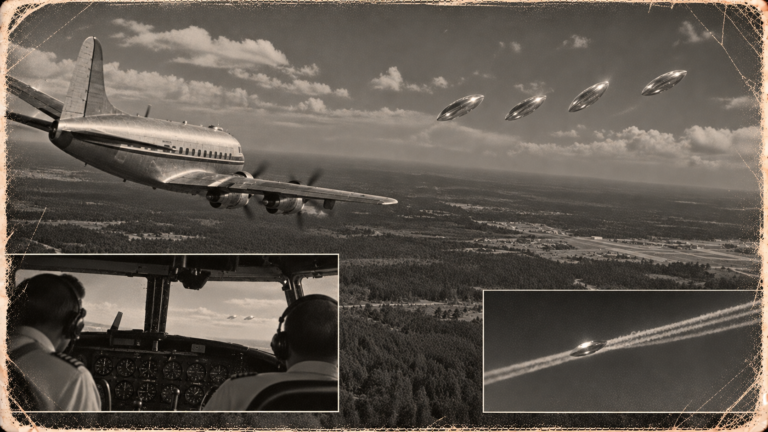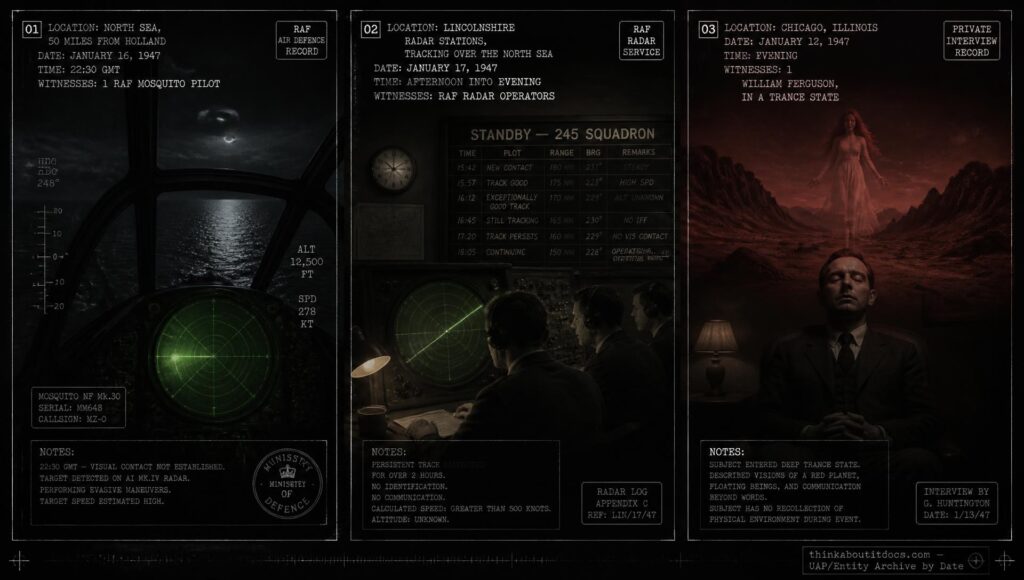
January 1947 — three cases: RAF's "Operation Charlie" radar pursuit over the North Sea, continued Lincolnshire radar tracking the next day, and William Ferguson's trance-state Mars contact claim in Chicago. thinkaboutitdocs.com.
1947: January UFO|UAP & Entity Sightings Archive
On the night of January 16, 1947, an RAF Mosquito pilot over the North Sea chased a radar target flying evasive maneuvers at 22,000 feet, at a speed matching or exceeding his own aircraft. Air Ministry files would call it “Operation Charlie” — one of the best-documented British radar-visual cases of the immediate postwar period, and the direct reason Fighter Command extended its night radar watch. The very next evening, two Chain Home Low stations in Lincolnshire picked up the same pattern again, tracking an “exceptionally good” unidentified target for thirty minutes at over 200 mph. Elsewhere that January, the record turns stranger and thinner: a Texas man’s disputed claim of a crashed egg-shaped craft with small large-headed occupants in rural New Mexico, and Chicago electrician William Ferguson’s trance-state account of traveling to Mars and meeting a being named “Khauga.” This archive’s existing full report on the January 15 Yokohama, Japan sighting rounds out a month that opens the year on its strongest documented footing.
Date: Jan. 1947
Location: Boston, Massachusetts
Time: Evening
Summary: A witness named Massinger reported a close-range observation of a metallic, disc-shaped object that appeared to follow his vehicle for several miles before accelerating vertically at high speed.
Source: George M. Eberhart, A Geo-Bibliography of Anomalies, Greenwood Press, Westport, 1980, ISBN 0-313-21337-2 Source Status: UNVERIFIED — cited to a real published bibliography; this archive could not independently confirm the entry’s content against that source.
Date: Jan. 1947
Location: Little Rock, Arkansas
Time: Night
Summary: Witnesses reported strange blue lights performing erratic maneuvers over the city.
Source: “UFO Sightings in Arkansas,” onlyinark.com Source Status: INSUFFICIENT DATA — a general-interest roundup, not a primary or specialist source; no named witness or independent corroboration located.
Date: Jan. 7, 1947
Location: Rural New Mexico
Time: Unknown
No. of Entity’s: Three
Entity Type: Small, large-headed humanoids matching what later became the archetypal “Grey” description
Summary: A Texas man reportedly found an egg-shaped craft in a remote arroyo, with three small, large-headed beings inside.
Source: Attributed to H.E. Puthoff Source Status: DISPUTED — H.E. Puthoff is a real physicist known for parapsychology and remote-viewing research at the Stanford Research Institute, not for UFO crash-retrieval investigation; no publication by Puthoff describing this case has been located, and the attribution should be treated with significant caution.
Date: Jan. 12, 1947
Location: Chicago, Illinois (witness in a trance/meditative state)
Time: Evening
No. of Entity’s: One
Entity Type: Claimed Martian, described as red-haired and red-complexioned with broad features and the ability to float
Summary: While in an out-of-body state, William Ferguson reported traveling at the speed of light and finding himself on Mars, where he met a being he called “Khauga.”
Source: Jerome Clark, Extraordinary Encounters Source Status: CONTACTEE/CHANNELING — a documented claim from a credentialed UFO encyclopedia, but categorically a subjective trance experience rather than a physical sighting; retained as a documented contactee-era claim, not as an established event.
Date: January 15, 1947: Yokohama, Japan Sighting [Full Report]
Date: Jan. 16, 1947
Location: North Sea, 50 miles from Holland
Time: 22:30 GMT
Case Status: Unexplained
Summary: An RAF Mosquito pilot pursued an unidentified radar target showing efficient, controlled evasive action at 22,000 feet, at a speed equal to or greater than the Mosquito’s own, heading west toward Norfolk. The target’s ability to “zoom” at roughly 400 mph — faster than most contemporary fighters — was linked to another “X-raid” tracked earlier the same day. An FBI document from July 1947 quoted the Air Ministry’s case summary stating “no explanation has been forthcoming, nor has it been repeated” — an assessment overtaken within a day, since a very similar incident recurred the following evening (see January 17 below). As a direct result, Fighter Command extended its permanent night radar watch for unidentified targets. Known in Air Ministry files as “Operation Charlie,” this is one of the best-documented British radar-visual cases of the immediate postwar period.
Source: Declassified UK Air Ministry files (FOIA release); David Clarke and Andy Roberts, UFO researchers, drawing on National Archives (Kew) documents; Loren E. Gross, UFOs: A History — 1947, Jan-Jun, p. 6 Source Status: VERIFIED — corroborated by declassified official RAF/Air Ministry documentation.
Date: Jan. 17, 1947
Location: North Sea (tracked from Lincolnshire radar stations)
Time: Afternoon, continuing to 19:45
Summary: Two Chain Home Low radar stations in Lincolnshire (Skendleby and Humberstone) tracked what was described as “an exceptionally good track,” designated U294, at 10,000 feet above the North Sea. With Eastern Sector on alert, Meteor jets of 245 Squadron were placed on standby to scramble if the target — nicknamed “Charlie” — came within range, but the plot faded before interception. At 19:45, the Humberstone station, near Grimsby, again tracked an unidentified target over the sea for 30 minutes at a speed exceeding 200 mph.
Source: RAF Intelligence / declassified FOIA documents Source Status: VERIFIED — corroborated by declassified official RAF documentation, continuing the same “Operation Charlie” investigation as the January 16 entry.
EXECUTIVE SUMMARY
January 1947 — Operation Charlie Opens the Postwar Radar Record
Two consecutive nights over the North Sea give January 1947 its strongest documentary anchor of any month in this archive so far. On January 16, an RAF Mosquito crew pursued a radar target flying controlled evasive maneuvers at a speed matching their own aircraft — and the Air Ministry’s own declassified files, not a secondary retelling, describe the pursuit in detail. The very next evening, two Lincolnshire Chain Home Low stations tracked what was very likely the same phenomenon again, well-documented enough that Meteor jets were placed on standby to intercept. Together, Air Ministry files call this “Operation Charlie,” and its direct institutional consequence — Fighter Command extending its permanent night radar watch — makes it one of the best-corroborated British cases of the immediate postwar period.
The rest of the month sits at the opposite end of the evidentiary scale. A rural New Mexico crash-retrieval claim rests on an attribution to physicist H.E. Puthoff that no located publication of his supports. William Ferguson’s Chicago account is an out-of-body trance experience, not a physical sighting, and is retained here as a documented contactee-era claim rather than an event. Two undated “January 1947” entries from Boston and Little Rock carry no named witness or independent corroboration strong enough to move them past Unverified or Insufficient Data. Measured against Operation Charlie’s declassified paper trail, January 1947 is a month of one exceptionally solid case and several considerably weaker ones — and this archive treats that gap honestly rather than smoothing it over.
“No explanation has been forthcoming, nor has it been repeated” — an assessment overtaken within a day.
Air Ministry case summary, quoted in a July 1947 FBI document, describing the January 16 “Operation Charlie” North Sea radar pursuit.