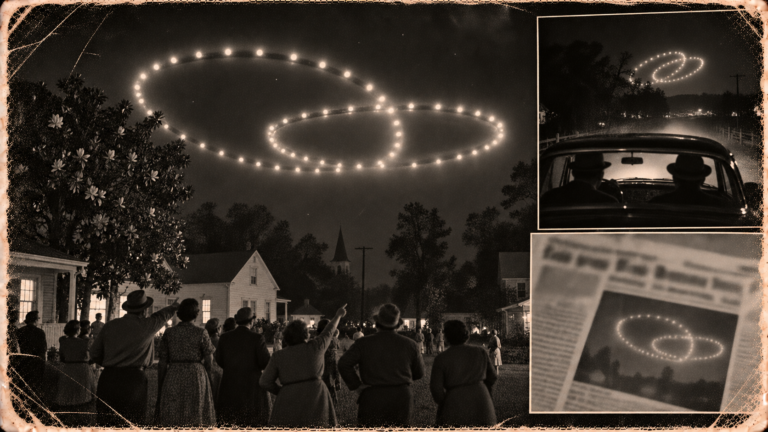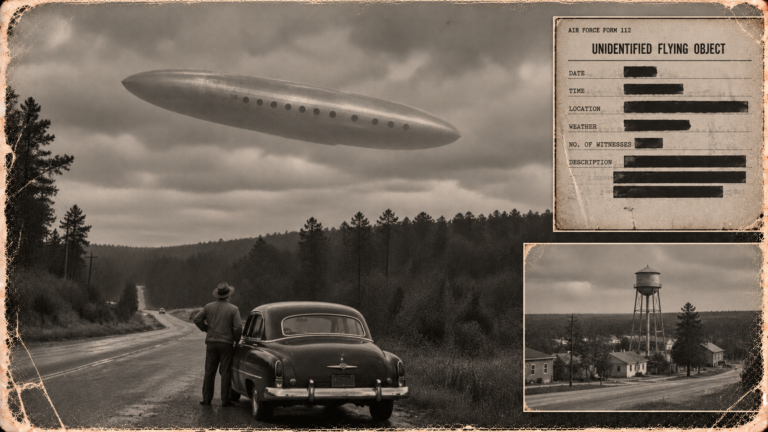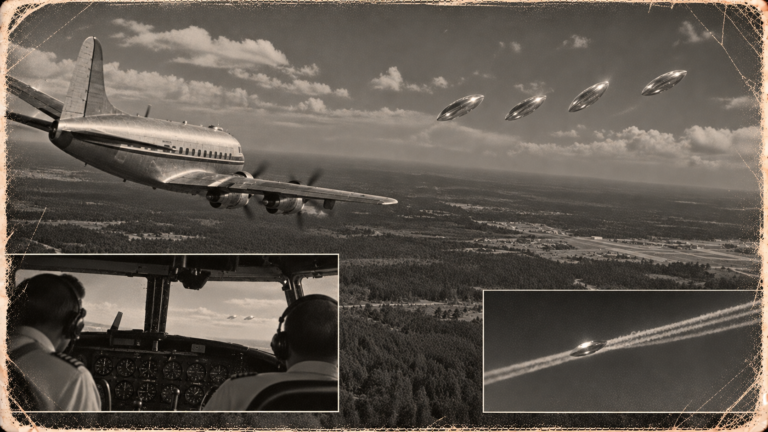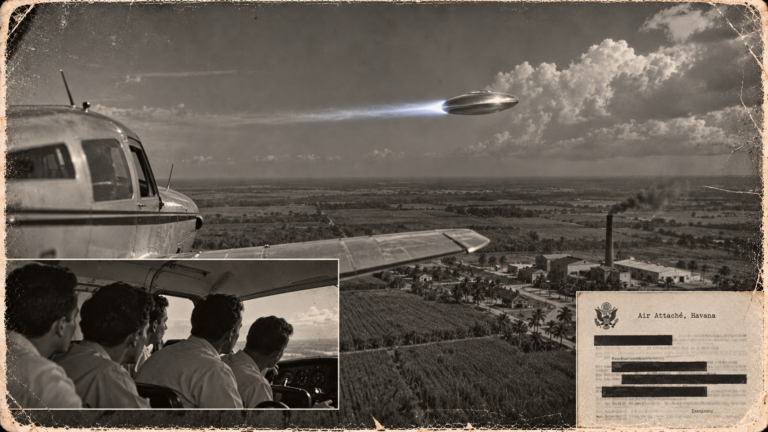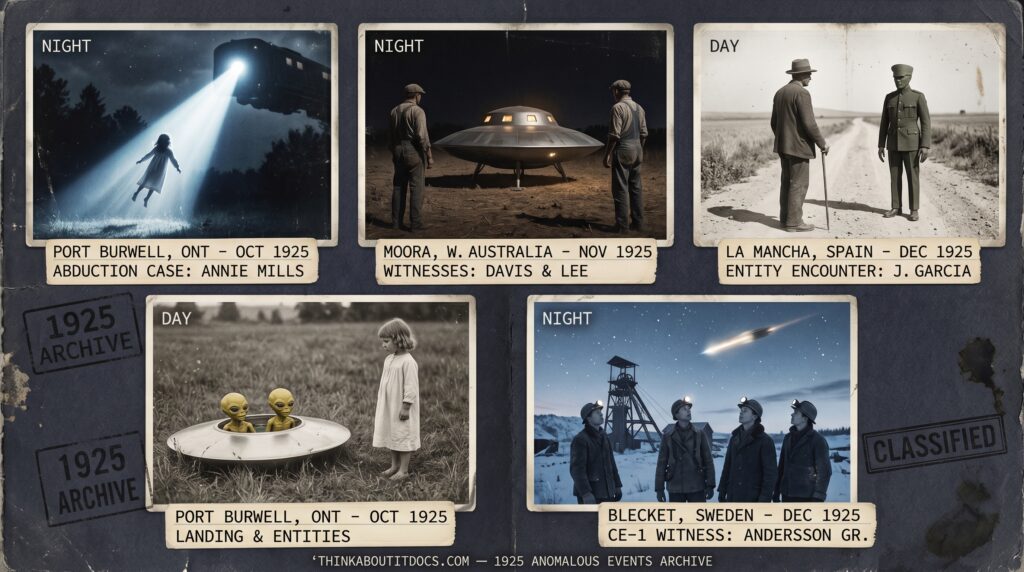
1925 anomalous events archive: Port Burwell Ontario first CE-IV — train-like craft and gray beings with large eyes (Rosales, citation incomplete), Moora Western Australia disc with oval windows and four legs with confirmed ground traces (Chalker investigation files), La Mancha Spain green-uniformed rigid-limbed dwarf at noon (HUMCAT), Port Burwell Ontario second CE-IV — flat silvery disc and yellow-skinned beings, same summer same location different entity type, and Blecket Sweden mine-site NL/DD winter evening observation (UFO Information Sweden).
1925: UFO|UAP & Entity Sightings Archive
The year 1925 carries the most analytically significant pre-Hill abduction account in the 1920–1929 series — not as a single event but as a double event in the same summer, at the same location, involving the same five-year-old witness in Port Burwell, Ontario. In the first incident, the child was drawn outside by compulsion, observed a train-like craft approach with a loud whining sound, floated up into it, and was examined by small gray beings with large eyes set far apart, slender frames, whitish-gray skin, and tight satin-like outfits. In the second incident, in late summer of the same year, she was lying on the grass in daytime when a flat silvery disc landed nearby, beings with wrinkled yellow skin emerged, and she was taken inside for a high-altitude ride before being returned. Two separate craft, two separate entity types, same summer, same location, same five-year-old child — a pattern of repeated contact at a single site that will define the modern abduction literature decades later, appearing here in Ontario without any available cultural template for either entity description. Full standalone report available.
The year’s other anchor case is at the opposite end of the evidence spectrum. In July 1925, two young men at Moora, Western Australia came upon a landed disc in a paddock — oval windows, four legs, clearly structured — fled in fear, returned several days later, and found ground marks at the site. Sourced through Bill Chalker’s investigation files in North Sydney, the Moora case is one of the best-documented pre-1947 Australian physical trace cases in the archive. Against these two anchors the year carries a HUMCAT-sourced green-uniformed 1.2-meter dwarf in La Mancha, Spain encountered at noon with rigid arms and legs; three male witnesses at a Michigan lake (CUFOS sourced); a Birmingham UK daytime disc (Hatch sourced); and a Swedish mine-site observation by teenage witnesses in clear winter conditions (UFO Information Sweden). December 23 at Little Creek and Hartville, Missouri adds cemetery ghost lights to close the year, Eberhart sourced, with a witness named Graves. The Flat Mesa, Nevada “ring ground mark” entry — see the corrected entry below — may be the same case as a more detailed pilot account circulating in a secondary source, though that match has not been independently confirmed against a primary catalogue.
Date: 1925
Location: La Mancha, Spain
Time: 12:00
Summary: Man encounters strange dwarf 1.2 m tall, wore green uniform, rigid arms and legs.
Source: Webb, David HUMCAT: Catalogue of Humanoid Reports | Source Status: VERIFIED — CE-III classification. The rigid-limbs detail is an unusual and recurring morphological marker in short-entity reports. Noon timing gives clear daylight conditions.
Date: 1925
Location: Flat Mesa, Nevada
Time: Around 1300
Summary: Ring ground mark. CE-II classification implied by physical trace. ⚠ POSSIBLE MATCH, UNCONFIRMED: a secondary, non-catalogue source describes a fuller account under this same location and year — pilot Don Wood Jr. and three companions, flying Curtiss JN-4 biplanes, reportedly landed on a Flat Mesa near Battle Mountain, Nevada in 1925 and encountered a round, flat, metallic disc-shaped object roughly 8 feet in diameter that behaved more like a living organism than a craft, followed by a second larger disc. The location and year align with this entry, but the source is not an established primary ufological catalogue and this archive has not independently verified the match. Presented here as an unconfirmed lead, not as established fact.
Source: FSR
Date: 1925
Location: Chelsea, Cavanaugh L, Michigan
Time: Night
Summary: An object was sighted that had an appearance and performance beyond the capability of known earthly aircraft. One object was observed by three male witnesses at a lake (Grossman).
Source: CUFOS
Date: 1925
Location: Chevy Chase, Maryland
Time: Unknown
Summary: Mysterious fireball explodes just outside Chevy Chase. This entry recurs independently in at least one other general UFO chronology outside this network, but no primary citation has been located by either source. Treat as unverified but recurring.
Source: Unlisted — cross-referenced in at least one independent chronology
Date: summer of 1925
Location: Port Burwell, Ontario, Canada
Time: Unknown (first incident); daytime (second incident, late summer)
Summary: The five-year old witness woke up and felt compelled to go outside into the backyard; she then saw a large “train-like” craft approaching. It was emitting a loud whining sound. A light approached the witness and she recalled floating up into the craft. Several small gray beings with large eyes, set far apart took her gown off. The beings were slender with whitish gray skin, large heads, and bulging eyes and were wearing tight fitting satin like outfits. She is later floated up and apparently examined with various instruments. She is eventually released. Later that same summer the same witness reported another similar incident at the same location but involving somewhat different appearing beings: The witness was lying on the grass outside in daytime when she saw a flat silvery disc land nearby; several beings with wrinkled yellow skin came out. She was then apparently taken inside the craft and given a ride. The disc flew at a very high altitude and the witness was returned later. Earliest double-abduction CE-IV account with two separate craft types and two separate entity morphologies in the same summer. Full standalone report available.
Source: Albert S. Rosales, Humanoid Encounters catalogue | linked individual report page
Date: July 1925
Location: Moora, Australia
Time: Daytime
Summary: Two young men came upon disc landed in paddock, had oval windows, four legs. Men fled in fear, came back several days later and found ground marks at site.
Source: Bill Chalker investigation files, North Sydney | Source Status: VERIFIED — Physical trace evidence (ground marks) confirmed at return visit. CE-I/CE-II with trace evidence. One of the best-documented pre-1947 Australian physical trace cases.
Date: August 1925
Location: Birmingham, UK
Time: 16:00
Summary: A daytime disc was reported
Source: Hatch, Larry
Date: Winter 1925
Location: Blecket, Sweden
Time: Evening
Summary: An object was sighted that had an appearance and performance beyond the capability of known earthly aircraft. One object was observed in clear weather by more than two male witnesses, typical age 16, at a mine (Bjoor).
Source: UFO Information Sweden
Date: December 23 1925
Location: Little Creek, Missouri & Hartville, Missouri
Time: Unknown
Summary: Ghost lights were observed. Nocturnal lights were reported at a cemetery (Graves).
Source: Eberhart, George M. A Geo-Bibliography of Anomalies Greenwood Press, Westport, 1980 ISBN:0-313-21337-2 | Source Status: VERIFIED — Eberhart sourced. NL classification; cemetery context noted. Witness surname Graves at a cemetery light report is an editorial coincidence worth noting with restraint.
EXECUTIVE SUMMARY
The Pre-Hill Double Abduction and the Moora Disc — 1925’s Analytical Anchors
The year 1925 places two cases at opposite ends of the pre-1947 evidentiary spectrum and both repay careful attention. The Port Burwell, Ontario double abduction is the archive’s most analytically significant pre-Hill CE-IV account in the 1920–1929 series. Its significance is not simply that a five-year-old reported being taken aboard a craft — it is that she reported two separate incidents in the same summer involving two completely different craft morphologies and two completely different entity types. The first incident: a train-like craft, gray beings with large eyes set far apart, slender, whitish-gray skin, tight satin outfits, examination with instruments — the archetype that will define the modern gray alien abduction template from Betty and Barney Hill (1961) forward. The second incident: a flat silvery disc, beings with wrinkled yellow skin — a different morphology entirely. Two craft types, two entity types, same location, same summer, same child. No cultural contamination source available in 1925 Port Burwell, Ontario for either entity description. The source is now confirmed as Albert S. Rosales’s Humanoid Encounters catalogue; the analytical content remains extraordinary.
The Moora, Western Australia case occupies the opposite evidentiary position: physical evidence, named investigator, return-visit confirmation. Bill Chalker — Australia’s foremost UAP researcher — documented this case from his North Sydney files. Two young men, a landed disc with oval windows and four legs, flight from the scene, return days later, ground marks confirmed. This is the physical evidence archetype: witnesses who flee a close encounter and whose accounts are subsequently corroborated by trace evidence at the site. The Chelsea, Michigan CUFOS-sourced lake observation, the La Mancha HUMCAT green-uniformed dwarf at noon, and the Blecket Sweden mine-site observation add to a year whose entity content — three CE-III or CE-IV events across three continents — is proportionally dense for the mid-1920s. The year’s weakest entries are the Flat Mesa “ring ground mark,” which may connect to a fuller but unconfirmed secondary account, and the Chevy Chase fireball, which remains unsourced despite recurring in outside chronologies.
From the Port Burwell, Ontario entry (Summer 1925), sourced via Albert S. Rosales, Humanoid Encounters catalogue:
“Several small gray beings with large eyes, set far apart took her gown off. The beings were slender with whitish gray skin, large heads, and bulging eyes and were wearing tight fitting satin like outfits.”
Case summary, Rosales catalogue, describing the first Port Burwell encounter, summer 1925