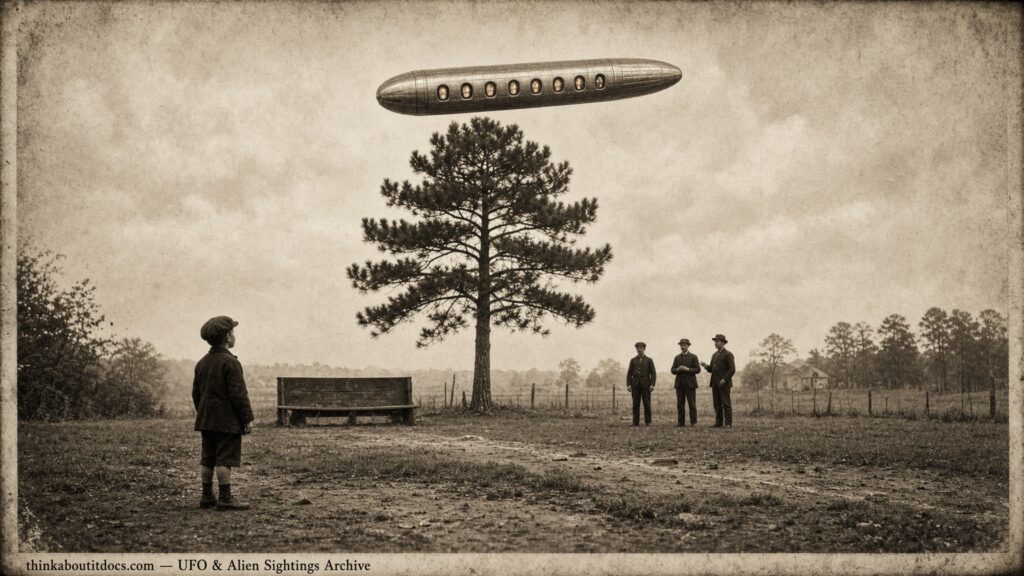
Spring 1910, Violetville, Maryland — young Lawrence J. Crone reported seeing pigeon-headed occupants through the windows of a hovering brown cigar-shaped object near a baseball field.
THINK ABOUTIT UFO|UAP|ENTITY ENCOUNTER REPORT
The 1910 Violetville, Maryland Encounter
A Child’s Account of Pigeon-Headed Beings
One morning in the spring of 1910, at a baseball field in what was then the small community of Violetville, Maryland, a young boy named Lawrence J. Crone watched a brown, cigar-shaped object hover over a pine tree and looked through one of its windows at something that looked back. He was somewhere between four and seven years old, depending on which of his own later retellings you read, and he wouldn’t be formally interviewed about what he saw until decades afterward. What survives is one of the most physically specific entity descriptions in the pre-war American record — and a case whose entire evidentiary weight rests on a single child witness’s memory, recorded long after the fact.
Date: Spring 1910 (some accounts say summer)
Sighting Time: Morning
Day/Night: Day
Location: Violetville, Maryland (now a Baltimore suburb)
Urban or Rural: Rural/suburban at the time (baseball field)
No. of Entity(s): Approximately 20, appearing in small groups of two or three at a time
Entity Type: Pigeon-headed humanoid occupants
Entity Description: Pigeon-like heads and necks, pointed heads or helmets, no visible nose or ears, a mouth slit, two round eye-spots on flat, chinless faces, covered in soft gray or light-colored fur-like material
Hynek Classification: CE-III
Duration: Undocumented
No. of Object(s): 1
Description of the Object(s): A brown, metallic, cigar- or blimp-shaped object with a row of rectangular, variously colored windows
Shape of Object(s): Cigar/blimp-shaped
Size of Object(s): Roughly 100 feet long, per Crone’s description (“twice the length of a railroad car”)
Color of Object(s): Brown, metallic
Distance to Object(s): Approximately 200 feet, hovering over a nearby pine tree
Height & Speed: Hovering with an oscillating motion; departed slowly
Number of Witnesses: 3 (Crone, his mother, and two young men, though the two young men reportedly fled before extended observation)
Special Features/Characteristics: Occupants visible only through one transparent window; several small groups took turns looking out
Case Status: Insufficient Data
Source: HUMCAT: Catalogue of Humanoid Reports, compiled by David F. Webb and Ted Bloecher, circa 1977, drawing on interviews conducted decades after the event
Summary/Description: A young boy, Lawrence J. Crone, reported seeing a brown, cigar-shaped object hovering over a pine tree near a baseball field, with an estimated twenty pigeon-headed occupants visible through its windows. His mother and two other young men also reportedly witnessed the object.
Witnesses: Lawrence J. Crone (primary witness, a young child at the time); two unnamed young men alerted by Crone, who reportedly fled; Crone’s mother, who also witnessed the object
Related Cases: Compare the 1912 Abram Penner, Vancouver, British Columbia case, another young-child witness account of an occupied craft recorded decades after the fact
DETAILED REPORT
The case comes down to us entirely through retrospective testimony. Decades after the event, two separate ufologists — Ted Bloecher and Thomas P. Deuley — independently interviewed Lawrence J. Crone about the encounter, and their recorded accounts form the basis for the entry in HUMCAT, the Catalogue of Humanoid Reports compiled by David F. Webb and Ted Bloecher around 1977. Crone’s own stated age at the time of the sighting varies across versions of his account — he is recorded as having been anywhere from four to seven years old, a detail this page states plainly rather than smoothing over, since it bears directly on how much weight to give the specificity of what follows.
At a baseball field, Crone reported seeing a brown, metallic object, cigar- or blimp-shaped, roughly 100 feet long — he later described it as “twice the length of a railroad car” — hovering with a distinct oscillating motion over a pine tree about 200 feet from where he stood. The object had a row of rectangular windows in various colors along its side. Through one window that was transparent, he reported seeing occupants looking back out at him, or watching him directly.
His description of those occupants is the case’s most distinctive feature: heads and necks he compared to pigeons, with pointed heads or helmets, no visible nose or ears, a simple slit for a mouth, and two round eye-spots set into flat, chinless faces. He described them as covered in something soft-looking — gray or light-colored, fur-like or gown-like in texture. Rather than a single pair of occupants, Crone described several small groups of two or three beings taking turns at the window, coming and going, with his overall estimate placing the total number involved at around twenty.
Crone called out to two young men nearby to show them what he was seeing. According to his account, they took one look and fled, screaming. His mother came outside as well and reportedly witnessed the object herself before it moved off slowly and departed.
RESEARCHER’S NOTES
Violetville — Weighing Detail Against Distance in Time
- This case sits at an unusual intersection: extraordinary descriptive specificity, paired with an extraordinarily long and uncertain chain of memory. A pointed-head, chinless, pigeon-necked entity description is far more detailed than most contact-era humanoid reports from this period. But it comes from a witness who was, by his own varying accounts, somewhere in early childhood at the time, recorded by researchers decades after the fact rather than in the days or weeks following the event.
- The age discrepancy across retellings (four to seven years old) is not a minor detail — it’s central to evaluating the case. Childhood memory formation, suggestibility, and the tendency for a story to sharpen and gain detail with each retelling over a lifetime are all well-documented psychological phenomena entirely independent of whether Crone’s original experience was genuine. This doesn’t mean the account is false. It means the level of confidence appropriate to the entity description should be lower than the vividness of the description alone might suggest.
- The corroborating witnesses add real weight, but with real limits: Crone’s mother and two young men are both described as having also seen something. Neither is named, and neither account is independently recorded — both come down to us through Crone’s own retrospective narration of what they reportedly did (fleeing, screaming) rather than through their own separate testimony. This strengthens the case that something was seen, without independently corroborating the entity description specifically.
- HUMCAT’s inclusion of the case, and its cross-referencing by two independent researchers (Bloecher and Deuley), reflects the compilation’s own standards — this is a case the field’s major humanoid-catalog effort judged worth preserving despite its evidentiary limitations, which is itself a meaningful, if not conclusive, signal about how seriously other researchers have taken it.
Violetville offers one of the most vivid entity descriptions in this archive’s pre-war American record, and one of its shakiest evidentiary foundations — both at once, and both worth stating plainly. A small child’s memory, recorded as an adult’s testimony decades later, produced a description specific enough to stand out among hundreds of vaguer contemporary reports. Whether that specificity reflects a genuinely unusual encounter or the way memory sharpens detail over a lifetime of retelling is a question this page leaves open, because it is genuinely open.
“They had heads and necks ‘like pigeons,’ with pointed heads or pointed helmets, no nose, no ears, a slit for a mouth, and two round spots or holes for eyes on their flat, chinless faces. They seemed covered with a soft-looking gray or light-colored gown, like fur.”
— Testimony of Lawrence J. Crone, recorded decades after the event, HUMCAT: Catalogue of Humanoid Reports, compiled by David F. Webb and Ted Bloecher, circa 1977