"A Transport" — Jane Lead's golden ship, London, February 1678
THINK ABOUTIT UFO|UAP|ENTITY ENCOUNTER REPORT
1678: Jane Lead’s “A Transport” | The Golden Ship of London
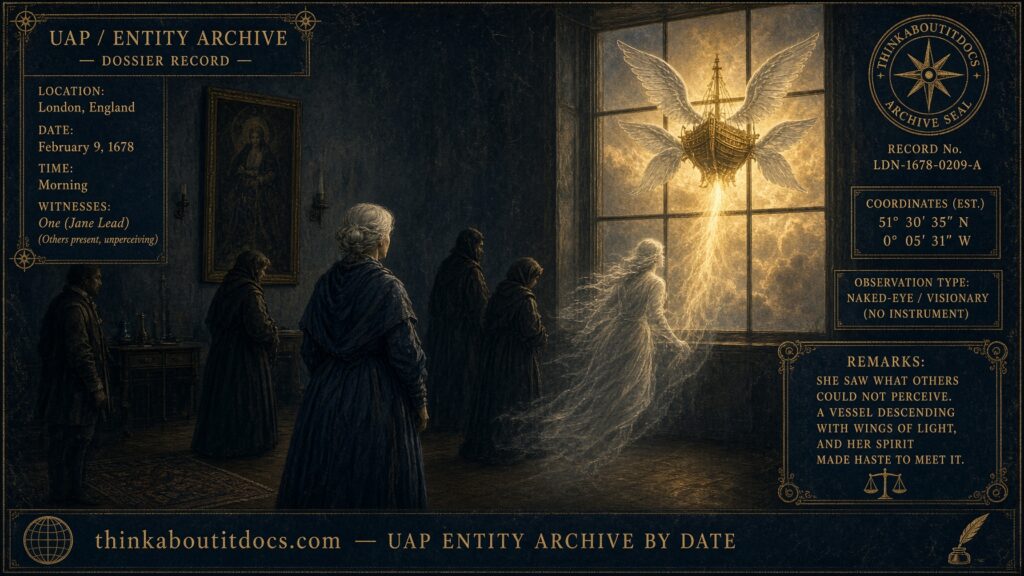
A woman wakes from sleep into a state she describes as being “without the clog of an Earthly Body” — silent figures around her, one familiar, no words spoken. Then a golden, four-winged ship descends with tremendous speed. She asks the figures beside her if they can see it too. They tell her they cannot. She watches herself, from outside herself, run toward it rejoicing — and then it withdraws, “unto the high Orb from whence it came.” Jane Lead titled the entry, simply, “A Transport.”
Date: February 9, 1678
Sighting Time: Morning, immediately after waking from sleep
Day/Night: Day (morning)
Location: London, England
Urban or Rural: Urban
No. of Entity(‘s): Multiple unnamed “figures,” at least one recognized from a prior encounter
Entity Type: Silent humanoid “figures,” identity and nature not specified by Lead beyond recognizing one from an earlier visitation
Entity Description: Present but not physically described in detail; notable for their complete silence and for stating, when asked, that they could not see the descending ship that Lead herself perceived
Hynek Classification: Not Applicable — a subjective/trance-state encounter with an associated craft description; classified as a CE-III/transport-type entity encounter outside the standard Hynek scale
Duration: Not precisely recorded
No. of Object(s): One
Description of the Object(s): A golden vessel in the form of a large ship with four golden wings, descending with great swiftness and withdrawing upward with equal speed
Shape of Object(s): Ship-like, with four wings
Size of Object(s): Described as “large”
Color of Object(s): Golden
Distance to Object(s): Descended to “a pretty distance” from the witness before withdrawing
Height & Speed: Descended and ascended with what Lead describes as the greatest swiftness imaginable, withdrawing to “the high Orb from whence it came”
Number of Witnesses: One (Jane Lead); the other figures present explicitly stated they could not perceive the object
Special Features/Characteristics: Lead describes an altered bodily state prior to the sighting (“insensible of any sensibility as relating to a corporeal Being”); a selective-visibility element in which companions present could not see what she saw; and an out-of-body third-person perspective in which she recalls watching herself run toward the ship
Case Status: Insufficient Data
Source: Jane Lead, diary entry titled “A Transport,” February 9, 1678, in The Works of Jane Lead, reproduced in A Fountain of Gardens (London: J. Bradford, 1696)
Summary/Description: “In the Morning after I was awaked from Sleep, upon a sudden I was insensible of any sensibility as relating to a corporeal Being, and found my self as without the clog of an Earthly Body, being very sprightly and airy in a silent place, where some were beside my self, but I did not know them by their Figures, except one, who went out, and came in again: and there was no speaking one to another, but all did set in great silence.” Lead then recalled seeing a gold-colored craft “come down” to “a pretty distance” from where she was, “in the form of a large Ship” with four golden wings, arriving “with the greatest swiftness as is imaginable.” She asked the figures beside her if they could see what she could, and they said they could not. She then saw herself, from a third-person vantage, “leaping and dancing and greatly rejoicing to meet it.” The entry concludes: “when I came up to it [the Ship], then it did as suddenly go up again, withdrawing out of sight, unto the high Orb from whence it came. After which I found my self in my Body of sense.”
Related Cases: Not Applicable
Detailed Report
Jane Lead (1623–1704) was a documented historical figure — a British Christian mystic, theologian, and founder of the Philadelphian Society, whose four-volume work A Fountain of Gardens was published in London in 1696 and has remained in continuous scholarly circulation as a primary text of English Behmenist and mystical theology. Her diary spans roughly four decades, from an initial vision in 1670 to entries recorded near the end of her life, documenting a sustained, internally consistent record of visionary and entity-contact experiences she consistently distinguished from conventional angelic or demonic categories, at points using the term “Magia” for the beings involved and consistently using the word “Transport” specifically for experiences involving a sense of bodily displacement or out-of-body relocation — a terminological choice this archive’s earlier compilers note maps unusually closely onto the vocabulary later developed independently by 20th-century abduction researchers.
The February 9, 1678 entry is among the most structurally detailed accounts in her diary and contains several elements that recur across the modern entity-contact literature: an altered state of consciousness immediately preceding the encounter, silent companion figures whose perceptual experience diverges from the primary witness’s (she could see the craft; they explicitly could not), and a dissociative or out-of-body third-person viewing experience. Lead’s own prose is dense and theologically inflected, consistent with her broader body of visionary writing, but the specific sequence of events — waking, an altered bodily sensation, silent figures, a craft descending and ascending with described speed and physical form, a selective-visibility discrepancy among witnesses, and a return to ordinary embodied awareness — is recounted with an internal narrative consistency that distinguishes it from a vaguer devotional vision.
RESEARCHER’S NOTES
Jane Lead’s Transport — London 1678 and the Pre-Modern Era’s Closest Case File
- Source chain assessment: Jane Lead is a well-documented historical figure whose complete theological works survive in print from 1696 onward and remain the subject of ongoing academic scholarship; this is a first-person, self-authored account rather than a secondhand chronicle, though it was written and published as explicitly religious/mystical literature rather than as a sighting report in the conventional archive sense.
- Classification issues / corrections: This entry, like Lead’s other diary accounts, is presented here as a documented historical primary source and is not psychologically diagnosed by this archive; readers should note that visionary religious experience, altered states of consciousness, and entity-contact phenomenology are separate categories of analysis that this account sits at the intersection of, and the archive does not adjudicate between them.
- Pattern context / comparative cases: The selective-visibility detail — companions present who could not perceive what the primary witness saw — and the out-of-body third-person viewing experience are recurring structural elements across centuries of entity-contact literature in this archive, from medieval bedroom visitations to modern abduction accounts, making this 1678 entry an unusually early and well-documented example of a durable experiential pattern.
- Geographic or historical context: Lead wrote within the specific theological context of 17th-century English Behmenism and the Philadelphian Society she later founded, a milieu already deeply concerned with visionary and mystical experience as a legitimate mode of religious knowledge — a context essential to understanding both how she interpreted her own experiences and how they were received and preserved by her contemporaries.
Whatever its ultimate nature, Jane Lead’s February 1678 “Transport” stands as one of the most detailed, internally consistent, and historically well-documented entity/craft encounter accounts anywhere in the pre-modern record — preserved not through anonymous folklore or secondhand pamphlet but in the author’s own published words, written within a broader forty-year diary that this archive treats as a singularly significant body of testimony.
“In the form of a large Ship, with four golden Wings… it came down with the greatest swiftness as is imaginable… when I came up to it, then it did as suddenly go up again, withdrawing out of sight, unto the high Orb from whence it came.”