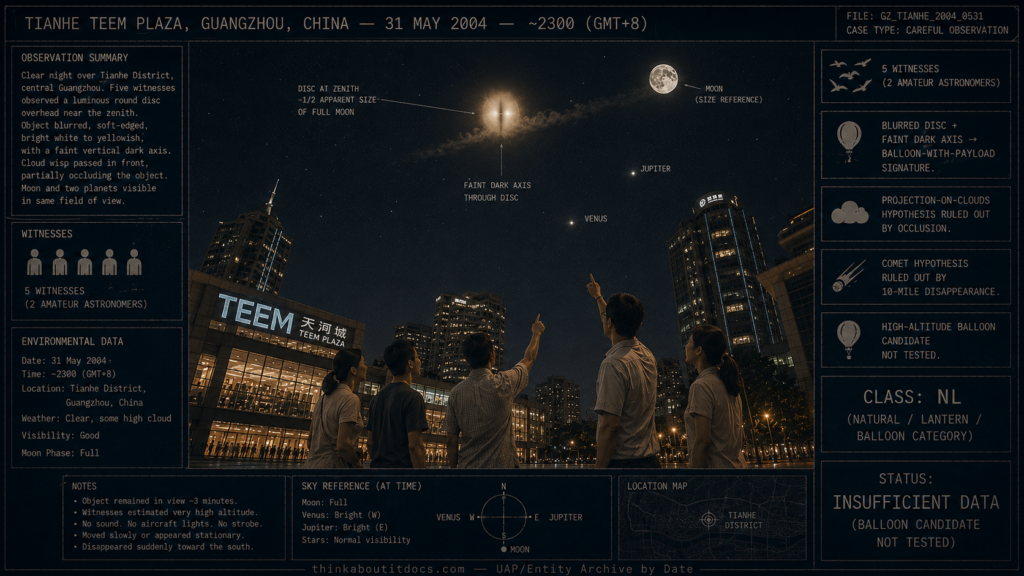
The May 31, 2004 Guangzhou Tianhe sighting — five witnesses including two amateur astronomers watched a blurred overhead disc with a possible dark axis for 30 minutes, ruling out projection-on-clouds and comet hypotheses in real time. The high-altitude-balloon candidate they didn't test fits the description tightly. Logged Insufficient Data. (thinkaboutitdocs.com — UAP/Entity Archive by Date)
THINK ABOUTIT UFO|UAP SIGHTINGS REPORT
2004: A Blurred Overhead Light Watched by Five Witnesses, Tianhe District, Guangzhou, China
On the night of May 31, 2004, at around eleven o’clock, five people came out of a restaurant at Tianhe TEEM Plaza in central Guangzhou and saw, directly overhead, a blurred round object roughly half the size of the Moon and about a third as bright, bright white going to yellowish, with what one observer thought might be a faint dark axis running through it. Two of the five were amateur astronomers, who immediately confirmed that what they were seeing did not match anything in their experience — and crucially, the Moon, two bright planets, and clear sky were all visible in the same view, so they had calibration points. They watched for about thirty minutes, actively testing what it might be. When a cloud drifted across the object, that ruled out “disco lights projected on the clouds.” When the object was no longer visible from home roughly ten miles and twenty minutes later, that ruled out “a comet.” What they did not test, and what fits the description tightly, is a high-altitude balloon — possibly with a suspended payload, accounting for the dark axis — drifting at the zenith and out of their angular sightline as their viewing geometry changed. The archive credits the witnesses’ careful on-the-spot reasoning, names the candidate they did not eliminate, and files this as Insufficient Data.
Date: May 31, 2004
Sighting Time: About 23:00 (11:00 p.m.) local time (GMT+8)
Day/Night: Night (the Moon, two planets, and stars were all clearly visible)
Location: Tianhe TEEM Plaza, Tianhe District, Guangzhou City, Guangdong Province, China
Urban or Rural: Urban (the prior page’s “Rural” is incorrect — Tianhe is a major commercial district in central Guangzhou, a city of roughly 15 million; TEEM Plaza is a downtown shopping center)
No. of Entity(‘s): None reported
Entity Type: Not applicable
Entity Description: Not applicable
Hynek Classification: NL (Nocturnal Light) — a point or extended luminous source observed at night, with no structured craft seen and no entity; retained from the prior page, this is the correct classification
Duration: About 30 minutes of observation, after which the witnesses drove approximately 10 miles home and discovered the object was no longer visible
No. of Object(s): 1
Description of the Object(s): A round, blurred luminous object directly overhead (at or near the zenith), about half the apparent size of the Moon, about one-third the brightness of the Moon, bright white to yellowish in color. One observer noted that although the object appeared completely round, it may have had a faint dark axis (a vertical dark line) running through it — a detail consistent with a balloon-and-payload configuration. The blurred quality is a key diagnostic feature: it distinguishes the object from sharp point sources like stars, planets, or aircraft lights
Shape of Object(s): Round, blurred
Size of Object(s): Approximately half the apparent angular size of the full Moon
Color of Object(s): Bright white to yellowish, blurred (not a sharp point source)
Distance to Object(s): Not directly measurable; the object was overhead but altitude was unknown to the witnesses
Height & Speed: Apparently stationary or near-stationary at or near the zenith for the ~30 minutes of observation; not visible 20 minutes later from a location about 10 miles away
Number of Witnesses: 5, including 2 amateur astronomers — meaning at least two witnesses had the observational training to compare the object against known celestial objects (the Moon, two bright planets, and stars were all visible in the same sky, providing real-time calibration)
Special Features/Characteristics: Blurred (not sharp) luminous appearance; possible faint dark axis through the disc; positioned at or near zenith for about 30 minutes; observed alongside Moon, planets, and stars, none of which the object matched; the witnesses actively tested and ruled out the “lights projected on clouds” hypothesis (a cloud occluded the object, which would not have happened if it were a projection) and the “comet” hypothesis (a comet would have remained visible 10 miles away 20 minutes later); the high-altitude balloon hypothesis was not tested and fits the description well
Case Status: Insufficient Data
Source: First-person email/web submission written within a day of the event by one of the witnesses, an unnamed amateur astronomer; no formal investigation, no photograph, no corroborating reports from other Guangzhou observers cited
Summary/Description: On the night of May 31, 2004, around 11 p.m. local time, five witnesses — two of them amateur astronomers — emerged from a restaurant at Tianhe TEEM Plaza in central Guangzhou, China, and observed a blurred, round, overhead luminous object roughly half the apparent size of the Moon and about one-third as bright, with a possible faint dark axis. They watched it for about 30 minutes, in a sky where the Moon, two planets, and stars were all clearly visible for comparison. They actively tested and rejected two candidate explanations on the spot — disco lights on clouds (ruled out by a cloud occluding the object) and a comet (ruled out by the object being absent ~10 miles and ~20 minutes later from home). The strongest remaining mundane candidate the witnesses did not test for is a high-altitude balloon, possibly with a suspended payload accounting for the dark axis, drifting out of their zenith view as their position changed. The case is logged as Insufficient Data.
Related Cases: 2007: Jellyfish-shaped ‘UFO’ Spotted in Shanghai, China | the 1979 Lanxi Zhejiang truck driver CE-III and the broader 1977–2010s Chinese UFO record | the corpus of high-altitude balloon misidentifications worldwide
DETAILED REPORT
The testimony is preserved as a first-person account written within a day of the event by one of the witnesses — an unnamed amateur astronomer — and posted to a UFO website. On the night of May 31, 2004, at around eleven o’clock, five people came out of a restaurant at Tianhe TEEM Plaza, in the busy Tianhe commercial district of central Guangzhou, and immediately noticed something directly overhead. It was round, bright white going to yellowish, and noticeably blurred rather than crisp like a star or a planet. To their estimate it was about half the apparent angular size of the Moon, and about one-third as bright. Two of the five were amateur astronomers, and they recognized at once that this did not match anything in their observational experience. They had good calibration that night, too: the Moon was clearly visible, the sky was clear, and they could see two bright planets and the usual stars — none of which the object resembled.
What follows is what makes this report unusually worth weighing carefully, because the witnesses did something many do not: they actively tested mundane hypotheses in real time, while still watching the object. Their first guess was that they were looking at disco lights or floodlights from the busy Tianhe entertainment district projected onto clouds — a sensible candidate in central Guangzhou. They watched, and during their observation period a cloud drifted across the object. The object was occluded by the cloud rather than projected onto it. That ruled out the projection hypothesis cleanly, on the spot, by a witness-conducted occlusion test. After about thirty minutes they headed home, settling on a tentative “maybe a comet” guess. They drove approximately ten miles to the writer’s home. Once there, they looked up again to check on it, and the object was no longer visible. A genuine comet at that brightness would have remained visible across that journey — a passing local change in vantage of ten miles is not enough to move a celestial object out of the sky. So much for the comet, as the witness wryly put it. Concluding they could not explain what they had seen, they filed it as their first UFO.
Two ruled-out hypotheses, leaving the case open. But there is one candidate the witnesses did not test, and it fits their description tightly enough to be the leading mundane reading. A **high-altitude balloon** — meteorological, scientific, or industrial — drifting at significant altitude over Guangzhou at 11 p.m. accounts for nearly every diagnostic feature of the report. The blurred, non-sharp appearance is a hallmark: balloons at altitude are translucent latex or polyethylene envelopes that scatter and diffuse light, producing a soft-edged luminous disc rather than the sharp point source of a star, planet, or aircraft light. The possible “dark axis” running through the disc is the single most diagnostic detail the witness noted, and it has a very specific match: a balloon with a payload (an instrument package, a radiosonde, a tethered or trailed device) suspended beneath it produces exactly a vertical dark line running through or beneath a luminous orb when seen against a dark sky. The witnesses themselves were probably not familiar with how often this configuration is photographed and reported as a “UFO with a dark stripe.” The half-Moon apparent size at one-third Moon brightness is consistent with a large illuminated balloon at high altitude — exactly the kind of meteorological or research balloon the China Meteorological Administration and various scientific agencies released routinely from sites around the country. The illumination source at 11 p.m. over a major city is also straightforward: Guangzhou’s downtown skyglow alone is enough to underlight a translucent balloon at altitude, and any local searchlights, advertising beams, or atmospheric backscatter from the city contributes further.
The disappearance of the object during the 10-mile, 20-minute drive home also fits the balloon candidate cleanly, and in fact provides additional support. A balloon at altitude does not need to drift very far in 20 minutes — only enough to move out of the zenith viewing geometry the original observers had, especially in a hazy or partly cloudy urban sky. Once the balloon is no longer roughly overhead, it can drop below the rooflines, into haze, or behind buildings at the new viewing location — particularly the kind of dense high-rise environment the witnesses were now standing under at home in a Guangzhou neighborhood. A real comet would have been visible from anywhere within hundreds or thousands of miles. A nearby balloon at high altitude would be visible only from the original viewing geometry, exactly as the witnesses experienced.
Two secondary candidates deserve brief mention and dismissal. The first is a Chinese sky lantern (Kongming lantern) — these were widespread in early-2000s Guangdong and would have been visible in the night sky as glowing objects. The blurred, large appearance described argues against this; sky lanterns appear as bright, fairly sharp point sources with a warm orange tinge, not as half-Moon-sized blurred discs in white-to-yellow. The second is a spacecraft reentry or rocket-stage venting; no specific Chinese space launch ties cleanly to May 31, 2004 from the publicly available record, and reentries are typically brief streak-like events lasting seconds or minutes, not 30-minute stationary discs.
None of this calls the witnesses’ testimony into question — quite the opposite. The amateur astronomers were observationally careful, named real comparison objects in the same sky, performed two real-time hypothesis tests, and reported their results honestly even when those tests came out inconvenient for their initial guesses. What they did not do is test for the candidate that, by description, fits best. The honest verdict is Insufficient Data — a sincere, careful, multi-witness observation of a real overhead luminous object whose most likely identity, never tested, is a high-altitude balloon with a payload, and which the witnesses themselves were not in a position to confirm one way or the other.
RESEARCHER’S NOTES
The Tianhe Overhead Disc — Careful Witnesses, Two Hypotheses Ruled Out, One Unaddressed
- Why this report deserves to be taken seriously: Most online self-report UFO accounts are thin, vague, or anachronistic. This one is unusually strong in three specific ways. First, two of the five witnesses are explicitly amateur astronomers — meaning they can distinguish stars, planets, the Moon, satellites, comets, and atmospheric phenomena from genuinely unfamiliar visual events; this is real observational competence. Second, the testimony was written within a day of the event, not years later, so it does not carry the recall-distortion problems of late-recovered abduction or contactee narratives elsewhere in the archive. Third, the witnesses themselves performed two real-time tests on candidate explanations and reported the results honestly. That level of self-skepticism is uncommon and credible.
- The two hypothesis tests, credited: The witnesses initially guessed the object might be “disco lights projected to clouds” — a reasonable candidate in the entertainment-heavy Tianhe district. They watched, and a cloud passed across the object, occluding it. That is a clean on-the-spot occlusion test: light projected onto clouds would not have been blocked by a cloud, it would have been displayed by it. The projection hypothesis fails the test, and the witnesses say so. Their second guess was “comet,” settled on as they drove home. Twenty minutes later, about 10 miles away, the object was no longer visible. A comet does not change visibility over a 10-mile move; this rules the comet hypothesis out cleanly. These are good tests.
- The hypothesis they did not test, named plainly: A high-altitude balloon, likely with a payload, fits every key diagnostic feature in the testimony. The blurred (rather than sharp) luminous appearance is a hallmark of translucent balloon envelopes diffusing light. The “dark axis” through the disc — the single most distinctive detail in the witness account — has a precise match in a balloon-plus-payload configuration: a payload suspended beneath the balloon presents as a vertical dark line through or beneath a luminous orb. The half-Moon size at one-third Moon brightness is consistent with a large illuminated balloon at altitude underlit by city skyglow. The roughly stationary position over 30 minutes is consistent with a balloon drifting slowly enough that the angular change is small. And the disappearance after a 10-mile move is consistent with the balloon dropping below the new viewing geometry (rooflines, haze, building cover) — something a real celestial object would not do. The witnesses had no reason to think of this candidate, but it fits the description more tightly than anything else.
- Why not the alternatives — sky lanterns, reentries: Sky lanterns (Kongming lanterns) were widespread in early-2000s Guangdong but produce sharp, warm-orange point sources, not blurred half-Moon-sized white-to-yellow discs. Spacecraft reentries and rocket venting events are typically brief streak-like phenomena lasting seconds to a few minutes, not stationary 30-minute discs at the zenith. No specific Chinese launch on May 31, 2004 from Jiuquan, Xichang, or Taiyuan ties cleanly to this sighting in publicly available records. The high-altitude balloon candidate is much stronger than either of these.
- Why Insufficient Data rather than Explained: The high-altitude balloon candidate is strong but it is not proven. There is no balloon launch record I can tie to Guangzhou for that specific night, no photograph to analyze for envelope shape or payload string, no instrumented data, no second-witness report from elsewhere in the city to triangulate the object’s actual location and altitude. Calling the case Explained would overreach the available evidence. But calling it Unexplained would also overreach in the opposite direction, because a fully adequate mundane candidate sits unaddressed in the witnesses’ own reasoning. Insufficient Data is the proportionate verdict, with the balloon-with-payload candidate stated openly so the page does not implicitly claim more than the evidence supports.
The Tianhe sighting is a good example of how a careful, well-observed report can still resolve into ordinary phenomena once the right candidate is considered. The witnesses did serious work on the spot — they identified known comparison objects, named candidate explanations, conducted real-time tests, and reported results honestly. They ruled out projection on clouds and they ruled out a comet. They did not test for a high-altitude balloon, and they had no particular reason to know that the “blurred disc with a dark axis” they were describing is one of the most diagnostic signatures of a balloon with a suspended payload in the entire literature of misidentified lights. Credited as a careful sincere observation, with the unaddressed candidate named for the record, this stands as Insufficient Data — a small honest entry whose virtue is the witnesses’ own reasoning rather than any anomalous outcome.