Pilot James O'Connor reported the object paced his plane for 17 minutes, even through an emergency dive.
THINK ABOUTIT UFO SIGHTING REPORT
1966 Sebring Florida UFO:
The James O’Connor Cone Encounter
The 1966 Sebring UFO sighting is a high-credibility Daylight Disc (DD) encounter involving James J. O’Connor, a former Army investigator and private pilot. While flying over Florida, O’Connor was shadowed by a cone-shaped object as large as a football field. The incident is technically significant for the object’s ability to “cast a shadow” over the witness’s aircraft and its “reverse peel-off” maneuver, which the pilot described as the craft “falling up” into the atmosphere.
Date: September 20, 1966
Sighting Time: 10 a.m.
Day/Night: Day
Location: Near Sebring, Florida
Urban or Rural: Rural
Hynek Classification: DD (Daylight Disc) Metallic or whitish object was seen in the day.
Duration: 17 minutes
No. of Object(s): 1
Size of Object(s): big as a football field.
Distance to Object(s): na
Shape of Object(s): delta – giant cone-shaped
Color of Object(s): na
Number of Witnesses: Single
Source: U.F.O. Cone paces plane Investigator, Vol. Ill, No. 10, Oct.-Nov. 1966, p. 4; Hall 2001, pp. 128-29; Keyhoe & Lore, 1969a, p. 7; NICAP report form.)
Summary/Description: A Winter Haven, Florida, the private pilot reported he fled from a giant cone-shaped UFO which kept his plane in shadow for about three minutes on the morning of September 20, 1966. “That thing had not changed in size at all, but was still with me and pacing me. It was still as big as a football field.”
Report
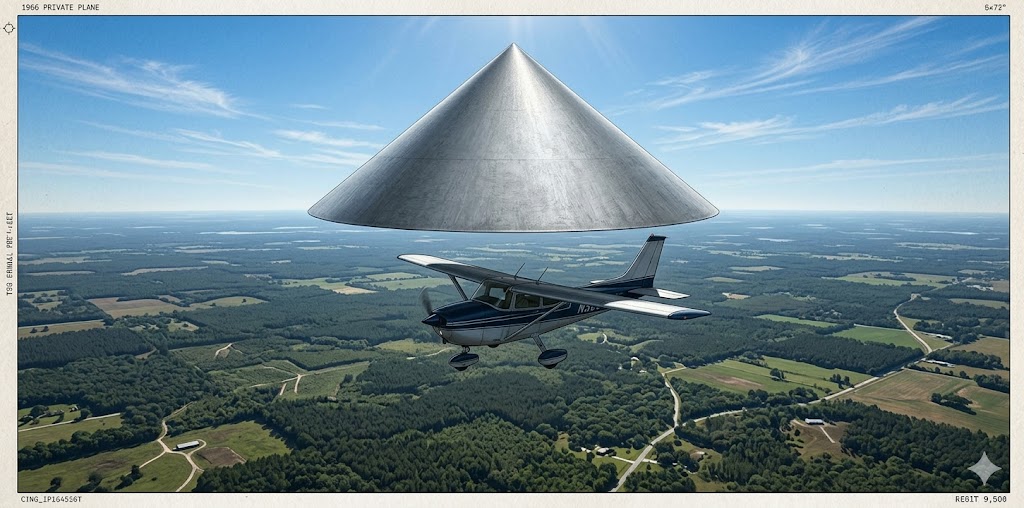
A Winter Haven, Florida, the private pilot reported he fled from a giant cone-shaped UFO which kept his plane in shadow for about three minutes on the morning of September 20, 1966. James J. O’Connor, a former Army investigator, was flying at 9500 feet in a small private plane near Sebring, Florida about 10 a.m. (EST) when he noticed what appeared to be a delta-shaped object above him. Curious, he climbed toward the object but leveled off about 10,000 feet because he had no oxygen equipment. Then the UFO began increasing in size, apparently descending toward his plane and pacing him.
O’Connor was somewhat unnerved, but “more curious than frightened.” He timed the descent of the UFO at 37 seconds. The object made a “singing” noise like automobile tires on wet pavement. When his plane was completely in the shadow of the object for several minutes and it continued to follow him, O’Connor became apprehensive. He pulled his plane up, reduced power, and stalled out, diving as fast as he could without putting undue strain on his small plane. He dropped to 3500 feet before looking up again. “That’s when I was frightened,” he later reported. “That thing had not changed in size at all, but was still with me and pacing me. It was still as big as a football field.”
Briefly, O’Connor thought of shooting at the UFO with a .38 special he kept in the cockpit, but about that time the object appeared to change shape to a wedge, then a thin line, and then vanished. “I realized it was climbing,” O’Connor said, “doing a reverse peel-off in a 360-degree turn. We don’t have an aircraft that could do this I think. It was more like the thing was falling ‘up’.”
O’Connor estimated that the UFO followed him for 17 minutes. The sighting was in bright daylight with a clear sky and only a few alto-cirrus clouds high above. When he noticed the object overhead,- O’Connor opened his canopy and looked straight up at it. He was flying VFR from Winter Haven to Miami at the time. When the UFO broke off the pursuit and climbed away, O’Connor got a view of the underside of a cone, point upwards.
Researchers Notes: Aerodynamic and Optical Anomalies
The Shadow Effect: One of the most compelling physical details was the object’s ability to keep O’Connor’s plane in shadow for approximately three minutes. This confirms the object was a solid, opaque mass positioned directly between the sun and the aircraft, ruling out simple optical illusions or reflections.
Acoustic Signature: O’Connor reported a distinct “singing” noise, comparing it to the sound of automobile tires on wet pavement. This high-frequency auditory feedback is often associated with the ionization of air or powerful electromagnetic propulsion systems.
Non-Inertial Maneuverability: The pilot witnessed a “reverse peel-off” in a 360-degree turn. He noted that the craft appeared to be “falling up,” a description that suggests a total negation of gravity rather than traditional aerodynamic lift.
Morphological Shift: During its departure, the object appeared to change its visual profile from a cone to a wedge, then to a thin line, before vanishing. This indicates either a physical transformation or a change in perspective as the craft rotated at high speed.
On the morning of September 20, 1966, pilot James J. O’Connor was flying VFR from Winter Haven to Miami at 9,500 feet. He noticed a delta-shaped object above him and attempted to climb toward it. As he reached 10,000 feet, the UFO—now appearing as a giant cone—began to descend, pacing his small plane and casting a large shadow over him.
Unnerved by the object’s size and proximity, O’Connor performed a desperate evasive maneuver: he reduced power, stalled his plane, and dived to 3,500 feet. To his horror, the object maintained its relative position, still pacing him despite the rapid descent. After 17 minutes of pursuit, the craft performed an impossible high-speed turn and “fell” upward into the clear sky. O’Connor, an experienced investigator, later stated, “We don’t have an aircraft that could do this.”
“That thing had not changed in size at all, but was still with me and pacing me. It was still as big as a football field.”
James J. O’Connor