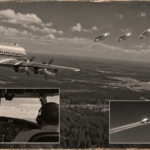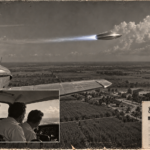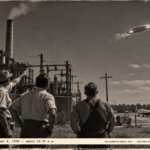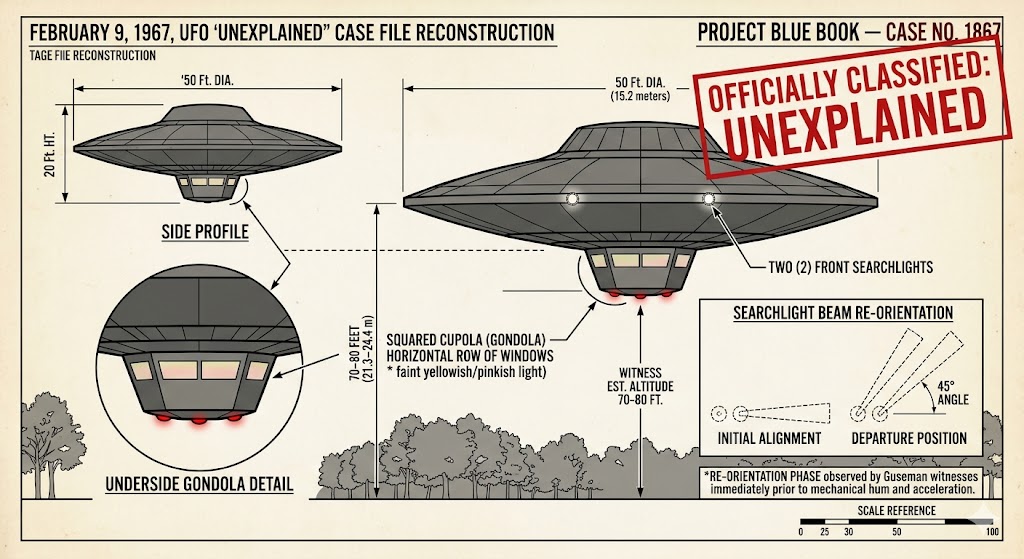
The Guseman sighting is one of the few cases in the Project Blue Book files officially listed as "unexplained."
THINK ABOUTIT UFO SIGHTING REPORT
1967 Odessa Delaware UFO: The Guseman Disc and Cupola Encounter
The 1967 Odessa UFO sighting is a significant Nocturnal Light (NL) encounter documented in the Project Blue Book files as an unexplained case. On February 9, 1967, Mr. and Mrs. Donald Guseman observed a highly structured, disc-shaped craft hovering silently over trees along U.S. 13. The sighting is technically notable for the detailed description of the craft’s “squared cupola,” localized acoustic signature, and its transition from a stationary hover to a forward trajectory accompanied by a mechanical hum.
Date: February 9, 1967
Sighting Time: 8:45 p.m
Day/Night: Night
Location: Odessa, Delaware (Rural area near U.S. 13)
Urban or Rural: Rural
Hynek Classification: NL (Nocturnal Light) Point or extended luminous source observed at night.
Duration: Several minutes (2 minutes of stationary observation)
No. of Object(s): 1
Size of Object(s): width was estimated at about 50 feet and its height at about 20 feet at the thickest point.
Distance to Object(s): 200 feet
Shape of Object(s): Disc with a “squared cupola” or gondola underneath
Color of Object(s): Except for the top, the object was clearly visible, a dark gray silhouette against the lighter sky. The surface was smooth and the bright white lights appeared to be searchlights affixed to the front end. The beams of these lights were wider at the ends than at the source and only the source of the closer beam was visible, the other being hidden by the body of the object.
Number of Witnesses: Multiple (Donald Guseman and his wife)
Source: Keyhoe and Lore, 1969a, p. 12; Air Force unexplained case, Project Blue Book files, National Archives.
Summary: “Mr. Guseman rolled down his left window and he and his wife studied the object more closely. It was disc-shaped with a kind of cupola under the main body. Its width was estimated at about 50 feet and its height at about 20 feet at the thickest point. Except for the top, the object was clearly visible, a dark gray silhouette against the lighter sky.”
Full Report
At about 8:45 p.m. on February 9, 1967, Mr. and Mrs. Donald Guseman of Middletown, Delaware, was driving south on U.S. 13 toward Odessa. They had just crossed a bridge over a canal when Mr. Guseman saw two lights near the road ahead and to their left. The left light was green and the one on the right red. Suddenly two bright white lights came on between the colored ones. Thinking they were landing lights, Guseman said to his wife, “Look at the crazy plane trying to land!”
As the couple drew nearer, they could see the lights were stationary and attached to a large and unfamiliar object. Only the white lights were visible as they came up opposite to the object, across the highway from them. It sat motionless just over the trees approximately 200 feet from them at an altitude of about 70 or 80 feet.
Mr. Guseman rolled down his left window and he and his wife studied the object more closely. It was disc-shaped with a kind of cupola under the main body. Its width was estimated at about 50 feet and its height at about 20 feet at the thickest point. Except for the top, the object was clearly visible, a dark gray silhouette against the lighter sky. The surface was smooth and the bright white lights appeared to be searchlights affixed to the front end. The beams of these lights were wider at the ends than at the source and only the source of the closer beam was visible, the other being hidden by the body of the object.
The rather squared cupola, or “gondola,” contained a horizontal row of windows which gave forth a faint soft light, steady and uninterrupted by any forms or movement. The light was described as “yellowish” by Mr. Guseman, “pinkish” by his wife. On the bottom of this gondola, in the center, were three red lights that shone with an even intensity.
For about two minutes the couple watched the object as it hovered motionlessly. Several cars and trucks passed on the high-way, but none slowed down or appeared to take notice. Then suddenly the two forward beams of light began to swing upward until they were pointed at a 45-degree angle from horizontal, shining upwards and out into the night sky. As soon as they reached this new position, the object began moving in a forward direction toward the north, and to the left of the witnesses. As it moved, the Gusemans heard a soft hum or buzz, similar to the sound of an electric motor.
The UFO proceeded in a slow, straight trajectory at an even altitude and as it changed its angle of perspective relative to the viewers’ position, it presented the same circular, disc-shaped with the undercarriage and windows below. After moving approximately two or three hundred feet to the north over the trees, the UFO seemed literal to disappear. They assumed it had dropped down into a field beyond the tree-line, but when they drove near the field to check further they saw nothing; nor could they find any evidence on the ground where the UFO had hovered when they searched it with a flashlight.
Guseman, 29 at the time of the sighting, is president of the Delmarva Contracting Company, Middletown; his wife is a business administrator in Wilmington Memorial Hospital. Their sighting was investigated by NICAP staff members Stuart Nixon and Isabel Davis and they were later questioned further at NICAP headquarters by Dr. James E. McDonald. The witnesses were articulate, unemotional, and cooperative in both their interviews.
Researcher Notes: The Guseman Encounter (1967)
Geometric Lighting Configuration: The craft featured a complex array of lights: two bright white “searchlights” on the front, three red lights on the bottom of the gondola, and a horizontal row of windows in the cupola emitting a faint, yellowish/pinkish light. The searchlight beams were notably wider at the ends than at the source, mimicking conventional spotlight physics.
Acoustic Signature: Unlike many “silent” sightings, the witnesses reported a “soft hum or buzz” similar to an electric motor once the object began moving. This suggests a propulsion system that generated a localized mechanical or electromagnetic vibration during its transition from hover to flight.
Non-Conventional Maneuverability: Before moving, the forward light beams swung upward to a 45-degree angle, pointed into the sky. This “signaling” or re-orientation phase preceded a slow, straight trajectory over the trees, after which the object seemed to “literally disappear.”
Witness Credibility: Donald Guseman was a local contracting company president, and his wife was a business administrator. Their testimony was later analyzed by Dr. James E. McDonald and NICAP investigators, who described them as articulate and unemotional observers.
On the night of February 9, 1967, the Gusemans were driving south on U.S. 13 when they spotted what they initially thought was a “crazy plane” trying to land. As they approached, they realized the object was a 50-foot wide disc hovering just 70–80 feet above the trees. The craft was a dark gray silhouette featuring a squared-off undercarriage (gondola) with a row of dimly lit windows.
The couple watched for two minutes as the object sat motionless while other traffic passed by without notice. Suddenly, the object’s front searchlights tilted upward, a soft electric hum began, and the craft glided north over the tree line. Despite a ground search with flashlights shortly after, no physical evidence or trace of the object could be found in the field where it appeared to descend.
“The rather squared cupola, or ‘gondola,’ contained a horizontal row of windows which gave forth a faint soft light, steady and uninterrupted by any forms or movement.”
Investigative Report