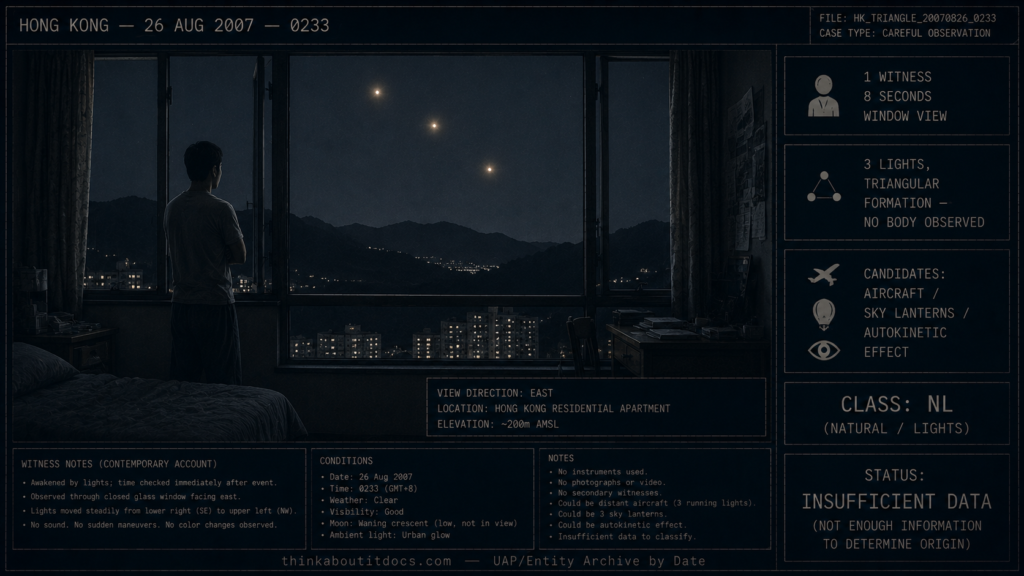
The August 26, 2007 Hong Kong triangle — a single witness saw three white lights in a triangular formation for 8 seconds at 2:33 a.m. through a bedroom window. Distant aircraft, sky lanterns, and the autokinetic effect all fit. Logged Insufficient Data. (thinkaboutitdocs.com — UAP/Entity Archive by Date)
THINK ABOUTIT UFO|UAP SIGHTINGS REPORT
2007: Three White Lights in a Triangle, Hong Kong (Single 8-Second Window Glimpse)
It is a brief entry that the archive should keep but read honestly for what it is. In the early hours of August 26, 2007, a single witness in Hong Kong looked out a bedroom window facing east toward the mountains and saw, for no more than eight seconds, three white lights arranged in a triangle with rounded edges, moving rapidly across the sky from southeast to northwest with what the witness described as “very rapid, erratic movements.” There is no second witness, no photograph, no follow-up, and no source. An eight-second glimpse of three running lights at distance, against a dark mountain backdrop, has two strong ordinary candidates the report does not eliminate: a distant aircraft approaching or departing Hong Kong International, or a small flotilla of Chinese sky lanterns. The archive keeps the entry, sizes it proportionate to what it is, and files it as Insufficient Data.
Date: August 26, 2007
Sighting Time: 2:33 a.m. local time
Day/Night: Night
Location: Hong Kong (the witness reports viewing from a bedroom window facing east toward the mountains; specific neighborhood not given)
Urban or Rural: Urban (the prior page’s “Rural” is incorrect — Hong Kong is one of the densest urban environments on Earth, with mountain views from many residential windows)
No. of Entity(‘s): None reported
Entity Type: Not applicable
Entity Description: Not applicable
Hynek Classification: NL (Nocturnal Light) — three luminous points observed at night with no structured craft body seen between or behind the lights; classification retained from the prior page
Duration: Approximately 8 seconds
No. of Object(s): 1 reported, comprising 3 light-points in a triangular formation
Description of the Object(s): Three white lights arranged in the formation of a triangle, with rounded edges; the dark body of any craft connecting the three lights was not actually seen — the triangle was inferred from the light-point arrangement, not directly observed as a solid shape
Shape of Object(s): Triangular formation of three white light-points
Size of Object(s): Not recorded
Color of Object(s): Three white lights
Distance to Object(s): Not estimated; the witness was viewing from a bedroom window through a large window pane
Height & Speed: Moving rapidly with “erratic” trajectory; heading from southeast to northwest; specific speed and altitude not estimated
Number of Witnesses: 1
Special Features/Characteristics: Brief 8-second observation through a window at 2:33 a.m.; three white lights in triangular formation; “rapid erratic” motion — consistent with the well-documented autokinetic effect, in which a small light against a featureless dark background appears to move erratically because the eye lacks a reference frame; no body or solid craft directly observed
Case Status: Insufficient Data
Source: Anonymous first-person submission; no investigator, no follow-up, no corroborating witness
Summary/Description: At 2:33 a.m. on August 26, 2007, a single witness in Hong Kong, looking out an east-facing bedroom window toward the mountains, observed for approximately 8 seconds three white lights in a triangular formation with rounded edges, moving rapidly from southeast to northwest with what the witness described as erratic motion. No body of a craft was directly observed between the lights. The brief duration, single witness, window-frame viewing, and lack of any reference points are consistent with either a distant aircraft (Hong Kong International Airport handles substantial traffic from those bearings), a flotilla of three Chinese sky lanterns drifting together, or the autokinetic effect producing apparent erratic motion in static lights. The case is logged as Insufficient Data.
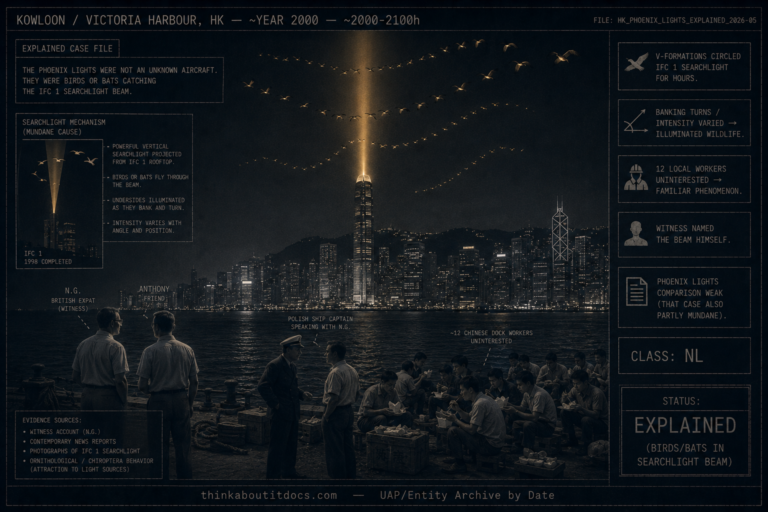
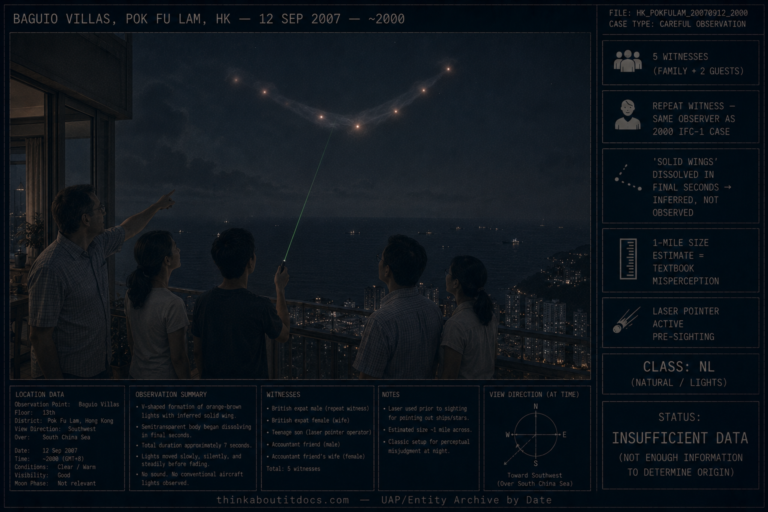
Related Cases: 2000: V-Formations around the IFC 1 Searchlight, Hong Kong | 2007: Pok Fu Lam, Hong Kong Sighting | the broader corpus of brief single-witness triangular-light reports worldwide
DETAILED REPORT
The testimony is brief and may be given plainly. At 2:33 in the morning on August 26, 2007, a witness in Hong Kong was looking out the large bedroom window of their home, which faced east toward the mountain side, when they saw something move very rapidly across the sky. Approaching the window, the witness was able to identify three white lights arranged in the formation of a triangle, with what they described as rounded edges. The lights performed what the witness called “very rapid, erratic movements” and traveled from southeast to northwest. The observation lasted no more than eight seconds.
The most honest thing to say about this report is that an eight-second single-witness nighttime glimpse from a window simply cannot bear the evidentiary weight of a definitive classification, and several strong ordinary candidates fit the description.
The leading candidate is a commercial aircraft seen at distance. Hong Kong International Airport at Chek Lap Kok handles substantial overnight traffic, and inbound and outbound flights routinely transit the airspace east of the Kowloon and New Territories mountains. A modern commercial airliner viewed from below and at distance presents exactly three running lights in a roughly triangular pattern — port (red) and starboard (green) wingtip navigation lights, plus a white tail or anti-collision light — though at far enough range the colors wash out to apparent white, especially through a window pane that filters color slightly. The “rounded edges” detail fits a real aircraft’s lighting arrangement seen as diffuse rather than sharp point sources. The southeast-to-northwest trajectory is consistent with a flight transitioning across Hong Kong’s airspace.
The “rapid erratic motion” over an eight-second observation is the part of the description that the witness took as anomalous, and it is also the easiest to explain. The autokinetic effect is a well-documented perceptual phenomenon in which a small, fixed point of light viewed against a dark, featureless background appears to move erratically — sometimes dramatically — because the observer’s eye and brain lack stable reference points to anchor the perceived position of the light. Looking through a bedroom window at lights against a mountain-side night sky, with no immediate landmarks against which to gauge motion, is essentially a textbook setup for autokinetic motion impressions. A genuinely steady aircraft can appear to dart and jerk under these conditions.
A second candidate is a small flotilla of Chinese sky lanterns (Kongming lanterns) released together. These were widespread in early-2000s Hong Kong and the wider Pearl River Delta region, especially around late-summer festivals (the Hungry Ghost Festival typically falls in August). Three lanterns released together and rising slowly while drifting on the breeze would present as three white-to-amber lights in a roughly triangular arrangement, with the warm color washing toward white at sufficient distance through a window. Their apparent motion would be slow rather than rapid, but the autokinetic effect would still influence the eight-second viewing.
A third candidate, though less likely, is a flight of three illuminated drones or model aircraft in formation. Drone technology in 2007 was less developed than today, but coordinated flights of small RC aircraft with running lights existed in Hong Kong’s enthusiast community.
None of this calls the witness’s honesty into question. A single brief observation of an unfamiliar pattern of lights at 2:33 a.m. through a bedroom window is exactly the kind of report sincere people make when they see something unusual. But “single witness, 8 seconds, no reference points, three lights, no body seen” is among the lowest evidentiary tiers a sighting can occupy. The archive keeps the entry as a recorded report and labels it for what it actually is.
RESEARCHER’S NOTES
The Hong Kong Triangle — Eight Seconds, One Witness, Three Lights
- Classification, retained: NL is the correct classification. Three luminous points were observed; no body of a craft was actually seen between the lights. The “triangular shape” was inferred from the arrangement of the lights, not directly observed as a solid form. NL fits, and CE-I or any “craft” framing would overstate what the witness actually saw.
- The evidentiary tier, named plainly: Single witness, 8-second glimpse, 2:33 a.m., window viewing, no photograph, no investigator, no source citation, no corroboration. This is among the lowest evidentiary tiers in any UFO archive. The archive keeps such reports because the chronological record values completeness over selectivity, but the weight assigned to them must match what they are.
- The leading mundane candidates, weighed honestly: A distant aircraft transiting Hong Kong’s airspace toward or from Chek Lap Kok International, with its three primary running lights washing to apparent white through a window at distance, fits the geometry, the trajectory, and the appearance. A flotilla of three Chinese sky lanterns released together — common in August around the Hungry Ghost Festival — fits the white-to-amber color and triangular grouping. The “rapid erratic motion” over 8 seconds is consistent with the autokinetic effect on small lights against a featureless dark background, which can make even a steady aircraft appear to jerk and dart.
- Why Insufficient Data: The report is too thin for any verdict beyond the most conservative one. The mundane candidates are strong, but proving one of them happened on this specific night with no documentary trail is impossible. The witness was sincere in reporting what they saw, but what they saw — for 8 seconds, from a window, alone, at 2:33 a.m. — does not rise to the evidentiary level of a documented anomaly. Insufficient Data is the proportionate verdict.
The Hong Kong triangle is a small, brief, single-witness entry — a textbook example of the kind of report that fills the bottom 80% of any UFO database. Kept for completeness, sized to what it actually is, and labeled with the strong mundane candidates it does not exclude, it stands as Insufficient Data.