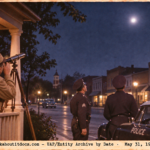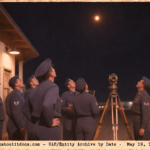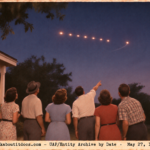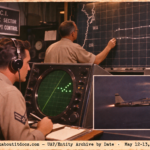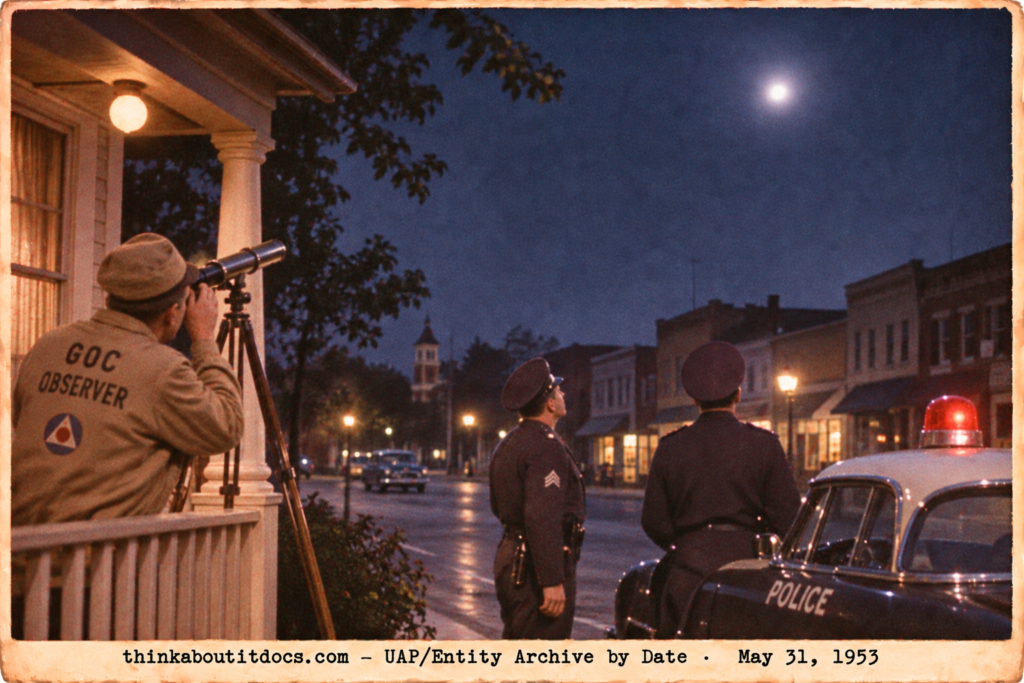
May 31, 1953: an eight-hour white light over Darlington, Wisconsin.
THINK ABOUTIT UFO|UAP SIGHTINGS REPORT
1953: The Darlington and Monroe, Wisconsin Eight-Hour White Light
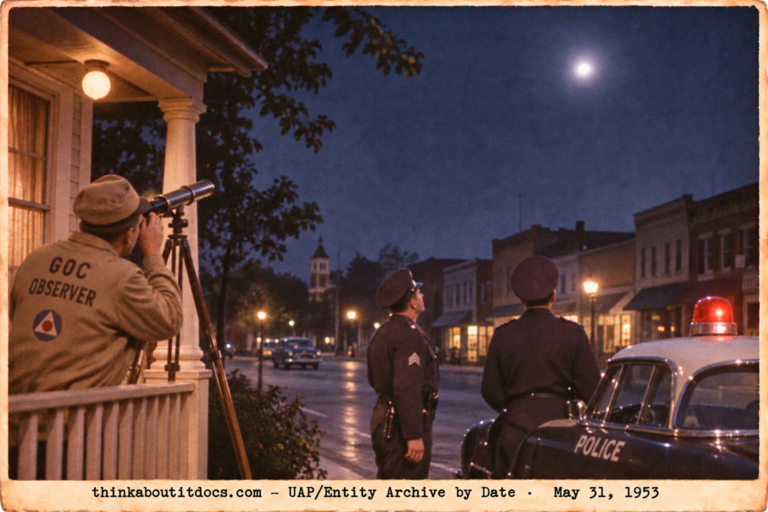
From about 3:15 a.m. on May 31, 1953, a steady white light rose in the east over southwestern Wisconsin and stayed in view for roughly eight hours. Eleven people in Darlington and Monroe, including police officers and Ground Observer Corps volunteers, reported it. Two officers chased it in a squad car without gaining ground, and jets scrambled from a Chicago filter center could not find it.
ATIC sent an officer and an astronomer to interview eight of the witnesses and concluded that the path closely paralleled Venus. Project Blue Book’s list agrees, but the file also holds a Darlington officer who knew Venus and said it was not.
Date: May 31, 1953
Sighting Time: About 3:15 a.m. to about 11:30 a.m. CST (0320 to 1130 in the ATIC report)
Day/Night: Night into day
Location: Darlington and Monroe, Wisconsin
Urban or Rural: Small town and rural
No. of Entity(‘s): 0
Entity Type: Not Applicable
Entity Description: Not Applicable
Hynek Classification: NL (Nocturnal Light)
Duration: About 8 hours
No. of Object(s): 1
Description of the Object(s): A steady, bright white light, much brighter than the stars and visible in daylight
Shape/Size/Color of Object(s): Starlike point; one officer said it was almost as large as the moon
Distance to Object(s): Not determined; a Monroe observer estimated its altitude at 10 miles
Height & Speed: Reports varied: slow drift west, or hovering followed by terrific speed; the faster descriptions came mostly from observers in moving cars
Number of Witnesses: 11 (police officers, Ground Observer Corps members and civilians); ATIC interviewed 8
Special Features/Characteristics: A telescope was used by the GOC post; two officers chased it at about 75 mph; jets scrambled from the Chicago filter center could not locate it; a radar contact was logged at about 1005 CST, though the file’s notes on it are unclear
Case Status: Astro (Venus): Project Blue Book list and ATIC report. Not uniformly accepted in the file: a Darlington officer ruled Venus out, and a June 8 ATIC memo judged that some observers saw Venus and others probably a balloon
Source: Project Blue Book files 6385021 and 6385108 (ATIC report on the Darlington, Wisconsin sighting; Chicago Filter Center special action report of June 1, 1953; Lt R.M. Olsson memo of June 8, 1953; Washburn Observatory letter of June 6, 1953)
Summary/Description: Eleven Wisconsin witnesses watched a bright white light for about eight hours. Officers chased it by car and jets could not find it. ATIC matched its path to Venus; a Darlington officer and part of the file disagreed.
Related Cases: None known
Detailed Report
The ATIC report says that between 0320 and 1130 CST on May 31, 1953, eleven people in the Darlington-Monroe area sighted an unidentified aerial object. It appeared as a steady white light low in the east, much brighter than the surrounding stars, and rose toward high overhead over about eight hours. Several local people, including county officers and Ground Observer Corps members, reported that it hovered and then moved at terrific speed. Two policemen pursued it in their squad car without gaining ground, and the GOC members used a telescope. The weather was unusually clear with a few scattered clouds drifting north.
A newspaper account reached ATIC, which sent an officer and an astronomer to interview eight of the eleven witnesses. Azimuth and elevation estimates were collected at evenly spaced times. All described a bright white object too bright to be a star that was also seen in daylight. Descriptions of motion varied, and the reports of radical maneuvers came mostly from people watching from cars. ATIC found that the object’s path, appearance and disappearance closely paralleled Venus, which rose at 0310 CST at about maximum brilliance and can occasionally be seen in daylight.
The Chicago Filter Center log for the Monroe observation post records a bright white light at 0323 going east and climbing, a bright steady star-like point at 0755 estimated at 10 miles up and moving west, a pinpoint drifting west at 0823, a heading south and higher at 0833 with an aircraft passing lower, a loss of contact in haze at 0912, a silver speck resighted at 0917, and a heading northwest then west at 0930. The log’s 1005 entry reads that radar called in a contact. GOC personnel alerted the Chicago filter center and jets were scrambled in daylight and vectored by visual directions from Darlington, but they could not find the object.
A June 8 ATIC memo by Lt R.M. Olsson recorded a call with Darlington police officer Glenn Winslow, who said he first saw the object at 0315 overhead, moving northeast, bright enough to light the surroundings, and almost as large as the moon. Another car set out after it at about 75 mph and could not keep up, and the direction changed to south later. Winslow said he was familiar with Venus and that it was not Venus. Olsson noted that the overhead sighting, brightness, northeast heading and change of direction seemed to rule out Venus. The Monroe GOC post chief reported the object only from 0845, as starlike and moving west, directly south at 0900, which is where Venus was. Olsson concluded that on the evidence some observers saw Venus and others did not and probably saw a balloon.
A reviewer’s note on the file observes that anyone with one astronomy course should identify Venus, that stars and planets do not change heading, and that they would not appear on radar; it asks for Form A questionnaires and for winds aloft to be checked for a General Mills research balloon from Minneapolis. A June 6 letter from the Washburn Observatory said the Air Force had investigated and that Capt John M. Fox believed it was moonlight on scattered low clouds against a high overcast. A later ATIC memo credited the new system of sending reports to McMillin Observatory with identifying the object as Venus.
RESEARCHER’S NOTES
The Darlington Light: An Eight-Hour Venus With Dissenters
- The official answer: ATIC found the path paralleled Venus and the Blue Book list evaluates the report as Astro (Venus).
- Dissent in the file: Officer Winslow, who knew Venus, said it was not Venus and that it lit the surroundings. Olsson’s memo split the witnesses between Venus and a balloon.
- The moving-car effect: ATIC noted that the reports of radical maneuvers came mostly from people in cars, who had no fixed reference point.
- Radar and the jets: A radar contact is logged at about 1005 CST and the jets found nothing, but the file does not show whether the radar return matched the visual object.
- Competing explanations: The file offers Venus, a balloon, and moonlight on low clouds. They cannot all apply to one object over eight hours.
- Why it is kept: The scale of the response (police, GOC, a filter center, a scramble and an ATIC trip) makes this a documented case even though it was explained.
An eight-hour light, eleven witnesses and a jet scramble ended with an ATIC finding of Venus. The file also records witnesses and reviewers who did not accept it for the whole event.
“very closely paralleled course of Venus”
— ATIC report on the Darlington sighting