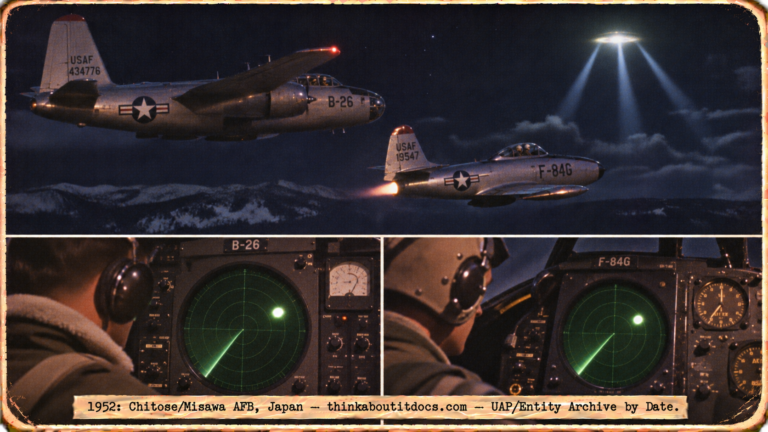
Near Vega, Texas, December 29, 1952: the B-26's 7,000-foot climb.
THINK ABOUTIT UFO|UAP SIGHTINGS REPORT
1952: Near Vega, Texas, the B-26‘s 7,000-Foot, Five-Second Climb
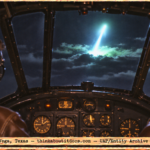
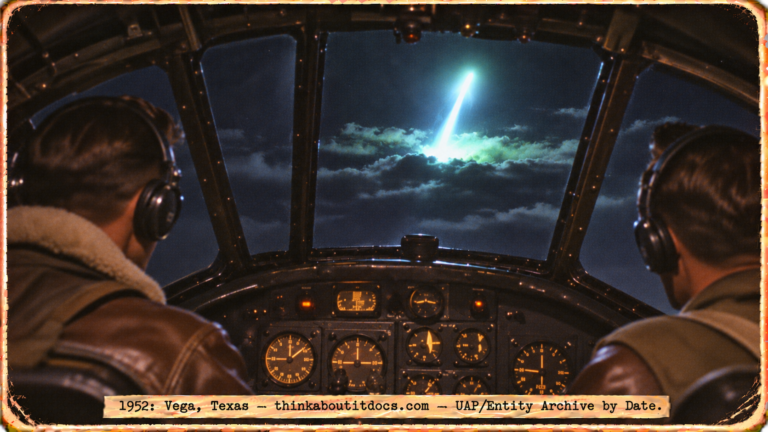
On the night of December 29, 1952, two USAF pilots on a training flight west of Amarillo, Texas watched an enormous bluish-white light pace their B-26 bomber for several minutes before it did something no aircraft of the era could do: it climbed 7,000 feet in five seconds, a rate of ascent corresponding to a peak velocity near 2,000 miles per hour and an estimated 17 g’s of acceleration, then vanished into thin cloud and lit it from within like a searchlight. The light reappeared briefly before climbing away for good. It stands among the most dramatic performance claims of the entire 1952 flap.
Date: December 29, 1952
Sighting Time: 9:05 p.m. CST
Day/Night: Night
Location: About 35 miles west of Amarillo, near Vega, Texas, and east-southeast of Tucumcari, New Mexico
Urban or Rural: Not applicable — airborne over rural terrain
No. of Entity(‘s): None
Entity Type: Not applicable
Entity Description: Not applicable
Hynek Classification: NL (Nocturnal Light) with an instrumented performance claim; no structure was resolved and no entity was involved
Duration: 7–10 minutes
No. of Object(s): 1
Description of the Object(s): An extremely large, intense, bright bluish-white light with frequent green tints, showing no trail, exhaust, or other aerodynamic feature, estimated at roughly three times the size of a C-54 (approximately 350 feet)
Shape of Object(s): Not resolved — seen only as an intense light; no silhouette or structure described
Size of Object(s): Estimated at roughly three times the size of a C-54 transport, or about 350 feet, based on the crew’s distance and size estimate
Color of Object(s): Bluish-white with frequent green tints
Distance to Object(s): Estimated 40 miles off at the aircraft’s 11 o’clock position when first noticed, slowly closing over about 5 minutes
Height & Speed: The B-26 was flying level at 6,000 ft and 250 knots; the object paralleled the bomber’s course at a similar general altitude before climbing 7,000 feet in approximately 5 seconds — an average vertical rate near 1,400 ft/sec, corresponding to a peak velocity near 2,000 mph at an estimated 17 g’s
Number of Witnesses: 2 (USAF Capt. William T. Bowley and Capt. Herbert T. Lange, Perrin AFB, Texas)
Special Features/Characteristics: No trail, exhaust, or aerodynamic features of any kind despite its enormous apparent size and extreme performance; a slow parallel closing approach over several minutes before the sudden climb; the climb caused the thin broken overcast at roughly 13,000 ft to glow as though lit by a searchlight from within; a CAA controller at Tucumcari, radioed by Bowley during the encounter, was unable to spot the object, likely due to viewing direction or cloud obstruction; the object reappeared briefly beneath the clouds about two minutes after vanishing, before climbing west and disappearing for good
Case Status: Unexplained
Source: Jan Aldrich
Summary/Description: On the night of December 29, 1952, USAF Capt. William T. Bowley and Capt. Herbert T. Lange of Perrin AFB, Texas, piloting a B-26 on a training flight at 6,000 ft and 250 knots about 35 miles west of Amarillo, saw an extremely large, intense bluish-white light with green tints, roughly three times the size of a C-54, at their 11 o’clock position. The light slowly closed over about five minutes before suddenly climbing 7,000 feet in five seconds — a peak velocity near 2,000 mph at an estimated 17 g’s — disappearing into thin broken overcast at about 13,000 ft and causing the clouds to glow as if lit by a searchlight. Bowley radioed the Tucumcari CAA controller, who could not locate the object. It reappeared briefly beneath the clouds about two minutes later before climbing away to the west and vanishing for good. The case remains unexplained.
Related Cases: the Dallas, Texas B-36 radar case, December 24, 1952 | the broader December 1952 close of the year’s UFO wave
DETAILED REPORT
Capt. William T. Bowley and Capt. Herbert T. Lange, both of Perrin Air Force Base, Texas, were flying a B-26 bomber on a routine training flight on the night of December 29, 1952, cruising at 6,000 feet and 250 knots roughly 35 miles west of Amarillo, Texas, in the general direction of Tucumcari, New Mexico. At about 9:05 p.m. they noticed an extremely bright bluish-white light, tinged frequently with green, at their 11 o’clock position. By their estimate, comparing its apparent size against the distance, the object was enormous — roughly three times the size of a C-54 transport aircraft, or on the order of 350 feet across.
For about five minutes the light simply paralleled their course, slowly closing the distance, showing none of the features either pilot would expect from a genuine aircraft of that apparent size: no exhaust trail, no engine flare, no navigation lighting pattern, nothing but the steady, intense glow itself. Then, without warning, it did something neither man had ever seen anything do before. The light climbed approximately 7,000 feet in about five seconds. Worked out as a rate, that is roughly 1,400 feet per second sustained for the climb — a peak velocity in the neighborhood of 2,000 miles per hour, and an estimated acceleration near 17 times the force of gravity, a figure that would destroy almost any conventional aircraft and its crew.
The object disappeared into a layer of thin, broken overcast at roughly 13,000 feet. The clouds did not simply swallow the light; witnesses described them glowing from within as the object passed through, as though illuminated by a powerful searchlight. Bowley, attempting to get an independent confirmation, radioed the CAA (Civil Aeronautics Administration) controller at Tucumcari. The controller was unable to locate anything matching the description — whether because he was looking in the wrong part of the sky or because the object was by then obscured by the cloud layer is not recorded.
About two minutes after vanishing into the overcast, the light reappeared briefly beneath the clouds, visible again to the two pilots before it climbed away to the west and was lost from view for good. The entire encounter, from first sighting to final disappearance, lasted somewhere between seven and ten minutes.
RESEARCHER’S NOTES
A Performance Claim That Exceeds Any 1952 Aircraft
- Classification and its limits: NL is the correct baseline classification — a light with no resolved structure — but it undersells what makes this case distinctive. The reported climb rate is the heart of the report, and no Hynek category from the original system was built to flag an extraordinary kinematic claim on its own; that detail belongs in the narrative and the fields above rather than in the classification tag itself.
- The numbers deserve to be stated plainly: A climb of 7,000 feet in 5 seconds is not a loose estimate rounded up for drama — worked through as arithmetic, it implies an average vertical speed near 1,400 feet per second, or roughly 955 mph of vertical component alone, with the stated peak velocity near 2,000 mph and 17 g’s of acceleration. No aircraft flying in December 1952, and very few at any point in aviation history since, could survive that acceleration with a human crew aboard, which is precisely why the case has no mundane explanation on record.
- Two trained observers, no radar or ground confirmation: Both witnesses were USAF pilots, a stronger evidentiary position than an untrained civilian observer, and their accounts of the size estimate, closing behavior, and climb rate agree. But the CAA controller at Tucumcari could not independently locate the object, and no radar track for the encounter has been identified in the sources reviewed for this entry — the case rests on the two pilots’ word alone, however credible their training and position make that word.
- The cloud-glow detail as corroboration of scale: An object merely passing behind thin cloud would not necessarily illuminate it from within; that the overcast reportedly glowed “as if lit by a searchlight” is consistent with an extremely bright, large light source at relatively close range to the cloud base, and is one of the few details in the account that does not depend solely on the witnesses’ own distance and size estimation.
Two Air Force pilots, flying a straightforward training mission, watched an enormous light parallel their aircraft and then execute an acceleration that no machine of their era, or arguably any era, could survive with a crew aboard. No radar track, no ground witness, and no mundane explanation accompanies the account. It stands as Unexplained, resting on the credibility of two trained military observers and the plain arithmetic of what they described.
“The object suddenly climbed 7,000 feet in 5 seconds, disappearing into thin broken overcast at 13,000 feet and causing the clouds to glow as if lit by a searchlight.”
— Jan Aldrich, summarizing the report of Capt. William T. Bowley and Capt. Herbert T. Lange, near Vega, Texas, December 29, 1952