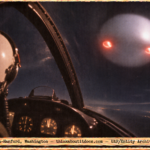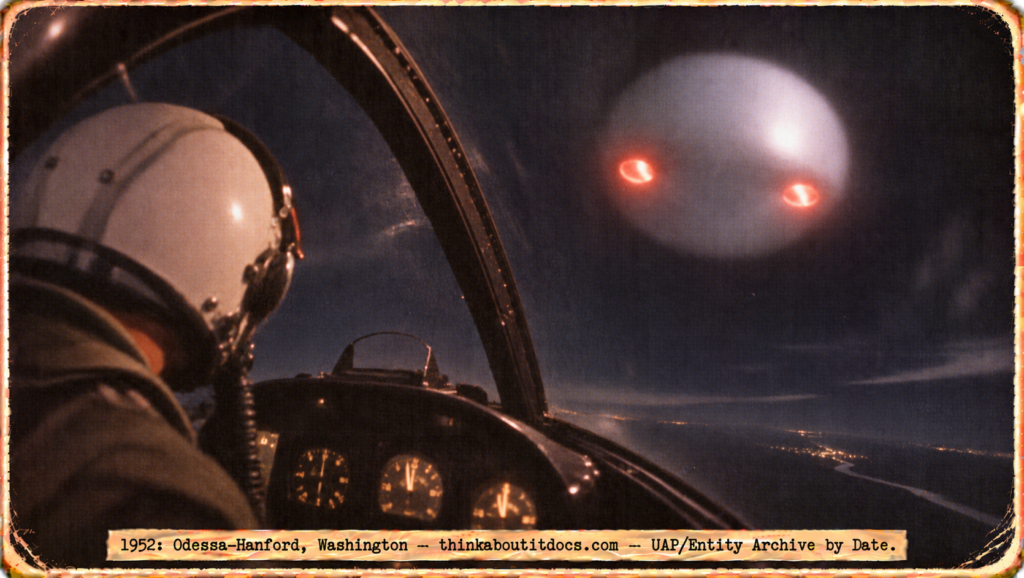
Between Odessa and Hanford, Washington, December 10, 1952: the near-collision.
THINK ABOUTIT UFO|UAP SIGHTINGS REPORT
1952: Between Odessa and Hanford, Washington
An F-94’s Head-On Near-Collision
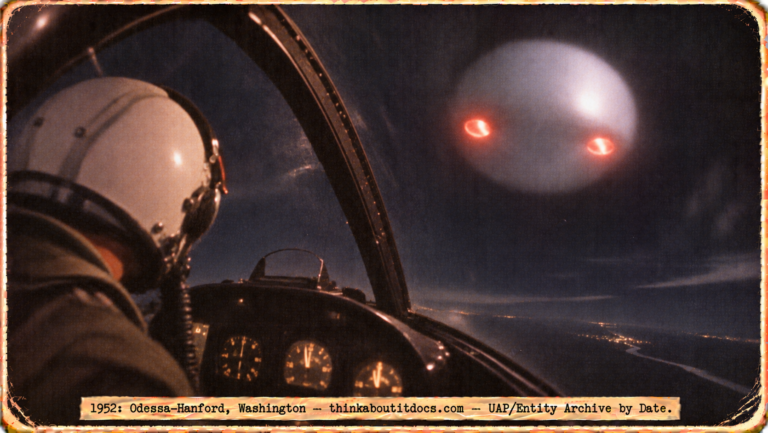
On the evening of December 10, 1952, an F-94 jet interceptor crew approaching 27,000 feet over Washington state spotted a light and moved to identify it — and the light came straight back at them. A large, round, white object with reddish light showing from two “window”-like openings bore down on a collision course before the crew banked away. Their aircraft’s own radar locked onto the target multiple times during the fifteen-minute encounter.
Date: December 10, 1952
Sighting Time: 7:15–7:30 p.m. PST
Day/Night: Night
Location: Between Odessa and Hanford, Washington
Urban or Rural: Not applicable — airborne over rural terrain
No. of Entity(‘s): None
Entity Type: Not applicable
Entity Description: Not applicable
Hynek Classification: RV (Radar-Visual) — a close-approach visual sighting with multiple onboard radar lock-ons
Duration: About 15 minutes
No. of Object(s): 1
Description of the Object(s): A large, round, white object with reddish light showing from two window-like openings
Shape of Object(s): Round
Size of Object(s): Described as large; exact dimensions not recorded
Color of Object(s): White, with reddish light from two “windows”
Distance to Object(s): Closed to a collision-course approach before the F-94 crew banked to avoid impact
Height & Speed: The F-94 was flying at 26,000–27,000 ft when the crew approached the light to identify it; the object then came at the aircraft on a collision course, forcing an evasive bank
Number of Witnesses: 2 (F-94 crew)
Special Features/Characteristics: Two reddish “window”-like openings on an otherwise white, round object; an apparent reaction to the F-94’s approach, closing on a collision course rather than simply being overtaken; multiple successful radar lock-ons by the F-94’s own ARC-33 radar during the encounter, directly corroborating the visual sighting with onboard instrumentation
Case Status: Unexplained
Source: Edward J. Ruppelt, The Report on Unidentified Flying Objects, p. 43; NARCAP
Summary/Description: On the evening of December 10, 1952, an F-94 crew flying at 26,000–27,000 ft between Odessa and Hanford, Washington, spotted a light and moved to identify it. The object, large, round, and white with reddish light from two window-like openings, came at the aircraft on a collision course, and the crew banked to avoid impact. The F-94’s ARC-33 radar achieved lock-on multiple times during the roughly fifteen-minute encounter. The case remains unexplained.
Related Cases: December 1952 archive | the Pope AFB/Fort Bragg dual-radar case, December 10, 1952 (same date)
DETAILED REPORT
An F-94 jet interceptor was on a routine flight at 26,000 to 27,000 feet between Odessa and Hanford, Washington, on the evening of December 10, 1952, when the crew noticed a light and, as a matter of standard procedure, turned to approach and identify it. What they found as they closed the distance was not an aircraft, a balloon, or a star: a large, round, white object showing reddish light from what appeared to be two window-like openings.
Rather than being simply overtaken or passed by the interceptor, as a stationary light source would be, the object appeared to react to the F-94’s approach. It came directly at the aircraft on what the crew understood to be a collision course, closing fast enough that they had to bank sharply to avoid a mid-air impact.
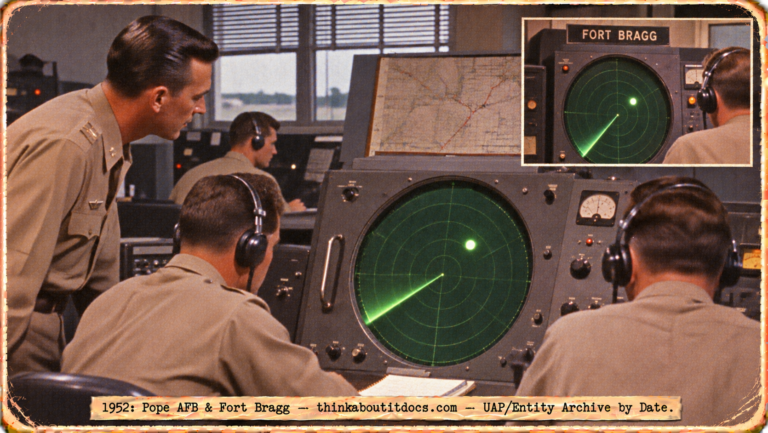
Throughout the encounter, the F-94’s onboard ARC-33 radar system achieved a lock-on to the target multiple separate times — not a single ambiguous blip, but repeated successful radar acquisition of the same object the crew was simultaneously watching visually. This instrumented corroboration, from a radar system built into the aircraft itself rather than a separate ground installation, is a significant evidentiary element distinguishing this case from a purely visual report.
The encounter lasted about fifteen minutes in total. It is documented in Edward J. Ruppelt’s own history of the Air Force’s UFO investigations, The Report on Unidentified Flying Objects, and separately cited by the aviation-safety research organization NARCAP. No conventional explanation for the object’s appearance, apparent collision-course maneuver, or the repeated airborne radar lock-ons is recorded.
RESEARCHER’S NOTES
A Crew’s Own Radar Corroborates a Collision-Course Approach
- Classification rationale: RV fits cleanly here: a direct visual sighting, including unusual structural detail (the two “window”-like openings), paired with the aircraft’s own radar achieving multiple independent lock-ons on the same target during the encounter. Few cases combine onboard radar corroboration with this level of close-range visual description.
- The apparent maneuver is the key detail: A light simply passed by a fast-moving aircraft is unremarkable. A light that appears to turn and close on the aircraft after being approached, forcing an evasive maneuver, is a materially different and more significant claim — and it is the specific detail that elevates this case above a routine unidentified-light sighting.
- Ruppelt’s own inclusion carries weight: Edward Ruppelt headed Project Blue Book during this period and was characteristically skeptical of sensational reports in his own book. His inclusion of this case in his history is itself a data point, suggesting the Air Force’s own chief UFO investigator found the account credible enough to preserve.
- Onboard radar lock-on versus ground radar detection: This case’s radar corroboration comes from the aircraft’s own ARC-33 system rather than an independent ground station, which is a different (though still meaningful) form of confirmation than the dual ground-radar cross-check seen in the Pope AFB/Fort Bragg case from the same evening — the two cases are not the same incident, but their shared date is worth noting.
An F-94 crew approached a light to identify it and instead found themselves on a collision course with a large, round, white object with reddish “windows,” confirmed repeatedly by their own aircraft’s radar during a tense fifteen-minute encounter. No mundane identification is recorded. It stands as Unexplained.
“The object appeared large, round, and white, with reddish light coming from two “windows,” and came at the F-94 on a collision course; the crew banked to avoid impact.”
— Case summary citing Edward Ruppelt, between Odessa and Hanford, Washington, December 10, 1952