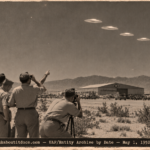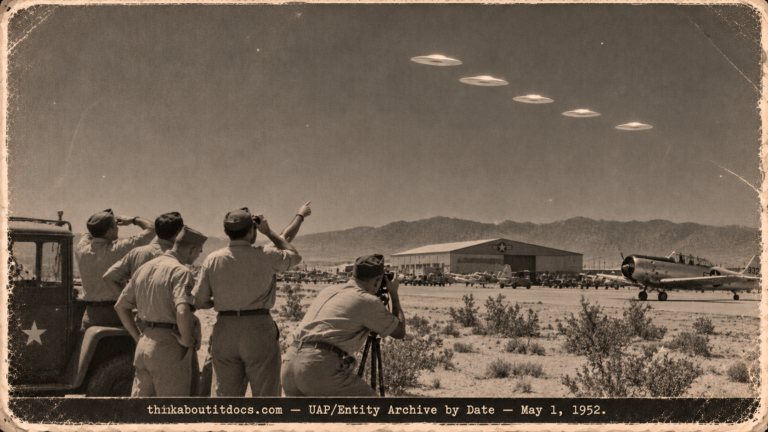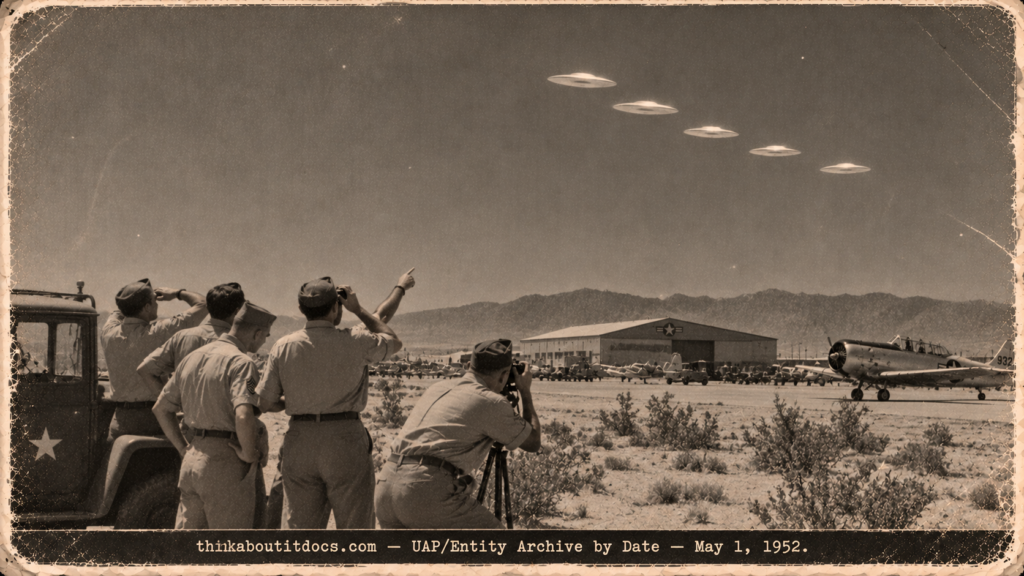
George AFB, California, May 1, 1952: five discs and the start of a three-week cluster.
THINK ABOUTIT UFO|UAP SIGHTINGS REPORT
George AFB, California:
Nine Reports in Three Weeks and Ruppelt’s Balloon Hunt
On May 1, 1952, three men on the George AFB arms range and an Air Force lieutenant colonel four miles away in Apple Valley saw five flat white discs, three in front and two behind, turn together through a sharp 90 degrees at about 4,000 feet. It was the first of nine reports from the same desert base in three weeks, every one filed by military personnel, and it brought Project Blue Book’s Capt. Edward Ruppelt to Victorville to find out why.
This George AFB UFO cluster of May 1952 is one of the clearest early cases of a base looking at a UFO wave from the inside. Ruppelt flew a T-6 with a Leica and a 135 mm telephoto lens, put a ground team on a telescope, and watched a weather balloon burst at 75,000 feet, but the record he left shows that some of the sightings were balloons and some were not.
Date: May 1 to May 21, 1952
Sighting Time: Various; May 1 at 10:50 a.m. PDT through May 21 at 2:30 p.m. PDT
Day/Night: Day
Location: George Air Force Base, Victorville, California (and Apple Valley / the arms range)
Urban or Rural: Rural desert air base
No. of Entity(‘s): Not Applicable
Entity Type: Not Applicable
Entity Description: Not Applicable
Hynek Classification: Daylight Disc (DD)
Duration: Seconds to 30 minutes, depending on the report
No. of Object(s): 1 to 5 per report
Description of the Object(s): Flat white discs, silver round objects, a “paper plate” turning end over end, an arrowhead-shaped thundercloud-colored object
Shape/Size/Color of Object(s): Round or disc / 32–95 feet estimated on May 1 / white, silver or metallic
Distance to Object(s): Unknown; observers located on the base and arms range
Height & Speed: About 4,000 feet at roughly 1,000 mph on May 1; 45,000 feet and nearly stationary on May 13
Number of Witnesses: Dozens of Air Force officers, airmen and pilots across the nine sightings
Special Features/Characteristics: All nine reports were by military personnel. Several had balloon launches at Edwards AFB within about an hour of the sighting. One observer filed three reports in three days.
Case Status: Mixed: May 1 Unknown, “well documented”; May 9, 13, 14, 20 and 21 attributed to balloons; May 9 at 12:30 and May 11 probable paper in thermals; May 9 at 5:20 p.m. Unknown
Source: Capt. Ruppelt memo “Trip to George AFB 20–23 May 1952”; Blue Book Status Report 7, Appendix VI (T52-11949); Project Blue Book record cards; Berliner; Dan Wilson (BBU 1176)
Summary/Description: A three-week run of military sightings at George AFB that Blue Book investigated on site, concluding that several were balloons and leaving others open.
Related Cases: Edwards AFB, May 29, 1952; Davis-Monthan AFB, May 1, 1952
Detailed Report
May 1, 10:50 a.m. PDT. Five round, flat white discs, three in front and two behind; the rear two darted in circles and zig-zags. Lt. Col. Lyle Albert Silvernail reported it from Apple Valley and was told radar was tracking the object(s) and fighters were being scrambled. Blue Book wrote that the report was “well documented” and reached no conclusions.
May 9, 10:30 a.m. A round silver object was sighted from the ground and by two F-86 pilots who broke off low on fuel. An Edwards balloon had been released 55 minutes earlier, and Blue Book thought it very probable the balloon was the object. May 9, 12:30 p.m.: two objects with dark spots moved slowly with the breeze, flaring at certain angles to the sun; Blue Book thought paper caught in thermals possible, noting a similar sighting turned out to be just that. May 9, 5:20 p.m.: an airman first class saw a dull, thundercloud-colored arrowhead object fly straight and level for ten seconds; Blue Book drew no conclusion except that it was seen by one observer “who has made several reports” and “could be too good an observer.”
May 11, 12:20 p.m. The same airman, in “the third report in three days,” saw a white disc flipping end over end, like a white paper plate, make a 90-degree turn and trail two small objects for three minutes. Blue Book called it Insufficient Data and suggested paper in a strong thermal. May 13, 2:25 p.m.: a T-6 pilot and observer watching a bomber saw a shiny silver-white round object, estimated at 45,000 feet, for 30 minutes before it vanished; a balloon had been released at Edwards 45 minutes earlier. May 14, 2:05 to 2:30 p.m.: the same crew saw the same thing, photographed it (the prints show only a small spot), and F-86 and F-94 aircraft from Edwards had no contact; Blue Book found the description fit May 13 “so perfectly” that a balloon was highly probable. May 20, 2:25 p.m.: several airmen watched a bright star-like object hover for five minutes, and a rawinsonde balloon had been launched at Edwards 53 minutes earlier.
May 21, Ruppelt’s test. Ruppelt flew in a T-6 piloted by Lt. Melzer at 1:30 p.m. PDT with a Leica and a 135 mm telephoto lens while a ground team under Maj. Vincent Wolrath watched with a telescope. At 2:30 p.m. the ground team saw an object that appeared to be a balloon, identical to the earlier reports; it vanished at 2:40 p.m., and an Edwards rawinsonde balloon burst at 2:38 p.m. at 75,000–80,000 feet. Blue Book concluded that this object was that balloon. Interviews the next day showed that some earlier sightings had been attributed to balloons while others could not be explained.
RESEARCHER’S NOTES
What Ruppelt Proved at George, and What He Did Not
- Balloons explain much of it: Four reports (May 9, 13, 20 and 21) coincide with Edwards balloon releases or bursts roughly 45–55 minutes earlier. This is circumstantial but strong.
- What stays open: The May 1 report, with five discs, a 90-degree turn and a radar report, has no balloon release and no conclusion. The May 9 airman’s arrowhead report also remained Unknown.
- One observer, many reports: Blue Book noted one airman filed three reports in three days. That raises questions about one witness and does not explain the other seven.
- Photographs: The May 14 photographs show only a small spot, which neither confirms nor rules out a balloon.
- Date check: Secondary listings give May 14 at 1:05 p.m. and May 20 at 1:25 p.m.; the Blue Book record gives 1405–1430 PDST and 1425 PDST, and the May 11 “Grendilund” listing is the airman’s report.
George AFB in May 1952 is a case study in how a sighting wave builds: one genuinely unexplained report, followed by a run of observations that Ruppelt could tie to balloons and thermals. The record supports both halves, and the May 1 five-disc sighting remains the one the file does not resolve.
“The sighting on 1 May 1952 at George AFB was the first of a series of nine sightings there in a three week period. All by military personnel.”
— Project Blue Book Status Report 7, Appendix VI