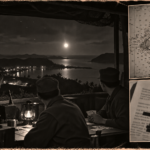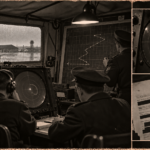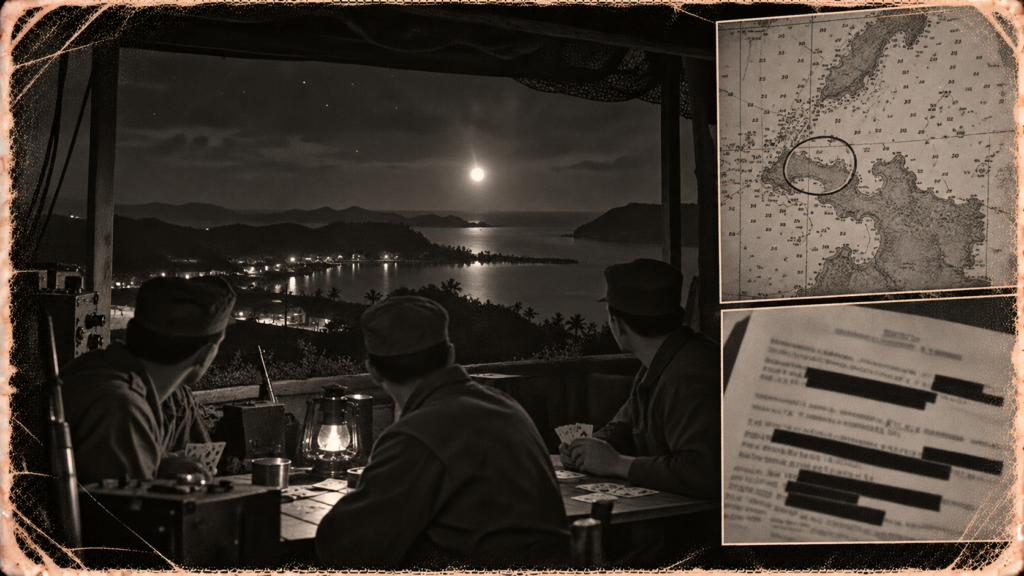
Northern Okinawa, November 21, 1950: a sergeant later told Capt. Ruppelt that a motor-like sound died and a white light fell into the sea.
THINK ABOUTIT UFO|UAP SIGHTINGS REPORT
1950: Okinawa
A Light Falls Into the Sea, and Captain Ruppelt Interviews the Sergeant Who Saw It
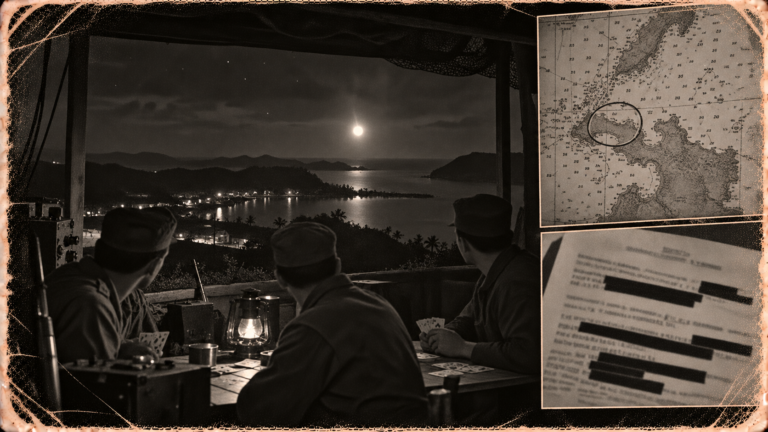
Two days before Thanksgiving, 1950, a handful of American airmen were playing pinochle at a hilltop outpost in northern Okinawa when they heard a sound like a motor — and then heard it die. A big white light that looked like a landing light had come in from the northeast and dropped toward the mouth of a lagoon. “It sounded like a motor and the motor died,” the sergeant told Air Force Captain Edward Ruppelt. “I have heard too many [aircraft]… I’ve got 12 years of service and most of it has been around aircraft.” It did not sound like an airplane to him.
The Okinawa UFO report surfaced two years later, when the same sergeant, by then stationed at Wright-Patterson, volunteered the story to Project Blue Book. The Air Force pulled charts to see whether divers could recover whatever went into the water. The answer, in a September 1952 memo, was no. The Okinawa case is a 1952 recollection of a 1950 event, and the file says so plainly: “Too old to investigate.”
Date: November 21, 1950 (record card date-time group 22/0700Z; interview says two days before Thanksgiving)
Sighting Time: After 7:00 p.m. local time (about 1000Z on the 21st by the interview; the card’s time group is hard to reconcile)
Day/Night: Night
Location: Northern Okinawa, near the northern tip of the island; the lagoon was identified by analysts as probably at Oku, not at Hedo Misaki
Urban or Rural: Rural
No. of Entity’s: Not Applicable
Entity Type: Not Applicable
Entity Description: Not Applicable
Hynek Classification: Nocturnal Light (NL)
Duration: Not reported
No. of Object(s): One
Description of the Object(s): A big white light like a landing light, preceded by a motor-like sound that died; a group of airmen at the outpost heard the sound; soldiers returning from town and a native on the far side of the lagoon saw the light; the airmen at the outpost did not see a splash
Shape/Size/Color of Object(s): Not determined; white light
Distance to Object(s): Several miles (the witness estimated four to five miles from the outpost to the lagoon)
Height & Speed: Not reported
Number of Witnesses: The sergeant and others at the outpost heard it; soldiers coming back from town and a local villager reportedly saw the light fall
Special Features/Characteristics: Engine-like noise that stopped; did not sound like a conventional aircraft, a pulse-jet or a Japanese “Betty”; fell into water near a lagoon mouth; no mayday or aircraft loss found when the witness called island control about half an hour later
Case Status: Insufficient Data per Project Blue Book (“Too old to investigate”); recovery judged impractical in 1952; file retained in case Blue Book’s status later warranted an attempt
Source: Project Blue Book record card; Memorandum for Record of the Ruppelt interview (1952); USAF Directorate of Intelligence DFs, August 1952 (references to a 28 August 1952 DF), with maps and hydrographic and aeronautical charts of Okinawa
Summary/Description: A sergeant recalled in 1952 that a motor-like sound died and a white light fell into water off northern Okinawa in November 1950; the Air Force decided a recovery attempt was impractical.
Related Cases: Other November 1950 reports filed with Blue Book as insufficient data: Rome, Georgia (November 13); see the November 1950 archive.
Detailed Report
The Blue Book card for this case is brief: date-time group 21 November 1950, 22/0700Z; location Okinawa; source military; one object; length of observation not reported; ground-visual; course northeast; no photos or physical evidence; conclusion “Insufficient Data for Evaluation.” The brief summary says: “Too old to investigate. Report of object falling into water. Information supplied to AF for possible recovery of object. See case file.”
The case file begins with a Memorandum for Record recording Captain Ruppelt’s interview with the technical sergeant, assigned to the Wright Air Development Center at Wright-Patterson AFB, who had appeared in person before Project Blue Book personnel at ATIC and volunteered the information. The memo’s covering note says he stated that the object had fallen into the sea, pointed out the approximate location on a map, and drew a large-scale sketch; Blue Book forwarded it to the Directorate of Intelligence so the Air Force could judge whether recovery was feasible.
In the transcript, Ruppelt establishes that it was two days before Thanksgiving 1950, some time after 7:00 p.m. local time, and that the sergeant and his companions were playing pinochle at an outpost. The first thing they heard was a noise that “sounded like a motor and the motor died.” Asked whether it sounded like a conventional aircraft, the sergeant said no, that he had “heard too many of them,” with twelve years in the service mostly around aircraft, and that he could tell single-engine from multi-engine sound. Ruppelt asked whether it was like the staccato of a pulse-jet engine; it was not. The sergeant said it came in from the northeast, that it looked like a big white landing light, and that the glow fell somewhere near the mouth of a lagoon, with a native village on one side and a line of sight across the water. Some of his fellow soldiers were coming back from town, and the sergeant waited about half an hour and then called island control: if it were one of theirs, the aircraft would have been in communication and a mayday would have gone out. The radio log, he said, was no longer on file because regulations required discarding it every six months. The soldiers who saw the light, he said, did not see a splash; they thought it was just another aircraft, because planes often came over and flashed their lights as a greeting, and it took them five to ten minutes to come up to tell him.
The sergeant said that after December 26 he visited a northern outpost and talked to men there who said they had seen a light at about that time. A separate note in the file records that an analyst who knew Okinawa well said the cove the sergeant described was not on the chart, that the sergeant estimated the cove at two to three miles wide and four fathoms deep, and that either he was confused about the location or the cove was much smaller than he judged; the sergeant offered to go back and point out the spot.
USAF Directorate of Intelligence documents of August and September 1952 then took up the question of recovery. A hydrographic chart showed that the sergeant’s sketch did not match the chart: the aeronautical chart placed the location at the northernmost point of the island, Hedo Misaki, but his sketch matched a lagoon about a mile wide and a native village at the southern edge of the lagoon better, probably at Oku, where the water is very shallow. If it was Hedo Misaki, depth would prevent any investigation. The Air Force asked ATIC to re-interview the sergeant using a chart to find the most probable location. A later memo recorded the finding after large-scale maps were obtained: the water off the village of the lagoon is rather deep, and by the sergeant’s sketch the object would have fallen in at least 10 fathoms. A search would require diving operations at that depth over about half a square mile or more, “for this reason it is considered impractical to request an attempt at recovery.” The Directorate suggested that all documents be filed in case “the future status of Project Blue Book warrants a recovery attempt.”
RESEARCHER’S NOTES
A Two-Year-Old Memory and an Unfindable Lagoon
- Memory over time: The sergeant gave this account about two years after the event, to Blue Book, in an informal interview, not a signed contemporaneous statement. Details of date, time and place had to be reconstructed, and the file shows the reconstruction did not match the charts.
- What the card’s date shows: The date-time group reads 21 November, 22/0700Z, which would put the event on the morning of the 22nd local time if read as Zulu; the interview puts it on the evening of the 21st. The two cannot both be exact.
- A light and a sound, not an object: No one saw a craft. The evidence is a motor-like sound that stopped, a white light like a landing light, and the soldiers’ impression that it was another aircraft. The Air Force’s later note that a Maj. checked no aircraft was reported down is from the sergeant’s own check.
- Depth question: The sergeant’s estimate of four fathoms and the chart’s 10 fathoms are the difference between a possible diving search and an impractical one. Analysts thought the sergeant had the wrong lagoon, not the wrong story.
- Ruppelt’s role: Captain Ruppelt, head of Project Blue Book at the time, conducted the interview himself, and his questions test the sergeant’s experience with aircraft sounds and pulse-jets, which is why the transcript is a useful look at how Blue Book probed a witness.
- Why it is in the archive: Blue Book kept the file on the chance a recovery was ever attempted, and the card shows the Air Force treated it as a real but unrecoverable report, not a hoax.
Okinawa is a weak case on evidence and a strong one on procedure. A sergeant’s memory of a motor that died and a light that fell into the sea, filed two years late, with the Air Force’s careful attempt to decide whether divers could ever check it. It is preserved here as the file records it, with the card’s date question and the lagoon uncertainty left open.
“It sounded like a motor and the motor died.”
— Technical sergeant, interviewed by Capt. Edward Ruppelt, 1952, on the November 1950 Okinawa sighting