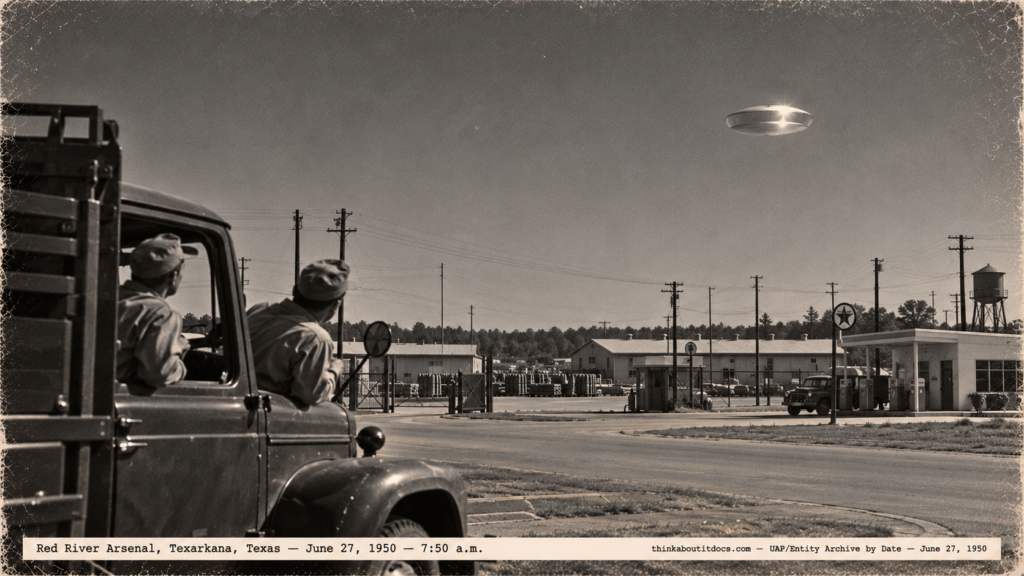
On June 27, 1950, two Red River Arsenal supervisors watched a glittering dishpan-shaped object cross the sky.
THINK ABOUTIT UFO|UAP SIGHTINGS REPORT
1950: Red River Arsenal, Texarkana — The Glittering Dishpan
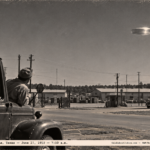
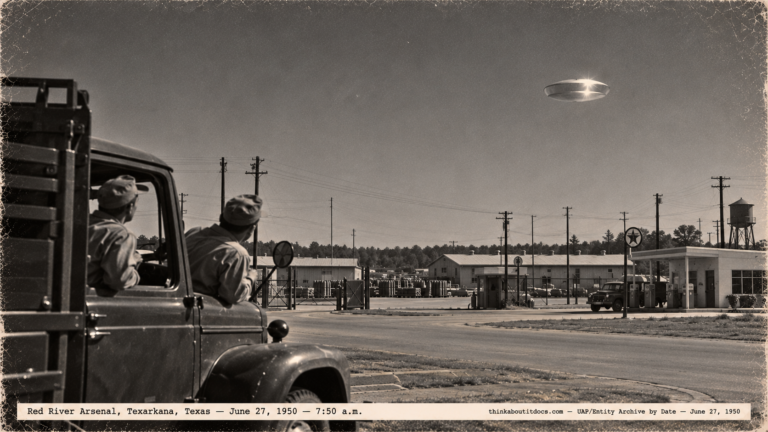
At 7:50 on the morning of June 27, 1950, two Red River Arsenal supervisors were driving a Federal truck south on Van Buren Street when the passenger glanced out the right window and saw something bright and glittering overhead. The driver leaned forward, looked up through the windshield, then turned the truck 90 degrees to keep it in view. For four to five seconds they watched a bright aluminum object, with the apparent size of an 18-inch dishpan held 15 feet away, streak from north to south in straight, level flight.
The arsenal’s own intelligence officer interviewed both men the next day and wrote that the character and integrity of the observers was beyond reproach. The Blue Book card reads Unidentified. This Texarkana UFO case records unusual detail about how the men saw the object, and one detail in it complicates the picture.
Date: June 27, 1950 (Tuesday)
Sighting Time: 7:50 a.m. local (card: 07:50)
Day/Night: Day (clear, sun shining)
Location: Red River Arsenal (Lone Star area), Texarkana, Texas; the observers were at the intersection of Van Buren Street and Fourth Street and the object appeared over Building G-37, a gas station
Urban or Rural: Industrial (military arsenal grounds)
No. of Entity’s: 0 — Not Applicable
Entity Type: Not Applicable
Entity Description: Not Applicable
Hynek Classification: DD (daylight disc)
Duration: 4 to 5 seconds
No. of Object(s): One
Description of the Object(s): Bright and glittering; spherical when first seen, flat on top and bottom with rounded sides as it receded, similar to two dishpans turned together
Shape/Size/Color of Object(s): Bright aluminum; apparent size of an 18-inch-wide, 5-inch-deep dishpan seen at about 15 feet
Distance to Object(s): First seen over a building about 1,200 feet from the observers
Height & Speed: Elevation angle about 70 degrees (65 to 75 by the other observer); speed unknown, described as “plenty fast”; straight, level flight north to south, a few degrees east of south
Number of Witnesses: 2 Red River Arsenal supervisors (Terrell and Yates, per Berliner)
Special Features/Characteristics: Seen through truck glass; no sound, odor, trail or projections; brilliance stopped when it passed a low cloud and resumed afterward; clear sun and no cloud overhead per the weather block
Case Status: Unidentified (Project 10073 Record Card; BBU #738); a handwritten card annotation appears to raise reflection on glass and a balloon as possibilities
Source: Project 10073 Record Card; Red River Arsenal spot report, Incident No. 1, June 29, 1950 (Capt. J. A. Matchan); Fourth Army letter to Air Materiel Command, July 17, 1950; Berliner
Summary/Description: Two arsenal supervisors in a truck saw a glittering aluminum dishpan-shaped object cross the sky in four to five seconds.
Related Cases: None identified in the archive
Detailed Report
The reporting chain. The spot report, from the Ordnance Department at Red River Arsenal, is dated June 29, 1950 and addressed to the Commanding General, Fourth Army, Attention AC of S G-2. The observation was on June 27 and the interview on June 28. Fourth Army forwarded it to Air Materiel Command on July 17, noting that the observers lived in Texarkana, Arkansas.
How the men saw it. The observers were in a Federal truck headed south on Van Buren Street at the Fourth Street intersection. The passenger first noticed the object by glancing out the right door window and called the driver’s attention to it. The driver leaned forward and glanced up through the right front of the windshield, then moved the truck about 20 feet in a 90-degree turn that put it heading west, and kept watching through the left door window. When first seen the vehicle was headed south and the object bore 270 degrees; when it vanished the vehicle was headed west and the object bore 180 degrees.
The object. It appeared bright and glittering, which attracted their attention, and looked spherical in shape when first seen. As it got farther away its appearance changed so that it looked flat on top and bottom with rounding sides, similar to two dishpans turned together. They compared its apparent size to an ordinary dishpan 18 inches wide and 5 inches deep at about 15 feet. It was bright aluminum, a shiny glitter that reflected the sunlight, with no fins, wings, antennae or canopies. It traveled from north to south, a few degrees east of south, in straight, level flight for about four to five seconds. The speed was unknown, though both said “plenty fast,” and it just got smaller and smaller until it disappeared. One observer noticed that it seemed to pass through a low flying cloud, at which point the brilliance and glitter stopped, then reappeared once it had cleared the cloud.
The observers. Both were employees in the Maintenance Mechanic Section, Ammunition Division, in supervisory roles. One wore plain-lens prescription glasses at the time, and the other does not wear glasses and has 20/20 vision on his medical records. Both said they were looking through a glass window or the windshield. Capt. J. A. Matchan, the arsenal’s Ordnance Department intelligence officer, wrote that the character and integrity of the observers was beyond reproach and that both possess above-normal intelligence.
The Blue Book card. The Project 10073 card lists a civilian source, 07:50, bright aluminum color, a flat-top round dishpan shape, 18 inches wide and 5 inches deep at 15 feet, an elevation of 65 to 75 degrees, a north-to-south course and a duration of four to five seconds. A handwritten annotation at the bottom, difficult to read, appears to suggest a reflection on glass and, in parentheses, a balloon. The evaluation is Unidentified.
RESEARCHER’S NOTES
A Careful Report With One Loose Thread
- The cloud: The weather block says clear, sun shining and no cloud overhead, yet one observer said the object went through a low flying cloud and dimmed. The report does not reconcile the two.
- Glass: The intelligence officer himself stresses that both men were looking through glass. A reflection is the obvious question, and the card annotation appears to raise it, but the spot report does not test it.
- A balloon alternative: A distant high balloon would glitter in morning sun and drift slowly; the observers described fast motion and a shape change from round to flat, which the report leaves unexplained either way.
- Observer quality: This is a rare Army-side interview: two supervisors, one with documented 20/20 vision, a named intelligence officer and a structured questionnaire with answers to 25 questions.
- Illegible items: The map and sketch enclosures, and the observers’ names, are not readable in the archive scan; the names Terrell and Yates come from Berliner.
The Red River Arsenal report is a model of how a 1950 sighting could be handled well locally and then handled badly at the top: detailed answers from credible observers, followed by a one-word evaluation and a pencilled suggestion that was never tested. It stays Unidentified, with a loose thread about glass and a cloud that the file leaves hanging.
“The character and integrity of the observers is beyond reproach.”
— Capt. J. A. Matchan, Ordnance Department Intelligence Officer, Red River Arsenal spot report, June 29, 1950