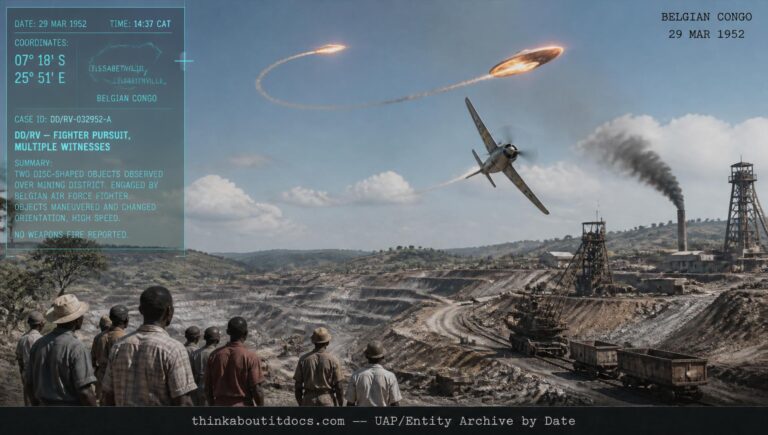
The March 29, 1952 pursuit of two fiery discs over the uranium mining district near Elizabethville, Belgian Congo.
THINK ABOUTIT UFO|UAP SIGHTINGS REPORT
1952: The Elizabethville Pursuit — Belgian Congo
Over one of the most strategically significant patches of ground on Earth in 1952 — the uranium-rich mining district of the Belgian Congo, whose ore had powered the Manhattan Project less than a decade earlier — two fiery discs appeared, gliding in curving, orientation-shifting patterns before hovering and then departing in a sharp zigzag. A fighter pilot scrambled from the local airfield and closed to within roughly 400 feet of one of them before it outran him. Whether the choice of location was coincidence or something more deliberate is a question this case leaves entirely open, but the setting alone makes it one of the more geopolitically loaded UFO encounters of the early Cold War.
Date: March 29, 1952
Sighting Time: Not precisely recorded
Day/Night: Not specified
Location: Elizabethville (present-day Lubumbashi), Belgian Congo, over the surrounding uranium mining district
Urban or Rural: Industrial/mining district
No. of Entity(‘s): Not applicable
Entity Type: Not applicable
Hynek Classification: DD (Daylight Disc) / RV (Radar/Visual) hybrid, applied for the visual pursuit component; no radar corroboration is documented in the surviving source
Duration: Not precisely recorded; long enough for extended maneuvering, a hover, a departure, and a fighter intercept attempt
No. of Object(s): 2
Description of the Object(s): Two fiery discs that appeared, in different phases of their maneuvering, as plates, ovals, and lines — implying they were changing orientation relative to the ground observers rather than physically changing shape
Shape of Object(s): Disc, appearing as plates, ovals, or lines depending on orientation
Size of Object(s): Not specified
Color of Object(s): Fiery (glowing/luminous)
Distance to Object(s): Commander Pierre closed to within roughly 120 meters (400 feet) of one disc during the pursuit
Height & Speed: The discs glided in curving patterns, changing orientation repeatedly, then hovered before suddenly departing to the northeast in a zigzag pattern too fast for the pursuing fighter to match
Number of Witnesses: Multiple ground witnesses (exact number not specified) plus Commander Pierre, the pursuing fighter pilot
Special Features/Characteristics: The objects’ repeated orientation changes, producing the appearance of plates, ovals, and lines in sequence, suggest a rotating or tumbling flight characteristic rather than a fixed profile; the sighting occurred directly over one of the world’s most strategically significant uranium mining districts, a detail this archive notes without asserting any causal connection; Commander Pierre of the Elizabethville airfield personally scrambled a fighter aircraft and pursued one of the discs to within about 400 feet before it outran him.
Case Status: Unexplained
Source: McDonald files; Jan Aldrich
Summary/Description: On March 29, 1952, two fiery, disc-shaped objects were seen over the uranium mines surrounding Elizabethville in the Belgian Congo (present-day Lubumbashi, Democratic Republic of the Congo). Witnesses on the ground watched the discs glide in curving paths, repeatedly changing apparent orientation so that they seemed at various points to resemble plates, ovals, and lines. The objects then suddenly hovered in place before abruptly taking off in a fast, zigzagging course toward the northeast. Commander Pierre, based at the Elizabethville airfield, scrambled a fighter aircraft and pursued the discs, managing to close to within roughly 120 meters (400 feet) of one of them before it outpaced his aircraft and escaped.
Related Cases: 1951: The Lt. George Kinmon Pursuit, Georgia | 1951: The March Field Intercept, California (comparable fighter-pursuit structure)
Detailed Report
The Elizabethville case’s location gives it a weight that its comparatively sparse witness detail does not, on its own, fully carry. The Belgian Congo’s Shinkolobwe mine, in the same general mining district described in this sighting, was the primary source of uranium ore used in the Manhattan Project — the raw material, quite literally, of the first atomic weapons. By 1952, the strategic and military significance of Congolese uranium was well understood by the major powers, and any unidentified aerial activity over the region’s mining infrastructure would have carried real intelligence and security weight independent of any UFO interpretation. This archive is careful not to overstate the connection — nothing in the source material claims the discs specifically targeted the uranium deposits, and coincidental proximity to a notable location does not itself constitute evidence of intent — but the setting is a legitimate and analytically relevant detail rather than incidental color.
The behavior described — extended, changing-orientation gliding followed by a hover and then a sudden, fast, zigzagging departure — describes a flight profile with real internal structure rather than a single simple pass. The shifting appearance (plate, oval, line) as a function of the discs’ orientation to the ground observers is a physically coherent description: a flat, disc-shaped object does present a different silhouette depending on the viewing angle, and a witness accurately describing that shifting silhouette as the object changed orientation is a more specific and technically plausible detail than a vaguer, more generic account might offer.
Commander Pierre’s direct, personal pursuit — closing to within some 400 feet before losing the chase — represents a genuine, hands-on military response rather than a passive observation or a distant radar contact. That the pursuing aircraft could not close the final gap, despite a scrambled response and a determined chase, fits a pattern this archive has documented repeatedly across other 1950-52 military intercept cases: era-appropriate fighter aircraft consistently unable to match the reported final-departure speed of the objects they pursued, regardless of theater or nationality.
RESEARCHER’S NOTES
The Elizabethville Pursuit — Belgian Congo 1952 and the Uranium Question
- Classification issues: A hybrid DD/RV designation is used given the documented visual pursuit; no radar corroboration survives in the available source, so the RV component should be read as provisional rather than confirmed.
- Source chain assessment: The case is preserved through the McDonald files and Jan Aldrich’s Project 1947 compilation, both serious archival efforts, though the ground witnesses are not individually named and Commander Pierre’s own account has not been independently located by this archive beyond the secondary compilation.
- Pattern context: The case’s fighter-pursuit-that-fails-to-close structure recurs across numerous 1950-52 cases in this archive regardless of country or service branch, suggesting either a genuinely consistent phenomenon or a genuinely consistent performance gap between era-appropriate interceptors and whatever these objects were.
- Physical evidence and evidentiary weight: No photograph or physical trace survives. The case’s evidentiary weight rests on multiple ground witnesses plus a named military pilot’s pursuit, a stronger multi-witness foundation than many single-observer cases in this archive, though still without independent documentary corroboration.
- Geographic and historical context: The Belgian Congo’s uranium mining district was, in 1952, one of the most strategically sensitive industrial sites on the planet given its direct historical connection to the Manhattan Project — a genuinely significant contextual detail, though this archive stops short of asserting the sighting was connected to that significance rather than coincidental to it.
The Elizabethville pursuit stands out among this archive’s early-1950s cases for the strategic weight of its setting as much as for the sighting itself — two maneuvering discs over one of the Cold War’s most consequential uranium-producing regions, pursued and nearly overtaken by a scrambled fighter before outrunning it. Multiple ground witnesses and a named military pilot give the case a firmer multi-witness foundation than many comparable reports, even without photographic or documentary corroboration. It is catalogued here as Unexplained: a determined, unsuccessful military pursuit over one of the most geopolitically significant patches of ground of its era.
Commander Pierre closed to within 120 meters before the disc outran his fighter.
— Account of the March 29, 1952 Elizabethville, Belgian Congo pursuit