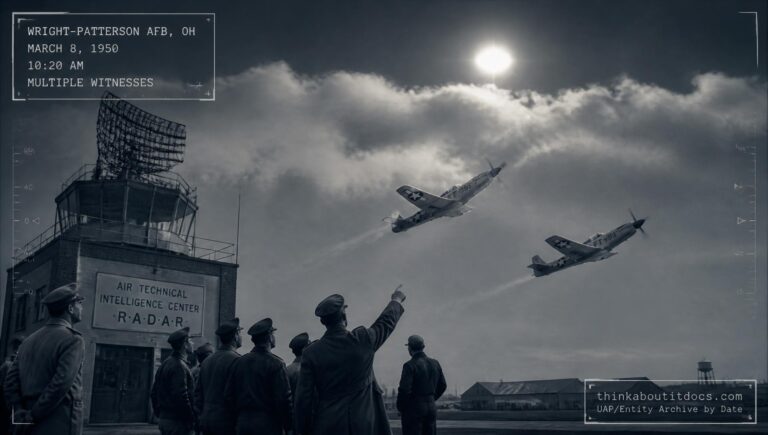
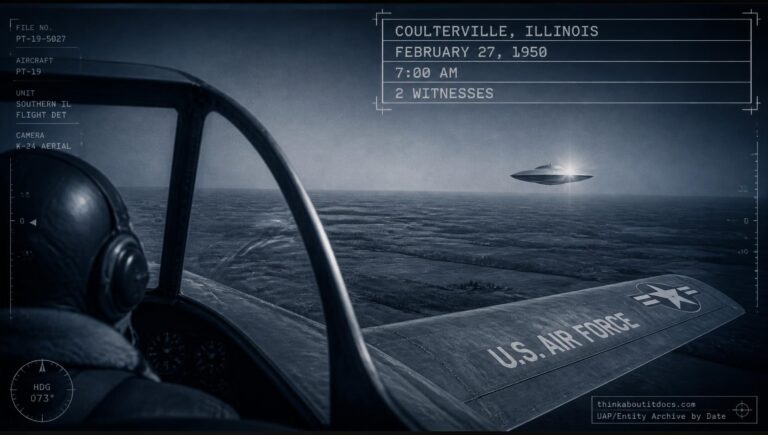
March 8, 1950 — F-51 fighters scrambled from Wright-Patterson AFB, radar-vectored toward an object seen by airline pilots and ATIC's own staff.
THINK ABOUTIT UFO|UAP SIGHTINGS REPORT
1950: The Wright-Patterson AFB Interception
Three airline pilots spotted it first. Within the hour, ground radar, control tower operators, and the Air Technical Intelligence Center’s own staff were all watching the same brilliant light — and two F-51 fighters were climbing blind through icing clouds to reach it, guided the whole way by a radar operator reading their target’s position over the radio.
Date: March 8, 1950
Sighting Time: Mid-morning, beginning around 10:20 a.m.
Day/Night: Day
Location: Over Wright-Patterson AFB / the Air Technical Intelligence Center (ATIC), Dayton, Ohio
Urban or Rural: Urban/military installation
No. of Entity(‘s): Not Applicable
Entity Type: Not Applicable
Entity Description: Not Applicable
Hynek Classification: RV (Radar/Visual)
Duration: Roughly an hour from first report to the interceptors landing
No. of Object(s): 1
Description of the Object(s): An extremely bright light, described as much brighter and larger than a star, intermittently obscured by high, thin, scattered cloud cover
Shape of Object(s): Not resolved — visible only as an intense point of light to ground observers
Size of Object(s): Not determined
Color of Object(s): Bright white/gleaming
Distance to Object(s): High altitude, above the cloud layer; the pursuing F-51s lost visual contact around 15,000 ft when they entered the clouds
Height & Speed: Held a generally fixed high-altitude position through most of the encounter; radar showed the target fading as the interceptors’ closest approach was reached
Number of Witnesses: Numerous — three TWA airline pilots (including Capt. W. H. Kerr), 20-plus independent callers from the Vandalia area, control tower operators, ATIC personnel, a radar lab crew, and the two F-51 interceptor pilots
Special Features/Characteristics: Multi-Source Simultaneous Corroboration (Visual, Radar, Airline Crew, Ground Public), Active Fighter Interception, Radar-Guided Vectoring in Instrument Conditions, Interception Aborted for Flight Safety, Official Explanation Offered
Case Status: Explained (Air Force conclusion: probable balloon)
Source: Project Blue Book files
Summary/Description: Mid-morning on March 8, 1950, the Civil Aeronautics Administration relayed a report from TWA Capt. W. H. Kerr and two other airline pilots who had an unidentified object in sight. Around the same time, the CAA logged more than twenty separate calls from the Vandalia, Ohio area describing the same thing. Wright-Patterson AFB was notified and scrambled four F-51 interceptors. Personnel at the Air Technical Intelligence Center stepped outside and saw it for themselves: an intensely bright light, far outshining any star, occasionally hidden by thin, high cloud. Someone checked whether the radar lab at Wright Field had equipment running; it didn’t, but crews brought a set online within minutes and picked up a target in the same position as the visual light — along with the two F-51s already climbing to intercept. A radar operator vectored the fighters toward the target by radio, both pilots confirming they had the light in sight as they closed in. Around 15,000 ft the fighters flew into thick cloud and lost visual contact entirely; already fighting icing and flying on instruments, the pilots — with radar reporting they were nearly on top of the target — made the safety call to descend rather than press on blind. The object faded from radar shortly after, and the fighters returned to base. The Air Force’s later assessment attributed the sighting to a balloon.
Related Cases: Not Applicable
Detailed Report
Few cases in this archive combine so many independent categories of witness at once: commercial airline pilots reporting through official CAA channels, a wave of unprompted public calls from a specific geographic area, direct observation by intelligence personnel whose job was UFO analysis, and — uniquely — an operational radar contact acquired specifically to confirm what everyone was already looking at. The sequence in which each element came online (visual sighting, public reports, scramble order, radar activation, interception, radar-guided vectoring) reads less like an isolated anomaly and more like an improvised but genuinely coordinated response, assembled in real time by people who had never planned for exactly this.
The interception’s abandonment is as informative as the interception itself. Two F-51s, radar reporting them nearly on the target’s position, chose to break off and descend rather than continue climbing blind through icing cloud toward an unknown object — a sound safety decision, but one that meant the closest approach of the entire encounter produced no additional visual data. The object’s fade from radar shortly afterward closed the case without resolution at the moment it came closest to being resolved.
The Air Force’s “probable balloon” conclusion is presented here as the official record’s own assessment, not as this archive’s independent finding — a distinction worth holding onto given how many elements of the account (extended radar tracking of a fading, high-altitude target; the sheer volume of independent ground reports) a stray balloon would need to account for simultaneously.
RESEARCHER’S NOTES
The Wright-Patterson Interception — Ohio 1950 and an Official Explanation Worth Examining
- Classification issues/corrections: Filed as RV given the confirmed radar contact matching the visual sighting’s position; this archive labels the case’s status as Explained per the Air Force’s own balloon conclusion, while noting in the Detailed Report that the conclusion leaves some elements — the extended radar-confirmed tracking, the object’s altitude and near-fixed position — less than fully accounted for.
- Source chain assessment: Documented directly in Project Blue Book’s own files, with enough operational detail (named pilot, radar lab sequence, specific altitude of cloud entry) to indicate this account derives from the original incident report rather than a later popularized retelling.
- Pattern context/comparative cases: Active fighter interception attempts are uncommon in this archive; this case, alongside the January 1950 Blackstone, Virginia pursuit and the Coulterville, Illinois pilot case the same month, form a small cluster of encounters where the response went beyond passive observation.
- Physical evidence/evidentiary weight: No photograph is documented, but the case combines visual, radar, and multiple independent witness categories more thoroughly than almost any other case in this archive’s early-1950 record — a strong evidentiary basis regardless of which explanation is ultimately correct.
- Geographic/historical context: ATIC, the Air Force’s own center for technical intelligence analysis (and the future home of Project Grudge’s successor, Project Blue Book), makes this case notable simply for where it happened — the people best positioned to investigate a UFO sighting were themselves eyewitnesses to one.
The people whose job it was to investigate reports like this one ran outside and watched it happen themselves, then scrambled fighters that got close enough for radar to call them “almost on it” before conditions forced a retreat. Whatever the object actually was, this case shows the system built to handle it working about as well as it ever would.
“Almost on it.”
The radar operator’s report to the intercepting F-51 pilots, March 8, 1950, Wright-Patterson AFB.